Learning how to build a personal brand on LinkedIn leads to greater visibility, credibility, and growth. To do this effectively, complete the following steps:
Expand your reach through public speaking and smart networking. We recommend using the Snov.io LinkedIn automation tool to automate outreach and engagement for quicker results.
You’re an expert. Your colleagues trust the insights you share. So why doesn’t the rest of your industry even know you exist?
Expertise without visibility is career sabotage in 2026. That’s why personal brand matters, and LinkedIn is where to grow it.
Need help getting started? This guide will give you a step-by-step plan on how to build a personal brand on LinkedIn.
Outline:
People have always paid attention to how they present themselves, but social media and online search have taken that to a whole new level. Now, reputation extends far beyond the immediate circle, making it even more important to be intentional about how you show up online.
Personal branding is a strategic process of defining and communicating one’s unique professional value. In other words, it involves shaping a story to stand out, increase visibility, and establish oneself as a thought leader.
A personal brand, then, is the sum of the perceptions, beliefs, feelings, and expectations that others hold about a person. The goal is to ensure that this narrative is accurate, consistent, compelling, and clearly sets them apart from others in their field.
Through deliberate personal branding, you can communicate the desired image clearly.
There’s more to personal branding than simply shaping how others perceive you. When done well, it can bring real advantages to your professional growth:
A strong LinkedIn presence is the epitome of “don’t chase, attract.” It acts as a powerful magnet for opportunities that align with your goals, making you the one who gets to choose.
Consistent effort in personal branding opens the door to organic, valuable networking opportunities. This way, you can form relationships with like-minded individuals and encourage partnerships within a supportive professional circle.
Building a personal brand on LinkedIn prompts you to reflect deeply on who you are and what you stand for. It not only helps others understand your value but also reinforces your own confidence through meaningful recognition.
A strong personal brand positions you as an authority in your field, making clients more comfortable and confident when buying from you. It helps you stand out in a competitive space.
Your brand helps highlight your unique qualities, expertise, and personality, making it easier for potential customers to choose you over others. It creates a connection.
Marketing Manager at Snov.io
Sounds like something worth investing in, right? Let’s explore how to approach your LinkedIn branding strategy the right way.
Follow these seven essential LinkedIn steps to build a personal brand with intention:
The first point isn’t specifically focused on LinkedIn. It addresses a broader, more strategic aspect of personal branding. This step gives you the clarity to move forward with direction by helping you define your purpose and values.
So, what should you do? Start by asking yourself these simple questions:
We also strongly recommend taking time to research your competitors. Pay attention to what they highlight, who responds to their messaging, and how they present their expertise.
Understanding what works for others helps you identify gaps, spot trends, and find ways to differentiate yourself.
In the end, you should ideally come up with something along the lines of:
“For [target audience], I provide [unique value] among [competitive cohort] because of [distinct strengths].”
Once these questions are answered, the long-term mission becomes clear, providing direction for future actions.
The next step in your LinkedIn branding strategy is optimizing your profile to align with your personal brand and support your professional goals. Remember, every element should work together to show who you are, what you do, and why it matters.
Pay special attention to the following parts of your LinkedIn profile:
By default, LinkedIn assigns a random string of characters to your URL, which doesn’t reflect well on a personal brand. Replace it with your name or a variation that aligns with your professional identity.
Avoid using pictures of pets, logos, or anything that looks too casual or distracting. A simple, professional headshot with a neutral background is the best choice.
We don’t recommend using distracting visuals such as space scenes, mountains, or flower fields. Instead, choose an image that supports your message and presents a clear, authentic snapshot of what you offer.
An effective structure is something along the lines of:
I help X do Y with Z, where X is your target audience, and Y is the value you provide. Z is your area of expertise.
Start with a question or a problem your target audience often faces. This approach makes your profile feel more authentic and encourages people to click see more. Expand on your value proposition and describe how you help solve that problem.
Focus on how you help others, what problems you solve, and how many businesses or individuals you have supported.
Posting quality content is king when it comes to your LinkedIn branding strategy; we will soon get into that. However, content alone is not enough. It is just as important to ensure that the right people see it.
Focus on identifying the top 100 influencers, decision-makers, and leaders in your niche. But rather than trying to chase after these people, who are likely overwhelmed with cold messages, shift your attention to their network.
Here is why this works. LinkedIn prioritizes content that is liked or commented on by people within your shared network. If you are connected to colleagues, collaborators, or team members of industry leaders, your content is much more likely to appear in their feeds.
This is a warmer, more strategic approach. It allows you to gradually increase visibility, grow your personal brand, and build influence without forcing your way in.
Is this something you’d be open to trying? Here’s your action plan:
📍 Note
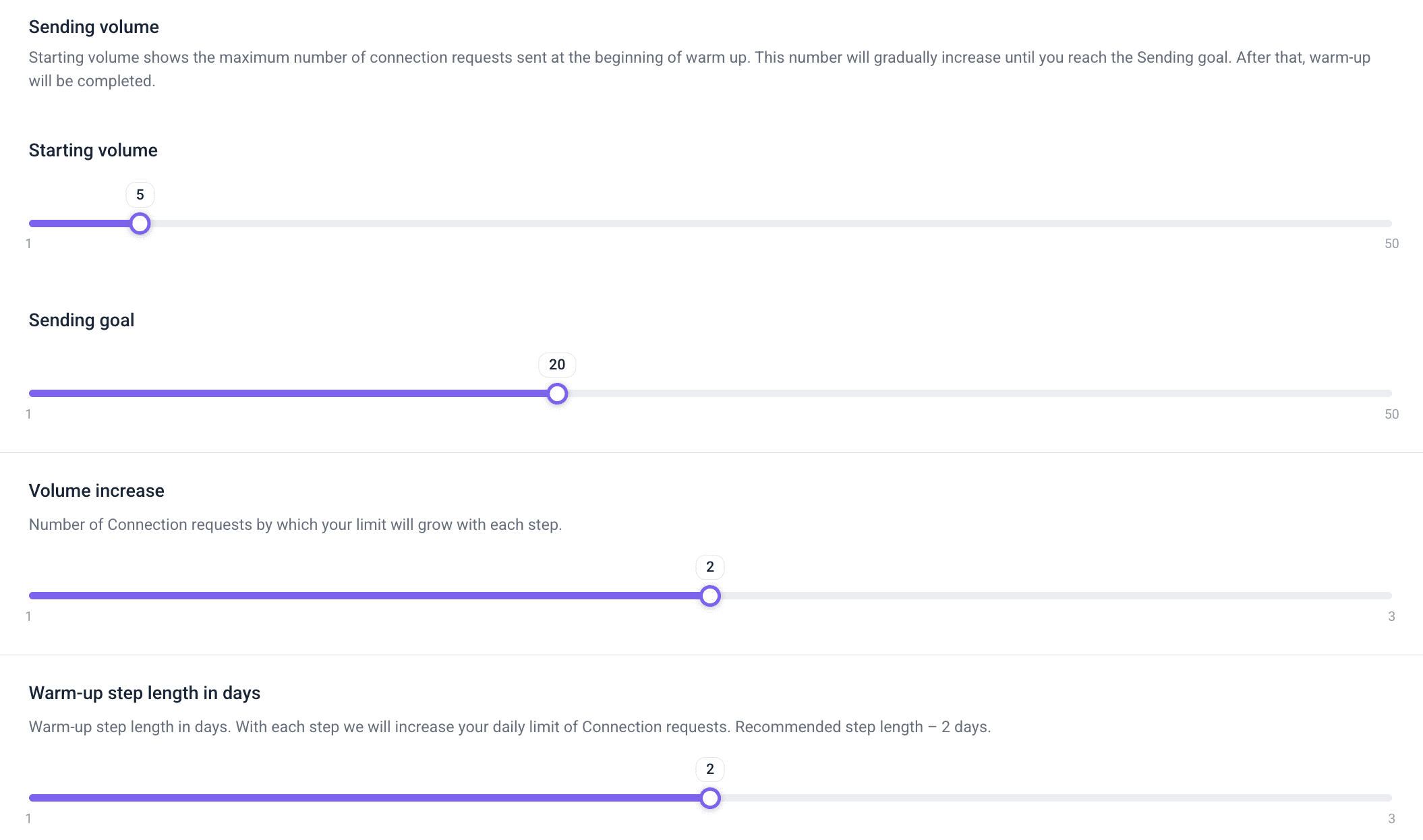
It’s important to note that LinkedIn closely monitors profile viewing activity and has fairly strict search limits. To prevent triggering spam filters or risking account limitations, this should be handled with care. At Snov.io, we recommend the following daily limits for safe use:
We recommend starting by warming up your account. For example, with Snov.io’s LinkedIn prospecting tool, you can set a daily limit on connection requests to ensure the platform doesn’t flag your activity as suspicious.
This way, you can boost your LinkedIn outreach while keeping your account safe.
It goes without saying that consistent posting is essential if you’re serious about building a strong personal brand on LinkedIn. But the real question is: what should you be posting?
Here are the core pillars of an effective content mix:
Question-based posts: Spark conversations with open-ended questions that invite thoughtful responses.
Industry insights/ timely updates: Share news, trends, or data to position yourself as someone in the know.
Visual content: Infographics, charts, quote cards, and even carousels help posts stand out in the feed.
Personal stories, tips, and hacks: Share experiences that highlight lessons learned, strategies tested, or unique perspectives.
Once you’ve built a small network of valuable connections — whether it’s people with an audience, active commenters under influencers’ posts, or those growing their own brand — it makes sense to tag them in question-style posts to ask for their opinion or experience. But only after you’ve built some rapport.
Engage with their content first. Comment, support, show up. Then ask.
That way, it feels natural, not transactional.
Marketing Specialist at Snov.io
Structure matters as well. Here is an example of a high-quality LinkedIn:
Start with a one- or two-line intro that creates curiosity and triggers the “see more” link. This increases engagement, as every click signals interest to the LinkedIn algorithm.
Deliver clear, useful, or thought-provoking content. Whether you’re telling a story, breaking down insights, or offering a quick how-to, make sure it brings value.
Conclude with a question that encourages genuine discussion, rather than a simple yes-or-no answer. This drives comments, boosts reach, and further feeds the algorithm.
💡 Bonus tip
Monitor YouTube, TikTok, and Instagram to identify emerging content formats or trending topics. These platforms often act as incubators for what’s “next”; adapting those trends for LinkedIn allows you to grow your personal brand with content that is fresh, timely, and more likely to go viral.
For those learning how to build a personal brand on LinkedIn, it’s also essential to think beyond the platform itself. One effective way to increase visibility and credibility is by speaking at industry events.
These opportunities provide a platform to showcase expertise, connect with new audiences, and support long-term professional goals. They also complement LinkedIn efforts by boosting engagement and contributing to a more dynamic professional presence.
Start by using LinkedIn to grow your networking base and build meaningful connections. As you become more active and visible, you may attract invitations to speak at events. But you don’t need to wait for that. Create a list of relevant events you’d like to speak at. Reach out to the organizers, introduce yourself, and share your bio along with work examples.
It’s absolutely fine to start by speaking for free. If you offer useful, relevant insights, there’s a good chance you’ll be welcomed as a speaker. Over time, this can lead to paid opportunities and even greater exposure.
Speaking at events positions you as a thought leader in your field. It also expands your influence beyond LinkedIn while reinforcing a personal brand on the platform.
Consistency is essential to any strong LinkedIn branding strategy. It’s not about taking big leaps, but about making steady progress every day. Remember, small but intentional actions add up over time and help you move closer to your professional goals.
Whether you are updating your professional profile, sharing insights, or engaging through networking, consistent effort builds a recognizable personal brand.
Success comes from knowing where you want to go and showing up regularly to take the next step. The more consistent you are, the more visible and credible you become on LinkedIn.
Building a personal brand on LinkedIn does not begin with broadcasting your message. It begins by showing up in conversations that matter.
Focus on engaging with your strategic 100 connections. They are the most influential people in the industry whose attention can significantly increase your visibility. Comment on their posts with thoughtful insights, ask meaningful questions, and join discussions by responding to others in the comments. This shows that you listen carefully, think critically, and consistently add value.
Once you’ve built that foundation, it’s time to strategically scale your presence. The following expert tips, combined with tools like Snov.io, will help you strengthen your personal brand.
Your Social Selling Index (SSI) is one of LinkedIn’s core reputation signals. It measures how well you build your brand, connect with the right people, share insights, etc. Higher SSI leads to better feed visibility.
We recommend tracking your SSI consistently and taking actions to boost it, such as:
Once you’ve built initial engagement and optimized your profile, automation can help you scale personal branding without losing authenticity.
We recommend using the LinkedIn automation tool to:
💡Bonus tip
Before launching automated sequences, make sure your profile activity looks organic to LinkedIn.
We recommend warming up your profile like this:
Every LinkedIn account has different safety thresholds. We recommend starting with 20 actions/day and adjusting limits gradually based on your SSI:
Under 40: Max 30 actions/day
40-50: 30–35 actions/day
50–60+: Up to 40–50 actions/day
Learning how to build a personal brand on LinkedIn is just the beginning. Real growth comes from showing up consistently with clarity and intention. A strong, authentic LinkedIn presence helps you attract the right opportunities, build trust, and establish yourself as a leader in your industry.
To scale your efforts and save time, explore Snov.io for LinkedIn automation. It’s a smart way to grow your network and support your personal brand strategy.
Learn how to get phone numbers from LinkedIn with tools like Snov.io. Up your B2B…
Interested in learning how to detect fake emails fast? Use proven tips and Snov.io’s verifier…
Learn how to send 10,000 cold emails safely in 2026 without hurting your deliverability. Use…
Want to find out who owns an email address? Discover the most effective ways to…
Learn how to properly set up a domain and mailbox for cold outreach with the…
Discover how AI email marketing automation is formed. Learn to effectively adopt and utilize it…