
Launching a new feature or looking to schedule a quick call to show how your solution benefits a prospect’s company? Then you need an email. Email marketing remains one of the most effective and cost-efficient ways to promote your product or service and move deals forward.
But here is the catch: results depend on the message. Crafting the perfect email can be tricky, especially when reaching out to new prospects. Dozens of tasks pile up, and creativity is the first thing to disappear. And if tools can handle that routine, the writing part is still on you.
Unless…you use pre-made templates.
Luckily, we’ve got you covered with a list of ready-to-use inbound and outbound outreach message templates. Whether you need a cold email to showcase your value proposition or engaging copy to inform your audience about your product updates, you’ll find the right fit.
Outline:
- TL;DR: Is email outreach still relevant in 2026?
- Why email marketing is still relevant in 2026
- Inbound vs. outbound email outreach: what’s the difference?
- Inbound outreach email templates
- Outbound outreach email templates
- Best practices for email outreach
- Common mistakes to avoid when writing outreach emails
- How to cold email with Snov.io
TL;DR: Is email outreach still relevant in 2026?
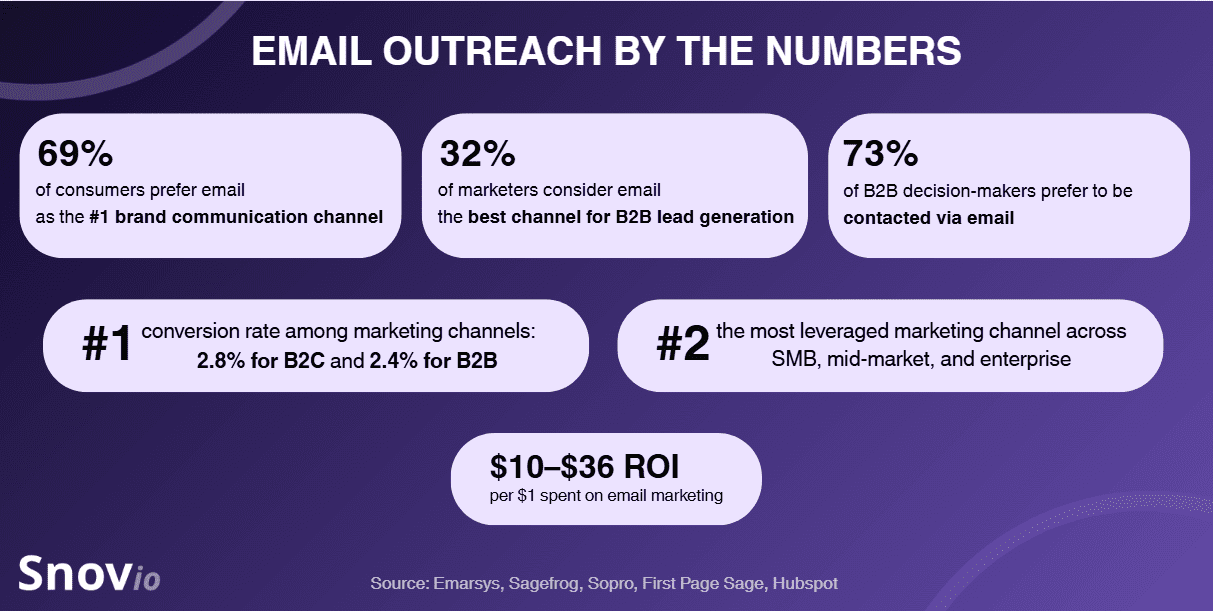
Emails remain one of the most effective channels for lead generation and customer communication, delivering the strongest ROI in 2026. Here are some quick statistics to prove this:
To help you put it into action, we’ve prepared 14 customizable templates for inbound marketing and cold email outreach. Keep reading to learn how to tailor them and write personalized emails that drive replies.
Why email marketing is still relevant in 2026
Did you know that email marketing still yields the highest return on investment (ROI)? For each dollar invested in email marketing, top performers achieve an ROI greater than $50, while the average ROI is $36 for every $1 invested.
Furthermore, email remains the channel people actually want to be contacted through—in both B2B and B2C. 69% of consumers choose this channel for brand communication, while 73% of B2B buyers prefer vendors to reach out via email.
Moreover, email is built for outcomes, not just engagement. It delivers the highest results across marketing channels, with average conversion rates of 2.8% for B2C and 2.4% for B2B. Plus, sales teams use email to grow pipelines. In fact, 32% of marketers call email the most effective channel for B2B lead generation.
Still not convinced? Simply look at the current and expected revenue from email marketing reported by Statista.

Here are more reasons why modern marketing and sales reps keep investing in email marketing in 2026:
- It helps you reach a more targeted audience and get more control over all sorts of distributed information.
- Email marketing keeps you in touch with current clients and prospects and helps you build rapport with them over time.
- It reinforces your other marketing channels, like social media platforms, by nurturing intent and gently guiding potential customers towards a decision.
- It lets you showcase your value proposition and encourage customers to take action with timely offers and clear CTAs.
- Email marketing increases brand recognition and awareness through consistent touchpoints.
- Depending on where your client is in the sales cycle, email marketing can help you move them further and eventually close the deal.
- It boosts website traffic. For instance, an email with the subject line “Recommended for you” and a link to a relevant page on your website can encourage people to click, explore your content, and spend more time on your site, bringing in more engaged visitors.
That efficiency is exactly why email remains one of the top 2 most leveraged marketing channels across small businesses, mid-market companies, and enterprises.
🔎 Did you know?
Businesses that use social media to connect with prospects and build relationships are 51% more likely to reach their quota. Impressive, right?
So why not add LinkedIn touches to your outreach sequences, especially when it’s so easy with Snov.io? Combine your emails with automated LinkedIn actions (profile views, post likes, connection requests, endorsements, messages, and InMails) in one campaign.
The cloud-based operation lets you run campaigns 24/7. Plus, Snov.io ensures safe LinkedIn automation with a location-based proxy per account and smart behavior patterns that simulate human activity.
Inbound vs. outbound email outreach: what’s the difference?
If you’re interested in email marketing, there are a couple of terms you should know.
Inbound email marketing involves sending outreach emails to people who have already engaged with your product, services, or content: signed up for a newsletter, requested more information, or subscribed to your email list for a free trial.
On the other hand, outbound email marketing targets people who have yet to show an interest in your business. Similar to a cold call, this type of outreach is aimed at audiences who are either unfamiliar with your company or have little knowledge of your product or service.
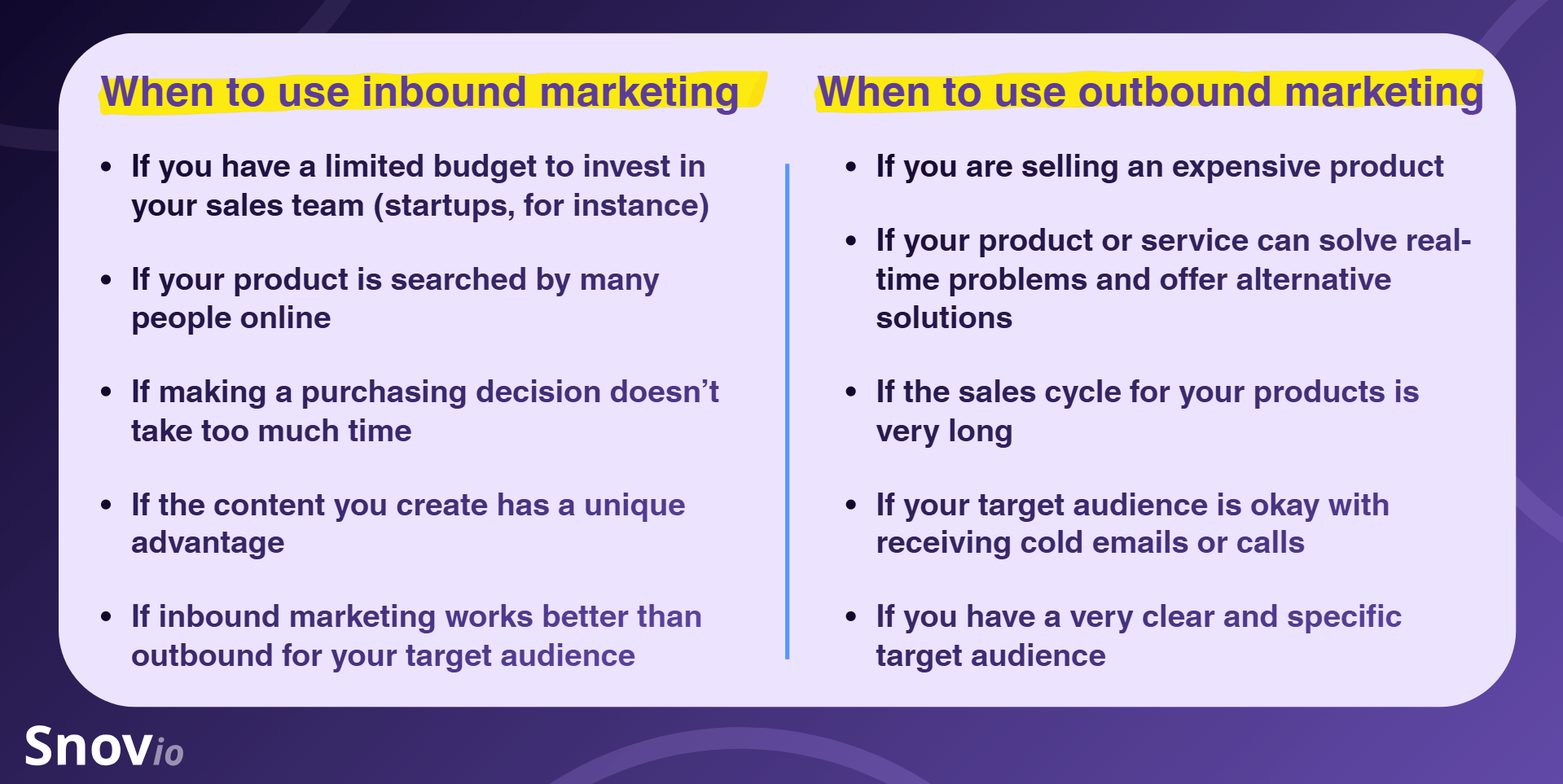
Both inbound and outbound marketing come hand in hand with inbound and outbound sales.
Conceptually, they are very close. In inbound sales, customers come to you. They find your company by searching for information that could help solve their pain points, attending webinars, or even scheduling a free consultation to learn more.
In outbound sales, you contact potential customers first. This includes cold outreach methods such as cold emailing or cold calling. Outbound leads usually are less aware of your product’s value and, hence, less engaged.
The best strategy is to use a combination of inbound and outbound outreach, depending on your industry, company type, and client needs. This will ensure that you provide relevant content and value to your audience and that your message actually reaches people.

Inbound outreach email templates
Inbound outreach letters are a breeze to write because your recipient has already expressed interest in your offerings. Whether it’s a prospect who requested a product demo, signed up for your newsletter, or followed up on a lead magnet to receive a discount, they are already hooked.
The main goal of inbound outreach emails is to nurture your leads and nudge them to become repeat clients. So, how do you craft a successful inbound email template, and what sets it apart from an outbound template?
Inbound email templates are targeted
Gone are the days when salespeople would resort to random “blast” emails, hoping someone would respond. Nowadays, such actions can violate the General Data Protection Regulation (GDPR), which could harm your sender reputation and cause your messages to be flagged by spam filters.
To make your templates more specific and targeted, divide your target audience into groups based on shared criteria. This way, you can create more relevant copy, leading to higher conversion rates and click-through rates. You can easily segment your audience list using CRM technologies based on their:
- Position
- Industry
- Job title
- Location
- Demographic data
- Type of relationship with you (B2B vs. B2C), etc.
The best thing is that all these contacts are already primed to do business with you, making them more likely to convert.
#1. Inbound outreach email template: new feature
Subject line: We’re excited to share [Product Name]’s new feature!
Hi [Prospect Name],
We wanted to share some exciting news—we’ve just added [Feature] to [Product Name], and we think your team will appreciate these new developments when bringing the lead generation process to a brand-new level. Here’s a quick breakdown of the benefits:
[Benefit 1]
[Benefit 2]
[Benefit 3]
Let me know if you have any questions.
All the best,
[Your email signature]
Why this template works:
It makes your outreach feel more genuine as a product update is a natural reason to reach out to an already engaged audience. The benefits are easy to scan, so the recipient can quickly see possible outcomes.
Inbound email templates are shareable
Because inbox attention is limited, visual and interactive content can help your message stand out and drive engagement. Litmus State of Email 2025 shows that today, 97% of marketers include at least one interactive element in their emails.
Due to the picture superiority effect, recipients are much more likely to remember images in your email than words. Videos also work wonders. So why not incorporate a video or infographic into a visually engaging inbound outreach template?
📝Smart tip: include visually appealing content that’s easy to share on social media. You can also add a link that redirects the recipient to content on your website, for example, to your recently published blog post. This way, recipients can share it with their colleagues or anyone interested in seconds, potentially expanding your reach beyond a single inbox.
Whatever interactive element you use, make sure it’s relevant to your email topic and doesn’t look spammy or gimmicky. It’s also crucial to optimize your content for mobile devices, as over 71% of consumers usually check email on their phones.
|
💡 Tip from Snov.io experts: Visuals work great for inbound email marketing. However, when it comes to cold emailing, I strongly recommend sticking to plain text, especially for the first message. Due to Google’s 2024 policy updates, emails with images may be flagged as suspicious or spam, which can significantly hurt your sender reputation and deliverability. So, save visuals for inbound and keep cold emails text-first to avoid triggering spam filters and protect deliverability. |

⮕ See how Gmail’s updates affect open tracking and what you can do to safeguard your sender reputation
#2. Inbound outreach email template: valuable content
Subject line: X helpful blog posts about [Prospect’s pain point]
Hi [Prospect Name],
Thank you for downloading our guide on using advanced email lookup tools!
If you want to dive deeper, check out our blog posts below. They break down how you can find quality leads step by step!
[Resource 1]
[Resource 2]
[Resource 3]
[Resource 4]
Let me know what you think!
Best,
[Your email signature]
Why this template works:
It naturally continues the conversation after a clear inbound action, so the email feels expected. The resources included in the message create value first and show the recipient that you care, which builds trust before any sales CTA.
Inbound email templates are informative
An inbound outreach email is a powerful way to connect with potential customers and showcase your value proposition. The key technique is to answer the most pressing questions, highlight your product’s strengths relative to competitors, and provide helpful information.
Share a link to the demo so that a recipient can see your product or service in action. It’s also good practice to offer a quick call or chat to answer their questions and briefly explain how your product solves their problem. The “informing” tactic is your subtle way to nurture a relationship that will naturally evolve into a sale.
#3. Inbound outreach email template: demo
Subject line: Can I help with [Product Name]?
Hi [Prospect Name],
I saw that you recently requested a demo of [Product Name]. I wanted to let you know that I’m here to answer any questions and provide additional information.
Our demo offers [Description of what the demo provides] and can help you achieve things like:
[Benefit 1]
[Benefit 2]
[Benefit 3]
Are you available for a 15-minute call this week to discuss this in detail? I’m confident we can help you improve your workflow.
Please let me know if that works for you, and I’ll send over a few available times!
Best regards,
[Your email signature]
Why this template works:
It’s triggered by intent, so the outreach is relevant and timely. The template includes a specific and low-friction CTA that makes it easier for the reader to take the next step. The benefits describe outcomes, giving the reader a reason to reply.
Inbound email templates are custom-tailored
If you’re in the sales business, you know first impressions are everything. That’s why creating custom-tailored sales email templates is a must. Personalized messaging will make your prospects feel seen and valued, which can go a long way in establishing a strong connection with them.
#4. Inbound outreach email template: bug fix
Subject line: All sorted!
Hi [Prospect Name],
Thank you for your prompt feedback regarding [Issue]. Your input is valuable, and I’m happy to let you know that we’ve fixed the issue affecting your account. You can now start using the feature again!
We’ve also added 20 credits for your patience. That’s right—20 free credits to keep using the [Product Name] you’ve been testing out.
If you have any questions or need further assistance, please let me know. Our team is always here to help.
Thanks again for your valuable feedback!
Kind regards,
[Your email signature]
Why this template works:
It closes the loop quickly and turns a negative moment into a positive experience of interaction with your product. Adding a small “thank you” demonstrates the importance of user feedback for your team and encourages continued product usage.
Inbound email templates are constantly evolving
In the fast-paced world of digital marketing, your outreach strategy can’t stay the same. Client interests and needs evolve daily, so keep a close eye on changes and reflect them in your sales email templates to stay ahead of the curve.
#5. Inbound outreach email template: survey
Subject line: Your opinion matters! Share your thoughts in our quick survey
Hi [Prospect Name],
At [Your company name], we’re committed to providing our blog subscribers with relevant and informative content. However, we know that everyone’s needs and preferences are different, and we want to ensure we meet your expectations.
We’re running a short survey to gather your feedback on the content we’ve been sharing. We want to know how we can improve and provide you with even more valuable insights into the industry.
Please follow this link to fill out a short survey: [Survey link]. It will only take a few minutes.
Thank you for your ongoing support and for being a part of our community!
Best regards,
[Your email signature]
Why this template works:
This message communicates user-driven improvement rather than a one-sided request. It also sets clear expectations of how long everything takes and reduces friction with a link placeholder.
Inbound email templates are purposeful
As a salesperson, you know that a well-crafted sales email template can be a step forward toward closing a deal. The key here is to set a clear purpose for your outreach and be as clear as you can.
#6. Inbound outreach email template: free trial
Subject line: You asked, we deliver!
Hi [Prospect Name],
Thank you for reaching out with your request for more information about our [Product Name]. I’m excited to share the many features that make our platform a top choice for sales teams.
With our [Product Name], you can streamline your sales process, improve your team’s collaboration, and stay organized with ease. Our free trial gives you access to all these features so you can try them out.
Here are just a few of the ways our [Product Name] can help you succeed:
[Benefit 1]
[Benefit 2]
[Benefit 3]
But don’t just take my word for it – give it a try yourself with our free trial. I’ve included a link below for your convenience.
[Link]
If you have any additional questions or requests, please let me know.
Sincerely,
[Your email signature]
Why this template works:
This message responds to explicit inbound intent, so the offer doesn’t feel pushy. Benefits come before the trial link, which can improve click rates and increase the likelihood of a conversion.
Inbound email templates are all about following up
You should have a couple of follow-up email templates in your sales arsenal. If you still doubt whether you need to bother your audience with extra messages, remember that they have voluntarily shared their email addresses with you, and so won’t mind learning more about the benefits of your product.
That being said, spamming your recipients with endless follow-ups and reminders is never a good idea. Create a well-balanced outreach sequence that keeps you top of mind without overwhelming your prospects, ensuring every message adds value and builds trust.
#7. Inbound outreach email template: webinar registration
Subject line: Your webinar registration
Hi [Client Name],
Thank you for registering for our upcoming webinar on [Webinar topic]. I hope you’re looking forward to it as much as we are!
If you are still seeking ways to boost your outbound prospecting, I’d love to chat with you about how [Product Name] can help provide a steady flow of quality leads into your sales funnel.
Are you available for a quick chat this Tuesday or Thursday?
I look forward to discussing how [Product Name] can benefit your business.
Sincerely,
[Your email signature]
Why this template works:
It starts with a warm trigger, such as registration, and keeps the next step simple. The CTA is time-bounded and specific, which reduces back-and-forth.
#8. Inbound outreach email template: webinar registration follow-up (1)
Subject line: Re: Let’s optimize your prospecting and lead search
Hi [Client Name],
I wanted to follow up on my previous email regarding your interest in [Product Name]. Are you interested in a consultation on optimizing your prospecting and lead search using [Product Name] features?
If you’re available this week, I would love to have a quick call with you.
Alternatively, I’ve attached a link to my calendar so you can schedule a demo at your convenience.
[Link]
[Product Name] has a lot in store for your business, and I’m here to help you navigate it. Let’s explore its potential together and see how it can benefit your business.
Looking forward to hearing back from you!
Kind regards,
[Your email signature]
Why this template works:
It’s a natural follow-up that provides two clear options. This increases the chances of a positive reply because the recipient can choose what is most convenient for them, rather than ignoring the offer altogether. Besides, the tone stays helpful and consultative, not salesly.
#9. Inbound outreach email template: Webinar registration follow-up (2)
Subject line: Put your lead search on autopilot for free!
Hi [Client Name],
I’m checking in again about the [Product Name] demo we discussed before. Did you have the time to check the available dates for scheduling a meeting?
I understand how busy things can get, but I’m hoping to assist you with automating your lead search and outreach efforts with ultimate ease.
If you’re still interested in testing our [Product Name], I’ve included the link so you can try it out for free.
[Link]
We value your opinion, so please let us know how it goes. We’re here to assist you in any way we can.
Kind regards,
[Your email signature]
Why this template works:
It reoffers value in a low-friction way by allowing a user to try a product for free. The CTA is simple and keeps momentum without sounding pushy or aggressive.
Outbound outreach email templates
Email templates for cold outreach are essential for reaching potential customers who may not have heard of your business before.
Being a digital version of a cold call, they are much avoided by vast audiences. This is why it is important to ensure that your recipient is on the targeted list of contacts and is likely to benefit from your product or service.
So, what makes an outbound email template effective? Let’s find out!
Outbound email templates are attention-grabbing
When sending a cold email to an unknown person, it’s hard to overemphasize the power of a good subject line.
It should be short, casual, and relevant to grab your prospect’s attention amidst the other cold emails they receive throughout the day. Seems much easier said than done, but an engaging subject line is your gatekeeper to your sales message.
#10. Outbound outreach email template: social media reference
Subject line: Are you prepared to overcome [Challenge]?
Hi [Prospect Name],
I recently saw your question on [Social media channel] about the best product for automated lead generation. Investing in the right lead generation tools is key, and we believe our [Product Name] can meet your requirements, including:
[Requirement 1]
[Requirement 2]
[Requirement 3]
Our [Product Name] offers a free trial that provides insights into [Overcoming challenge]. Please let me know if you’re interested in trying it out!
Best Regards,
[Your email signature]
Why this template works:
It establishes relevance by starting with a real trigger (their public question). The requirements-first framing makes the pitch feel consultative and specifically tailored for your recipient’s needs.
Outbound email templates are personalized and direct
Everyone wants to feel special, and your prospects are no exception.
When crafting your cold outreach template, show your clients you’ve taken the time to understand who they are and what they need. You must clarify that the email is tailored specifically to them and addresses their unique challenges.
If your email template fails to answer the question, “Why did they contact me?” it’s time to rewrite it until you reach that clarity.
#11. Outbound outreach email template: social media comment
Subject line: You’ll love this!
Hi [Prospect Name],
I’ve seen your LinkedIn comment on failed email drip campaigns due to untimely dispatch and decided to reach out.
Wouldn’t it be great if you could schedule your emails according to different time zones? Well, say no more. We have designed a new email scheduler just for you.
If you’re interested in giving it a try, just reply to this email, and we’ll set you up with a free trial.
Looking forward to hearing from you!
Best,
[Your email signature]
Why this template works:
It references a specific comment, making the outreach feel personal, as if mentioning a mutual connection or shared interest. This template also focuses on one clear pain point, providing a straightforward solution with a low-friction CTA.
Outbound email templates are problem-solving
Let your potential client know you are aware of their specific pain points. Add a brief description of the problem in your outreach message so they can immediately relate.
You should not only focus on their pains but also provide pain relievers up front. Research the problematic areas of your prospect’s business to look professional. An even better solution is to relate the problem to a specific decision-maker or stakeholder to make them pay attention to your email faster.
#12. Outbound outreach email template: mutual connection
Subject line: Let’s overcome [Problem A] and [Problem B] together
Hi [Prospect Name],
As a [Your job role] at [Your company name], I wanted to reach out to you specifically regarding [Company function] at [Prospect’s company]. I recently spoke with [Mutual connection name], and they mentioned that you might be the go-to person for this area.
I’d love to get on a call next week to discuss how we can help you overcome:
[Problem A]
[Problem B]
We specialize in [Service 1] and [Service 2], which can help businesses like yours overcome these issues.
If you’re not the right person to approach this, could you please refer me to the decision-maker responsible for [Company function]?
Thank you for your time, and I hope to hear from you soon.
Best regards,
[Your email signature]
Why this template works:
A mutual connection adds credibility and increases the likelihood of a response. This email also includes a graceful fallback, increasing the chance you won’t lose the opportunity if the contact isn’t the owner.
Outbound email templates are short and sweet
You’ve got a great product and want to shout it from the rooftops. But hold on a minute. Short and sweet is the way to go when it comes to the first reach-out email. The most effective opening lines of cold sales emails are usually concise, specific, and engaging.
#13. Outbound outreach email template: statistics
Subject line: Boost your follow-up success rate today
Hi [Prospect Name],
Did you know that 44% of salespeople give up after just one follow-up? Crazy, right?
But with [Product Name], you can swoop in and save the day. Our tool will help you land in your prospects’ inboxes and get the follow-up you need to make the sale.
Are you ready to get ahead of the game? Let me know, and we’ll be happy to help.
Looking forward to working with you!
Cheers,
[Your email signature]
Why this template works:
Including relevant stats helps position you as an industry expert worth listening to. The value is specific and tied directly to the pain point.
Outbound email templates ignite action
Want to make sure your cold emails are hitting the mark?
Remember to focus on a single call to action that tells your prospect exactly what you expect them to do. Support it with a friendly invitation to follow your business on social media or sign up for your newsletter or blog.
#14. Outbound outreach email template: hard-to-believe facts
Subject line: Ready to take [Prospect’s product name] game to the next level?
Hi [Prospect Name],
Did you know that [Add exciting facts related to your business?]
We found it hard to believe, too, when we first heard that!
But it is possible. We here at [Your company name] have crafted the perfect solution to [Problem].
If this sounds like something you’d be interested in, simply reply to this email, and my team and I will be happy to set up a demo call. We’ll walk you through the process and show you how [Product Name] can take your game to the next level.
Don’t miss out on this opportunity to elevate your business. We’re looking forward to hearing from you!
Best,
[Your email signature]
Why this template works:
A surprising fact captures attention and sparks curiosity, making your email sound more like a genuine insight rather than a sales pitch. The demo here is positioned as a helpful walkthrough, so the CTA stays low-pressure and easy to respond to.
|
💡 Tip from Snov.io experts: Even the best cold email template won’t work if it ends up in the spam folder. So, before sending, make sure you’ve taken key deliverability steps to ensure better inbox placement:
Need extra guidance? Check out our free Email Deliverability Guide for a step-by-step checklist to get ready for outreach and help your cold emails land in inboxes. |
Best practices for email outreach
Sales email templates give you a good starting point. But real results come from how you customize and actually send them. It’s less about perfect writing and more about personalization, targeting, and execution.
Therefore, we’ve compiled a list of the most essential outreach practices that help you write emails that sound human, stay relevant, and earn responses.
Define your ICP
A highly relevant email is only possible when it reaches the appropriate person. Therefore, start by defining who your message is for and how your product, service, or offering solves their problem.
Try to make your ICP (Ideal Customer Profile) as detailed as possible, specifying the role, industry, company size, and pain points. This way, you can write an email around a single use case instead of covering everything.
🤔 Not sure who your ICP is? Watch this video to learn how to create actionable ICPs in minutes with Snov.io AI ICP Builder:
Segment your audience
Segment your audience based on demographics, interests, behavior, or other relevant criteria. There’s a big chance that recipients in the same segment have common needs. This way, you can emphasize similar selling points in an outreach template designed for a particular group while remaining relevant to each recipient.
Personalize your subject line
Did you know that subject lines with two custom attributes drive 14% more open rates than those with just one? So, instead of only using a first name, consider using two fields. For example, you can add the prospect’s company, role, use case, or recent job change.
Start with relevance instead of generic openers
Personalize your cold email templates with a real trigger, not just compliments like “loved your website”. Anchor your opener into something specific, such as a recent post, a role change, a prospect’s company updates, and so on. A good, relevant trigger naturally leads into why you’re reaching out and proves that you don’t just mass-send.
Make the value proposition role-based
Instead of pitching a product, pitch the real outcome for your recipient. Just during a sales call, you describe how your interlocutor can benefit, not just your offering. The same goes for messaging, especially cold email campaigns.
What a Head of Sales cares about (pipeline and response rates) differs from what a Marketing Manager prioritizes (lead quality and conversion). So consider this when writing your value proposition. One-sentence pitch that addresses your recipient’s pain points or challenges beats paragraphs of feature descriptions.
Tailor your copy to the intent and funnel stage
Inbound emails can be more content-rich because the recipient is already familiar with your company. So, adding relevant visuals, links, and other resources works well.
Cold email templates should be lighter and more concise. Stick to plain text or minimal formatting, less text volume, and fewer links. When writing a cold email template, provide a clear answer for your recipient on why they should respond and how your communication is mutually beneficial.
Keep your cold emails short and concise to hold attention and reduce the chances of being flagged as spam. Personalize the subject line with the prospect’s company name. I also recommend avoiding AI spam-trigger openings like “I noticed…”. If it’s a first-touch message, don’t include any links.
Outbound Outreach Expert at Snov.io

Show industry awareness
Tailor the template contents to the recipients’ area of expertise. Reference the particular company’s news or industry trends and developments. This will not only grab the recipient’s attention but also position you as an expert in the prospect’s industry.
Build trust with proof and shared context
Reference shared experiences or mutual connections in your outreach messages. This will increase the likelihood of response and help create a sense of familiarity.
Plus, add a small piece of credibility that won’t feel salesly but convey trust and reliability. This may include a customer testimonial, short social proof point, or brief success stories with businesses similar to your prospect’s company.
Ask for one low-friction next step
To increase the chances of a response, be clear on what you expect your recipient to do next. Cold email templates work best with one simple CTA: pick a time, answer “yes/no”, confirm participation, etc.
Avoid adding too many stacking options, such as a brief call, a demo, and a quick chat, in a single template. Also, if you include a link (for instance, to a valuable resource or a case study about how you recently helped a similar company), make it the only link so your message doesn’t look spammy. Plus, add a quick note explaining what recipients get when they click.
Follow-up reasonably
Don’t stop your outreach attempts if you don’t receive a reply within a few days. In practice, the result usually comes from several follow-ups. When writing follow-up cold email templates, reference your previous communication and offer additional value.
Please note that each follow-up should add something new, for example, a different angle, an extra offer, a new resource, etc. If you’re repeating the same pitch, you risk looking spammy to filters and irritating to customers. Also, don’t overwhelm prospects with follow-up emails. My practical experience shows that the best option is 2-3 follow-ups spaced a few days apart.
Track and analyze results
Don’t judge overall campaign performance based solely on response rates. Track opens, clicks, and positive replies to see the full picture. I also recommend monitoring bounce rates to spot issues early.
A/B testing is crucial for optimizing cold outreach. Even small tweaks, like a period or an exclamation mark in a subject line, can impact reply rates. Note that A/B testing makes sense only when testing one variable at a time on similar ICPs. This way, you will be able to see what truly moves the needle.
VP of Global Sales at Snovio

A/B test your cold email templates with different subject lines and contents to identify options that resonate most. It’s also a good practice to continuously sample outreach personalization strategies to identify what works best for each segment of your audience.

Common mistakes to avoid when writing outreach emails
We’ve talked a lot about how to write an outreach email that will bring in leads, but it’s also crucial to mention what to avoid. There are a couple of mistakes that may cost you tons of customers.
So here are the “don’ts” any marketer should remember when creating emails for outreach:
❌ Don’t get down to lousy outreach tricks like starting your cold email subject line with “Re:” as if you’re responding to the recipient’s message. This can make you appear dishonest, ruin your first impression with the prospect, and potentially destroy the outreach.
❌ Don’t use excessive sales jargon in your cold outreach messages. It won’t bring you more meetings or more deals closed, but rather make you sound insincere and unprofessional. Use clear language and concise phrasing that your recipient will easily understand.
❌ Don’t forget to proofread your outreach templates. Typos and grammatical errors have no place in professional emails. A sloppy cold email can turn the prospect away faster than a bad review.
❌ Don’t forget a strong call to action. It feels great to talk about how great your product is, but a cold email template serves more than just an informative purpose. It must drive the recipient to take the desired action. Make sure your CTA is prominent and easy to find.
❌ Don’t use generic greetings in your outreach message. We can’t overemphasize the value of personalization in 2026. A standard “Dear [Name]” or “Hi there!” makes your email template look generic and lazy. Use dynamic content and Spintax to enhance your message variability and personalization.
How to cold email with Snov.io
Now that you’ve got ready-to-use templates and best practices, it’s time to put them into practice. Writing personalized emails for inbound and outbound is challenging, especially at scale. However, tools like Snov.io help streamline this process, providing automated outreach workflows.
Instead of sending emails one by one, marketing and sales teams can build a scalable system: find prospects, verify contacts, segment lists, and launch sequences with smart personalization.
Let’s see how to run outreach with Snov.io.
Step 1: Build your lead base.
Once you’ve defined your ICP, start searching for contacts that match the criteria. Use the Snov.io Database Search to build a high-quality lead list in minutes. Filter prospects by job title, industry, location, or company size to find and save the best matches. You can also use built-in AI that instantly displays B2B leads based on your ICP.
What’s more, you can collect prospects directly from LinkedIn pages or company websites using Snov.io email finder extensions. All leads are enriched with key data points you can use later for segmentation and personalization.
📝Smart tip: If you already have a list of recipients you want to include in campaigns, run email verification to remove risky or invalid addresses before you launch outreach. In Snov.io, you can verify both individual and bulk email addresses in seconds.
Step 2: Prepare your email account.
Connect your sender account and get it ready for stable sending. Ensure the authentication settings are configured correctly so that mailbox providers can trust your domain. Use Snov.io Email Warm-up to gradually build a reputation through natural interactions.
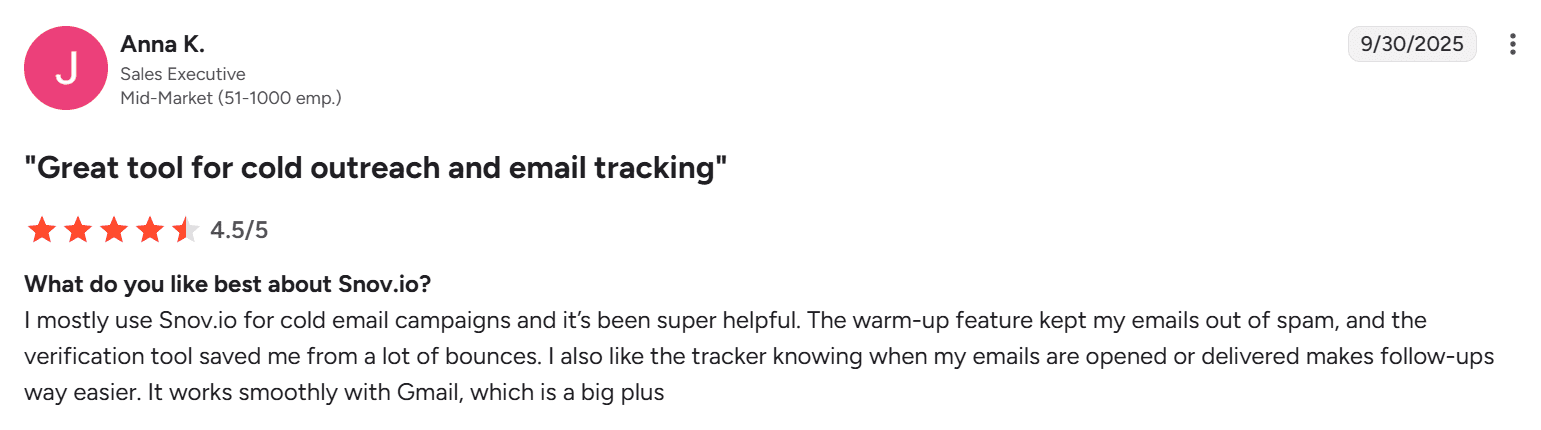
If you don’t know where to start, run a quick Deliverability Test in Snov.io. It will check DNS records, sender reputation signals, spam risks, and inbox placement across major providers, and provide personalized recommendations on what to fix.
🔎 Did you know?
You can buy domains and mailboxes already configured for outreach directly in your Snov.io dashboard. So if you want to skip this complicated technical setup, while still ensuring the core deliverability basics are in place, a done-for-you cold email infrastructure is a great option.
Step 3: Craft your emails.
Use templates as a base, then personalize them with lead data. You can add variables, such as first name, job title, company, and more, or create your custom fields based on the information you have. Include dynamic content to automatically adjust email copy based on specific criteria and add Spintax to keep your messaging unique at scale.
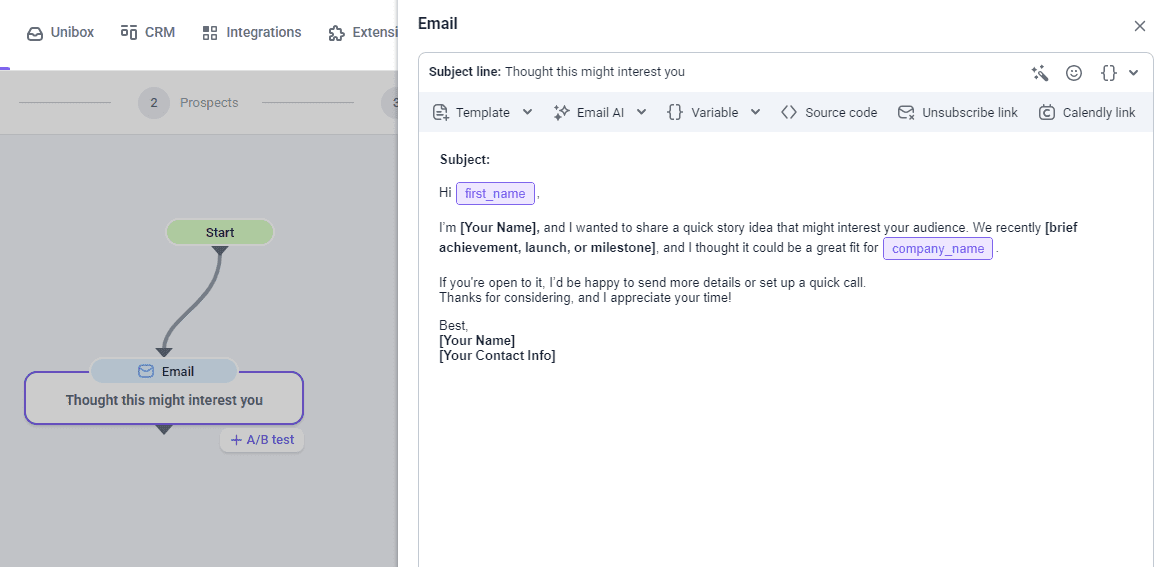
The best part is Snov.io AI Writing tools, built right into the editor. Use them to generate subject line ideas, fine-tune tone, adjust writing style, and create emails tailored to your use case. You can also translate your messages from English into 36 languages to support global outreach.
⮕ Learn how we sent 3,000 messages with Snov.io AI and boosted conversion rates by 30%
Step 4: Create an outreach sequence.
Build an outreach sequence by adding custom delays, conditional steps, and automated follow-ups in an intuitive drag–and-drop builder. You can also combine emails with LinkedIn touches to double your efforts with a multichannel flow.
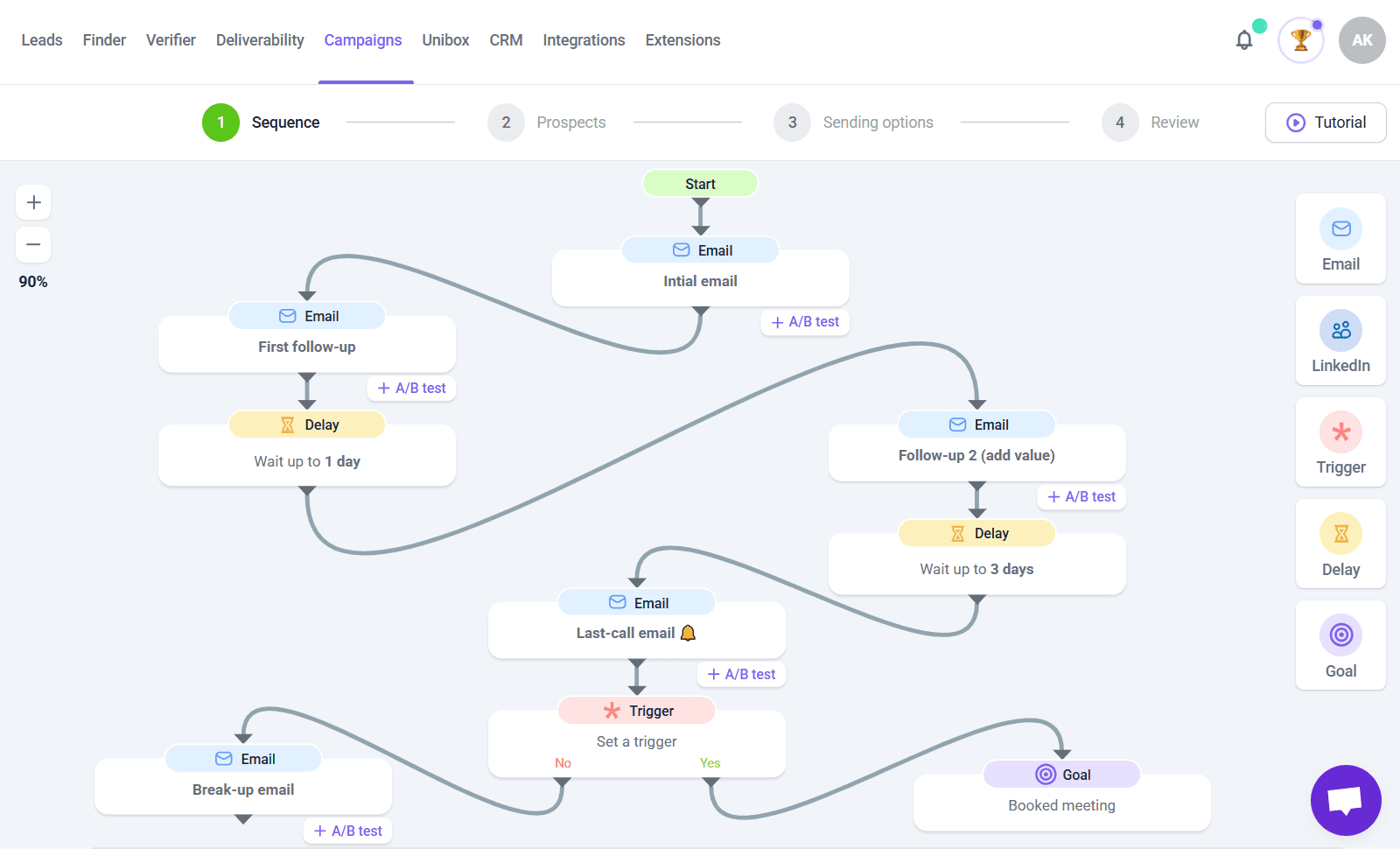
To optimize your messaging, you can also add A/B testing at each step of your sequence (up to 15 variations) to identify which template drives the highest engagement.
Step 5: Track performance.
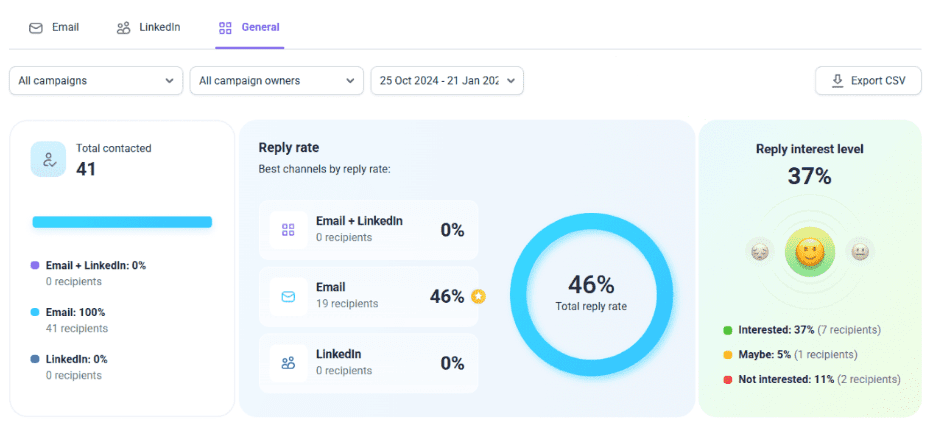
Once your sequence is live, monitor the performance metrics using Snov.io’s built-in reporting tools. Track key engagement metrics, like opens, replies, and clicks. Keep an eye on deliverability metrics, such as delivery, bounces, auto-replies, and unsubscribes.
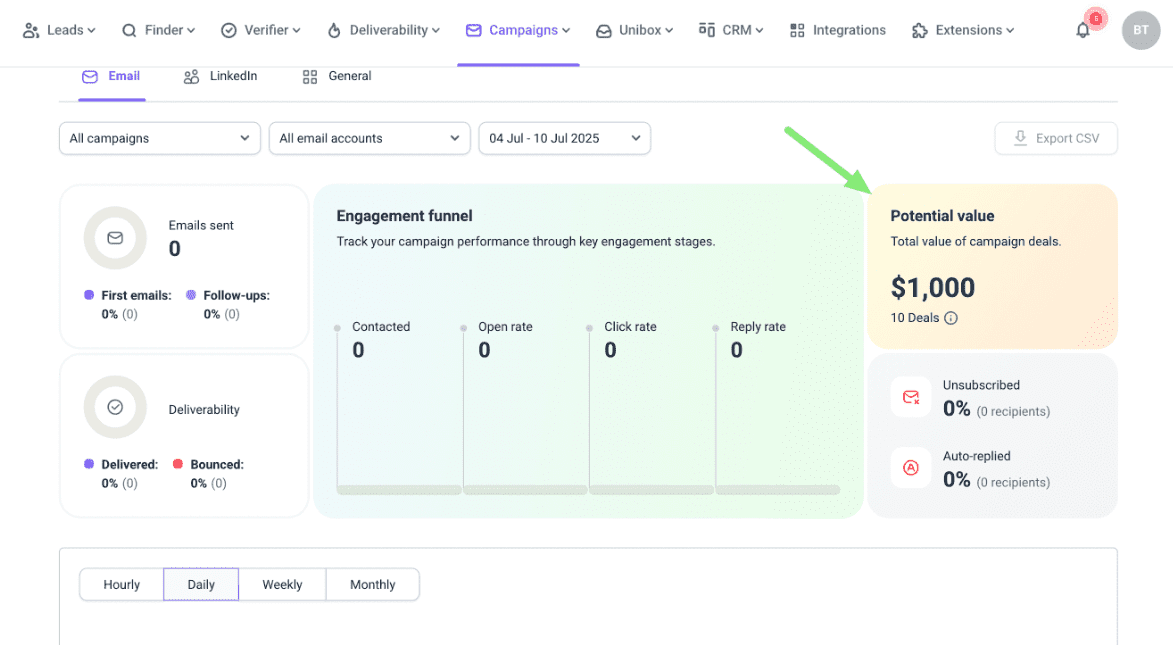
You can also track potential campaign revenue to estimate ROI and prioritize sequences that deliver the greatest impact. Snov.io reporting dashboards are customizable, so you can review results by campaign or mailbox and compare performance across segments, sequences, and sender accounts.
|
💡 Tip from Snov.io experts: Use Snov.io AI Sentiment Analysis to prioritize prospects and build a smarter follow-up strategy based on real data. It automatically classifies responses by intent (positive, neutral, negative), so you can quickly reveal the most promising leads. Follow up first with positive replies, then address objections in neutral replies with clarification or an additional helpful resource. Exclude negative responders from your further campaign to avoid spam complaints and protect sender reputation. |
Key takeaways
Email remains one of the most powerful channels for building relationships, generating leads, and moving deals forward. Inbound emails help you nurture existing interest, while outbound messages let you start new prospective conversations. Both approaches require the right messaging to drive results.
But the outcome doesn’t depend on clever wording alone. The real result also comes from proper targeting, smart segmentation, and deliverability. A solid outreach strategy combines strong messages with strong execution.
The templates provided in this article, along with best practices and actionable tips, will help you with the email content part. For reliable prospecting, scalable personalization, and smart follow-ups, you can rely on Snov.io.