TL;DR:
In this article, I’ve sorted out the best sales outreach strategies by channel:
I also reviewed the best sales outreach tools for a multichannel strategy. My top list of them is Snov.io, Apollo.io, Klenty, Reply.io, and La Growth Machine.
What is a good sales outreach strategy these days? Oof… That’s a million-dollar question. According to studies, using AI is among the best practices for modern sales professionals. Gartner predicts that 95% of seller research workflows will start with AI by 2027.
But is it all about AI only? Spoiler: No.
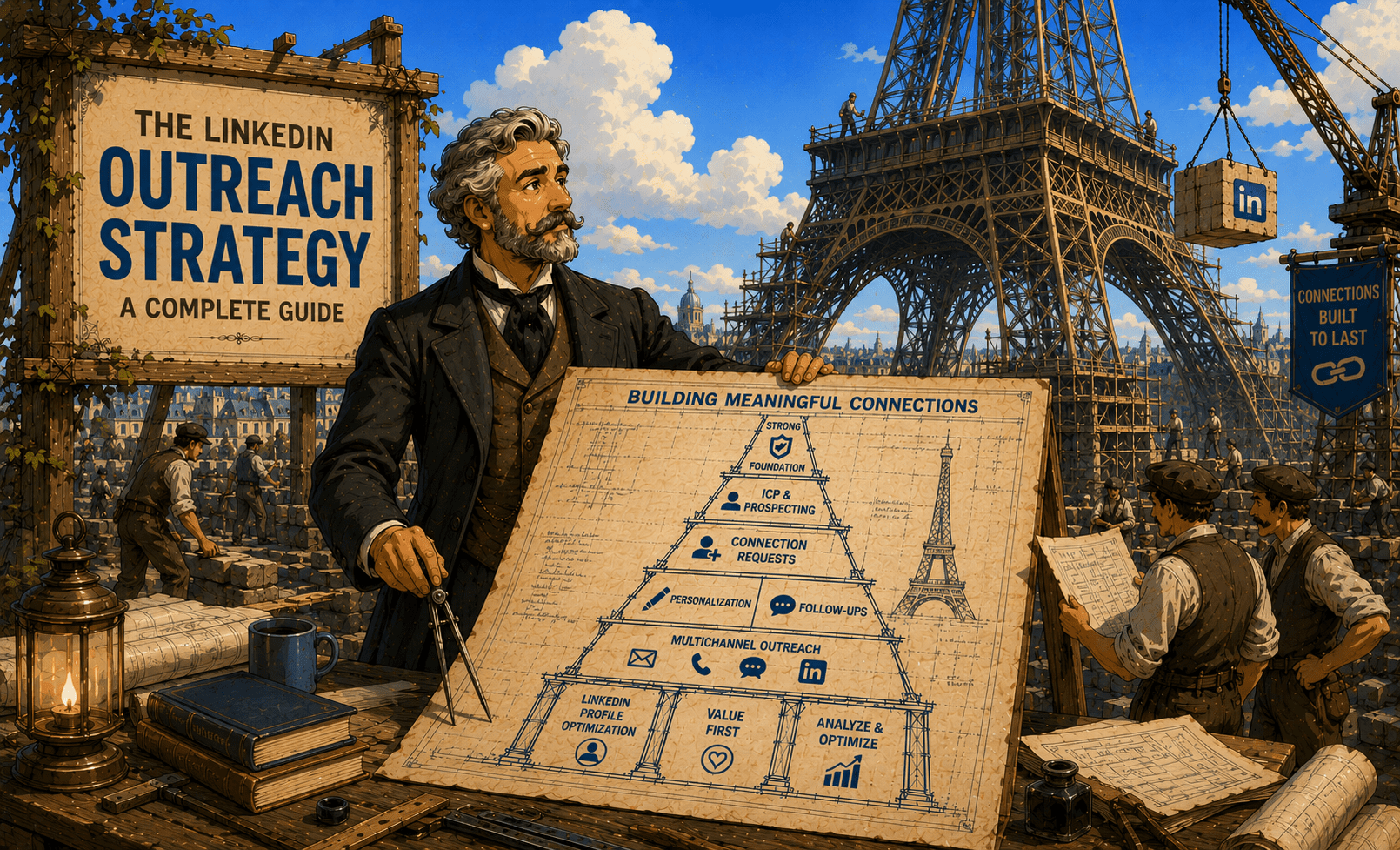
In this guide, I reviewed the best sales outreach strategies and tools for the future of outbound. I also shared expert recommendations on how to create a multichannel outreach strategy, from email to LinkedIn.
Key points of this guide:
- What is a sales outreach strategy?
- How to build an effective sales outreach strategy
- Best practices for cold email outreach
- Best practices for cold calling
- Best practices for LinkedIn outreach
- Top 5 multichannel sales outreach tools (based on my experience)
- Key takeaways for successful sales outreach in 2026 and beyond
What is a sales outreach strategy?
A sales outreach strategy is a planned approach to initiating and maintaining contact with your potential customers across different channels to drive conversions and close more deals.
A successful sales outreach strategy boils down to:
- Target audience: Who are your ideal prospects?
- Channels: Will you use email, social media, phone, WhatsApp/SMS, or multiple communication channels to reach out to them?
- Practices: Which activities and tactics will you adhere to? AI-powered automation, personalized messaging, shoulder-to-shoulder collaboration with your marketing team — what else?
- Timing: At what time exactly will you contact your prospects?
- Tools: Which sales outreach tool are you planning to use?
Note: Some sales reps closely collaborate with marketing teams to develop cross-departmental sales outreach strategies. This practice is often referred to as “Smarketing.” But whether you “smarket” or not, the key here is to develop a well-structured action plan with proven methods for each channel and choose the best sales outreach software for your unique needs.
So, let’s do just that.
How to build an effective sales outreach strategy
Follow these strategic steps to succeed in sales outreach.
Create your ICP and targeted prospect lists
Start by defining your target audience and defining an ideal customer profile (ICP), or several ICPs if needed.
Specify the basic elements of the ICP-building framework:
- Geographic data: Region, country, state, city/town
- Firmographic data: Industry, company size, job title
- Psychographic data: Goals, motivations, pain points
- Technographic data: Software, apps, devices
- Behavioral data: Purchase history, decision-making process, buying signals
💡Expert tip: If you’re struggling to define your ICP, Snov.io’s AI Buyer Persona Builder can help you out in just a few minutes.
Afterward, you can apply those ICP details as search filters in Snov.io’s AI-powered Database Search or LinkedIn Search (to capture leads directly from LinkedIn) and build targeted lead lists.
Tap into multichannel sales outreach automation
In fact, 81% of decision-makers note that their outreach results improve when they combine multiple channels.
All you need to do is pick the right channels for your multichannel outreach. For B2B campaigns, experts recommend choosing no more than 2 channels.
Suppose you prioritize LinkedIn + email outreach. Let’s map out the full sequence.
For example:
- Day 1 → Cold email
- Day 3 → LinkedIn profile view
- Day 5 → LinkedIn post like
- Day 7 → Follow-up email
- Day 9 → InMail
After mapping out, turn to a multichannel sales outreach tool (see my top-5 overview in a couple of paragraphs) to put your sequenced campaign on autopilot.
Put personalization first and hyper-personalize with AI
About 67% of sales reps say that personalization is even more significant to customers in 2026 than it was in 2025.
Today, an effective sales outreach strategy is all about personalized videos, email templates, cold call scripts, LinkedIn messages, SMS/WhatsApp communications, etc.
💡Expert tip: Let AI help you write emails that feel personal, as if you’ve read the prospect’s mind. With such tools as Snov.io’s ICP-based AI Email Builder, you can generate hyper-personalized messages in seconds.
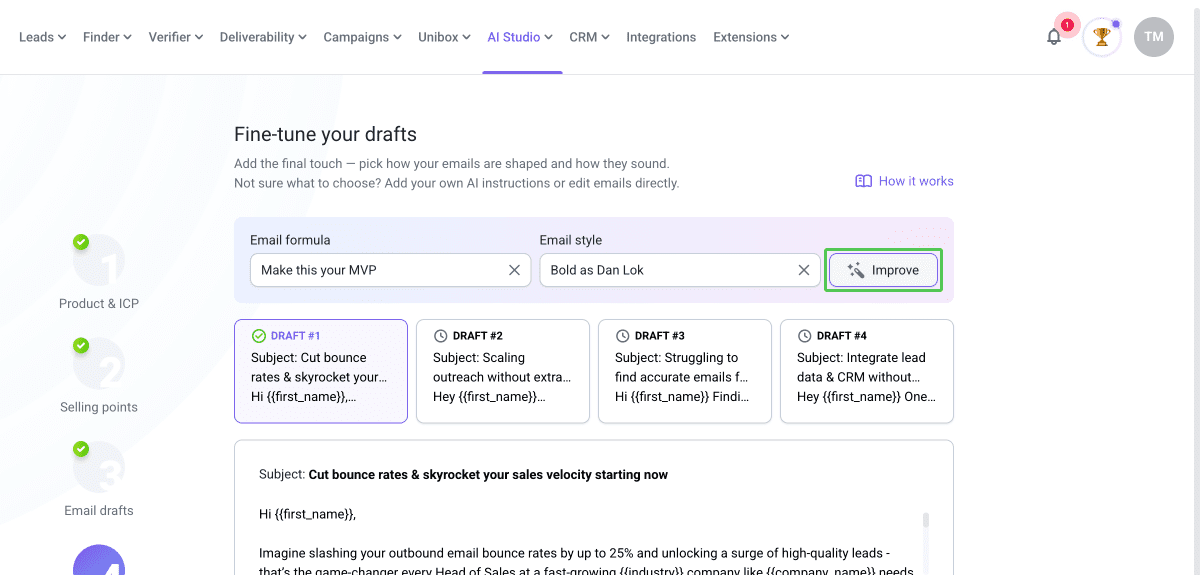
Or you can fine-tune your ready-made drafts so they look more professional and hyper-targeted to your ideal customer and their pain points.
Measure and optimize
An effective sales outreach strategy cannot rely on guesswork. You should collect prospect engagement data across every channel and monitor such metrics as:
- Open rate
- Click rate
- Reply rate
- Connection request acceptance rate
- Call conversion rate
- And other metrics.
Besides, sales outreach experts recommend running A/B tests to understand what works and what doesn’t, and continuously enhance your strategy over time.
Now that we’ve discussed general recommendations for building a successful sales outreach strategy, let me share the best outreach practices for each channel: cold email, cold calling, and LinkedIn campaigns.
Best practices for cold email outreach
Cold email remains one of the core channels for B2B outreach. When approached strategically, it can boost your sales strategy, bringing you the desired revenue growth.
Below are key recommendations from outreach experts on how to make cold email outreach your winning power:
Set up your email infrastructure
Your emails won’t matter if they never actually get landed in front of your prospects’ eyes. Prior to sending a cold email campaign, ensure your messages won’t trigger spam filters or bounce consistently.
Set up your email infrastructure to build a healthy domain and warm your account before bulk sending. Alternatively, choose a done-for-you approach to get all that SFP, DKIM, and DMARC authentication done for you.
Regularly run the email deliverability test to identify what undermines your sender reputation, causes emails to go to the spam folder, or bounce back.
A proper email infrastructure setup will help you avoid sender-reputation headaches and inbox placement downfalls.
→ Learn more about why it’s worth trying a done-for-you email infrastructure for a winning cold email outreach strategy.
Personalize, not just customize
It’s not a secret that personalized emails perform nearly 6x better compared to one-size-fits-all messages.
But here’s the harsh truth: using [FirstName] variables in your emails is not personalization. In 2026, personalization shouldn’t be mixed with what sales professionals and marketing experts call customization.
Everyone confuses customization with personalization.
Customization: Adding name/company = Fake personal
Personalization: Understanding context = Actually personal
CEO at Tej SolPro

Start by contextualizing the subject line and email body by adding deeper specifics about prospects.
For example:
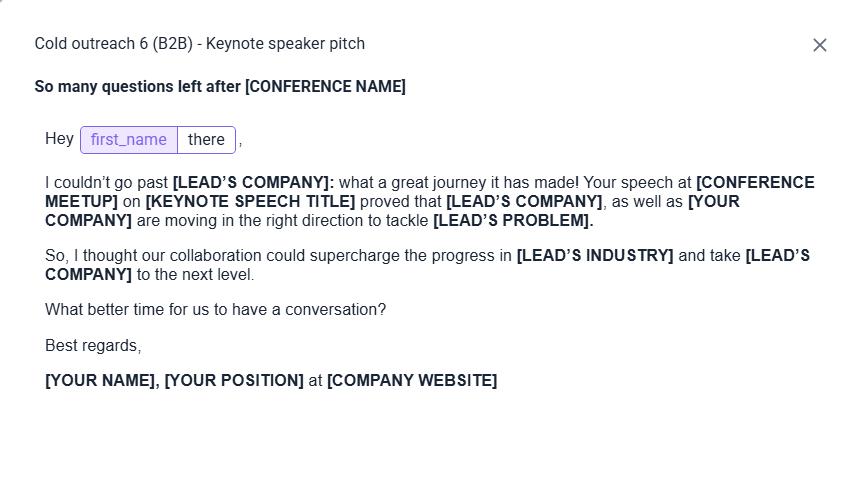
Here’s a post-event email template I found in Snov.io’s library:
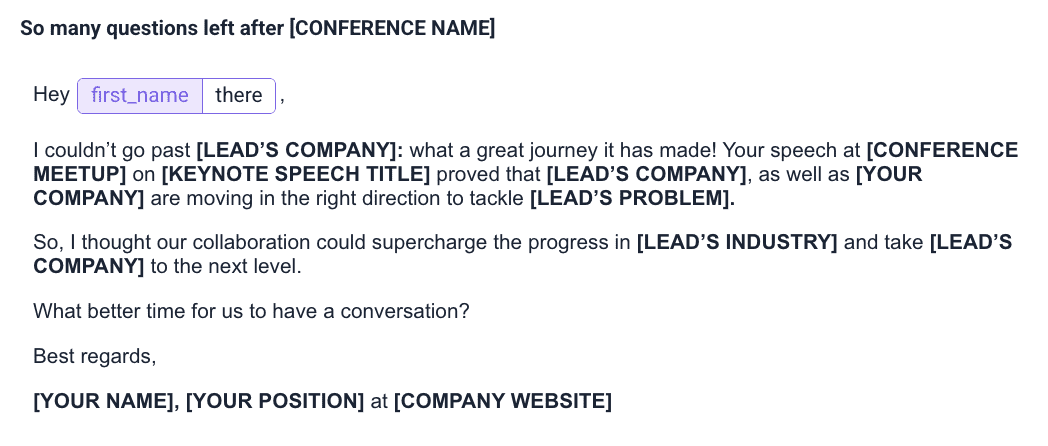
As you can see, the subject line, “So many questions left after [ConferenceName],” as well as the body text, look highly relevant to the prospect and the context behind the outreach.
On the technical side, Snov.io provides a wide range of email variables that make this email template look personalized.
Below are examples of introductory sentences you may use for your cold email to make it look special for prospects:
- Saw you speaking at [EventName]
- Your LinkedIn post about [Topic] got me thinking
- Spotted your new office on [StreetName]
- Heard you discussing [Topic] on a [PodcastName]
⚠️Note: You can personalize each element of your email, from a subject line to a sign-off. Take a look at the following sign-off examples:
- Appreciate your time and insights on [Topic]
- Hope your workday at [CompanyName] ends on a good note
- We’ll speak soon at [EventName]. Cheers!
- See you there at [ConferenceName]
Adding them to your cold or follow-up emails will make your messages sound more personal.
Act on buyer intent and psychological biases
Your potential customers constantly express the urge to buy, or buying intent, but do you actually track it? And if yes, do you act on it fast enough?
Successful sales teams ingrain buyer intent into their sales outreach.
“We’re moving from mass cold outreach to intent-based approach. Way more effective when you’re reaching people who’ve already shown interest in the topic.”
Sales and Marketing Specialist at Novataktik

For example:
Look at this intent-driven message triggered after the prospect commented on a specific LinkedIn post.
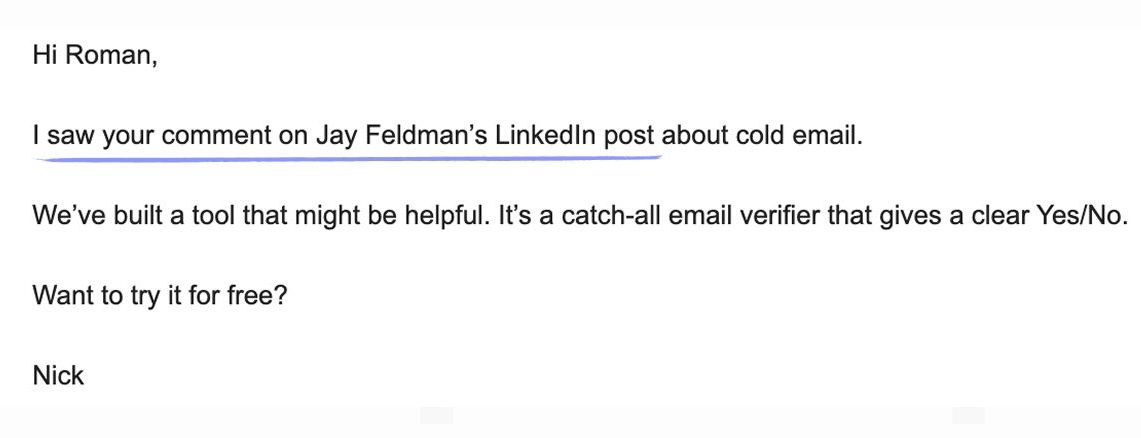
Sales professionals catch buying signals using automated intent-tracking systems, which enable them to react quickly by triggering relevant, personalized emails through sales outreach tools.
But reacting to buying signals won’t necessarily bring you replies. Much depends on your understanding of what makes prospects react to your cold emails.
Sopro analyzed 650,000 prospecting emails and found the psychological biases behind high and low response rates. Here’s a quick overview of the findings with examples.
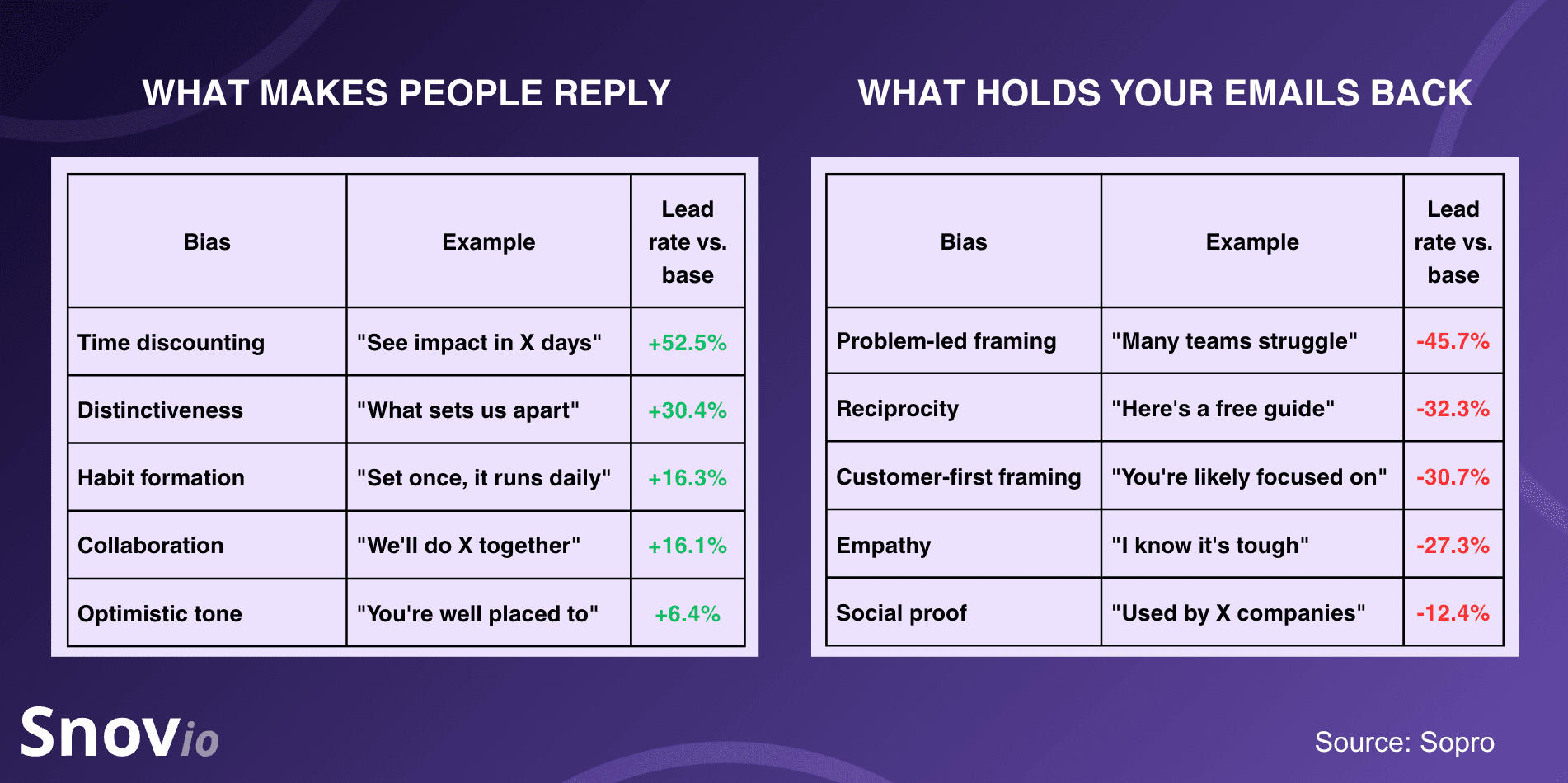
Surprisingly, problem-led framing and social proof fail to convert leads, while near-term time indicators (e.g., “in a week” or “within days”) perform the best.
As you can see, adjusting your cold email campaigns to current buyer behavior trends is another important strategy for boosting your sales outreach.
Run automated drip email campaigns
Automated drip campaigns work because they combine three things that are almost impossible to maintain manually – consistency, timing, and relevance at scale. Instead of sending one-off emails and hoping for a reply, you build a structured sequence that keeps you visible in a prospect’s inbox without constant manual effort.
Just keep in mind that, in automation, strategy matters more than volume.
I recommend sending one initial email and one follow-up after that. In my experience, this keeps you on a prospect’s radar without coming across as pushy.
Outbount Outreach Expert at Snov.io

The expert shares the following recommendations:
- Give prospects time to process your message – a 2–3 day gap between emails tends to perform best.
- Keep your sequence focused – 2–3 follow-ups are usually enough to stay on the radar without creating fatigue.
- Each email should add value or a new angle—not just repeat the same ask.
When executed with the right timing and messaging, automated drip email campaigns consistently outperform manual outreach.

Best practices for cold calling
Despite recurring claims that cold calling is “dead,” it remains one of the main channels for sales outreach, especially in B2B. Yet, cold calling tactics have changed dramatically. Cognism’s research findings illustrate this shift perfectly well.
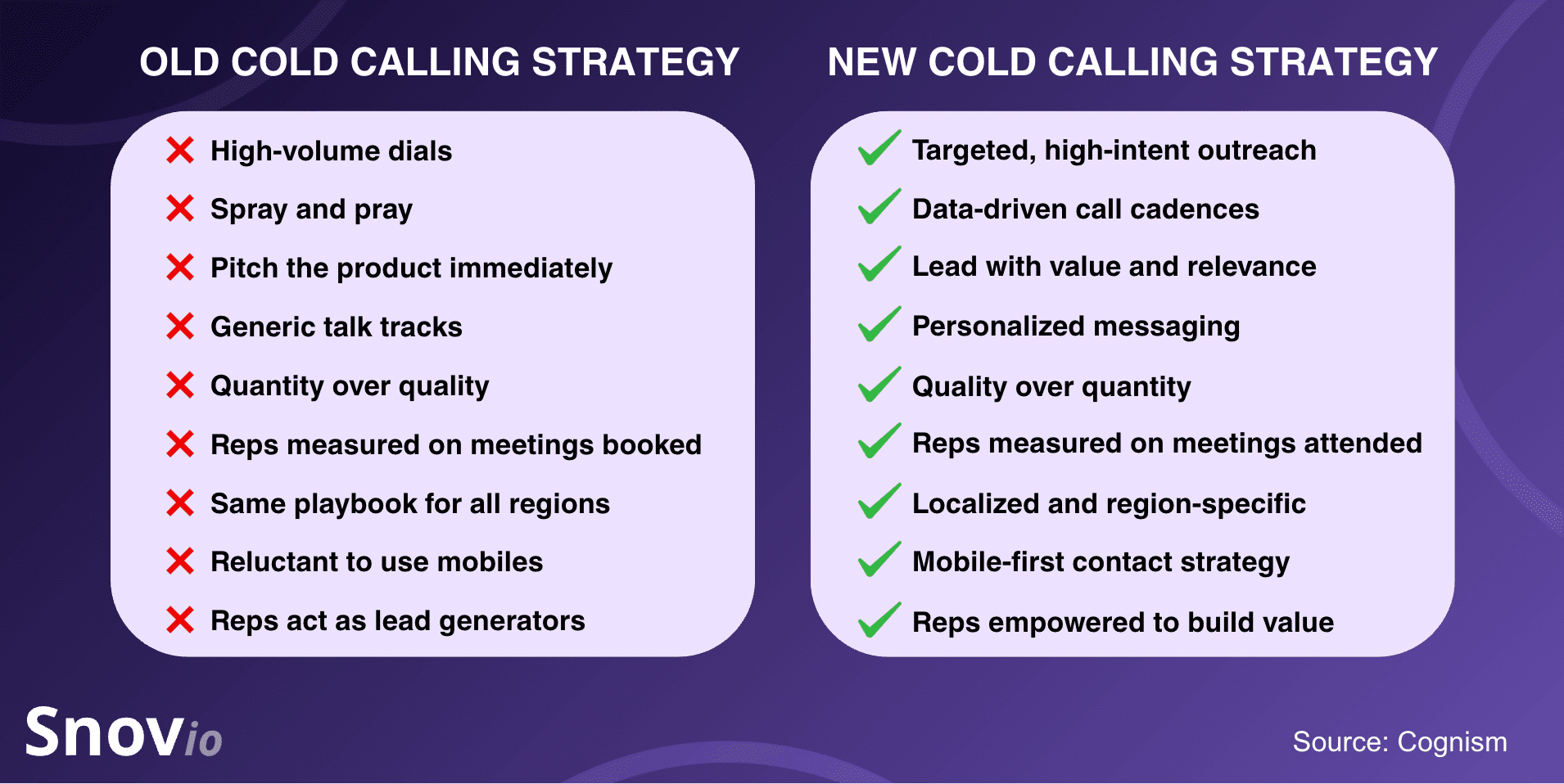
It used to be a numbers game: more calls = more chances. Now, what matters is quality: call the right person, at the right time, with the right message.
Use a personalized script to connect during the first 30 seconds
In 2026, personalized scripts aren’t just a nice-to-have for your phone calls with prospects. They are the keys to unlocking meaningful customer relationships from the very start, at the prep stage, when you create an ideal customer profile, research pain points, and plan your exact phrases.
70% of my own clients — yes, you read that right — are a result of cold calling. No doubt about it: cold calling is harder than it used to be. But that doesn’t mean it’s not worth the effort.
Founder of The Selling Academy

The first 30 seconds are the most pivotal part of the call. So, experts advise sales reps to add the following three elements to personalize the script during this half a minute:
- A quick intro about yourself and your company — 10 seconds
- A point of mutual connection (e.g., a referral’s name or something you have in common) — 10 seconds
- A note about the reason for your call (mention their specific pain points here) — 10 seconds
Remember to ask open-ended questions and identify this trio of factors in the prospect’s decision-making process: time, money, and impact:
- When do they need a solution?
- What is their budget?
- What metrics do they aim to achieve?
Only afterward, start selling.
Stick to the proper timing of phone calls
A common question young sales professionals ask is ‘What is the best time to cold call?’ According to recent research from LevelUp Leads, the absolute “golden hour” for cold calling is 8 a.m. — 9 a.m. It showed the highest connection rates: at 17-20% across time zones.
These windows yield 2-3x more connections and meetings booked per dial, regardless of the prospect’s industry or other factors.
⚠️Meantime, these are hours when you should never cold call:
❌Before 8 a.m.
❌During lunch hours
❌After 5 p.m — 6 p.m.
❌On weekends
Calling at the right time is one of the key sales outreach strategies that can translate into a “Yes,” a booked meeting, and a closed deal.
Respect your prospects’ privacy and rights to opt out of calls
You’re legally obliged to respect your prospect’s personal contact data (phone numbers) and the right to opt out of calls.
Here are the privacy protection laws sales reps must comply with when cold calling:
- GDPR (EU) → Protects customers’ personal data, including phone numbers
- ePrivacy Directive (EU) → Governs digital communications and unsolicited calls in particular
- Telephone Consumer Protection Act (TCPA, US) → Restricts automatic calls and requires consent for specific sales outreach types.
- Do Not Call (DNC) registries → Lists of people who have opted out of telemarketing calls.
💡Expert tip: Regularly update your DNC list. If you’re using a sales outreach tool for cold calling, ensure it is GDPR-compliant and supports do-not-call lists.


Best practices for LinkedIn outreach
Since LinkedIn is a go-to social media channel for B2B lead generation, I’ve compiled some of the best, tried-and-true LinkedIn outreach techniques for sales leaders recommended by experts.
Warm up before messaging
Just like with an email account, you won’t succeed in LinkedIn outreach if you start pitching out of the blue. You need to literally warm leads up with a sequence of LinkedIn touches, such as:
- View and follow their profiles
- Send a connection request
- Like or comment on their posts
- Endorse their skills, etc.
As a result of these subtle touchpoints, you’ll build trust with a prospect and see which of them are more inclined to convert.
Warm-first beats cold-first. People reply more often when they recognize your name before you message them.
Founder & CEO of Alygent Outreach

To back this statement up: LinkedIn sales outreach campaigns that combine additional touches with direct messages see higher response rates (up to 11.87%) than one-action campaigns.
Write personalized connection requests
There is still debate among sales professionals about whether to add a note when sending a LinkedIn connection request or leave it blank. While some vote for blank requests, others argue that a personalized note is more likely to be accepted by most prospects.
When we switched from 100 generic requests a day to 25 personalized ones, our acceptance rate moved from around 20% to just over 45%.
Founder of Bearconnect

If you want to personalize your connection requests, experts advise you to follow this simple formula:
In your copy, avoid trite phrases like “I’d like to add you to my professional network,” vague flattery, and don’t pitch immediately.
Keep your LinkedIn messages and InMails short
Stats show that shorter InMails get higher reply rates, with <400 characters (up to 100 words) reaching the highest number of responses.
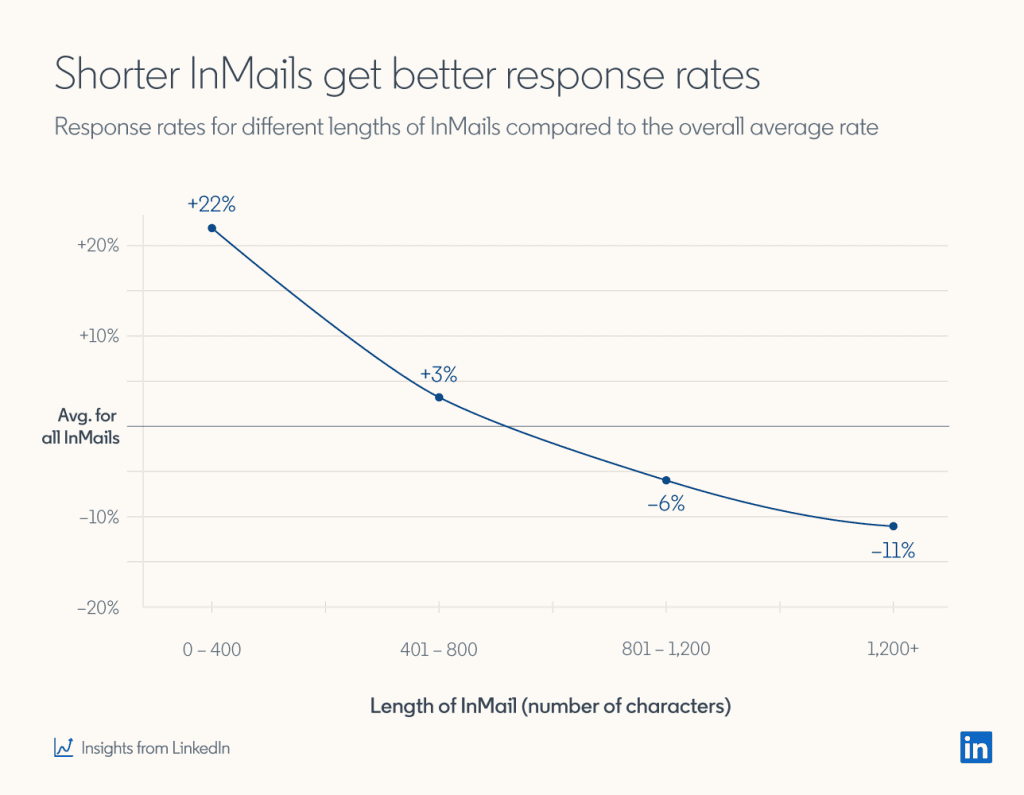
And if you wonder, ‘What’s the ideal LinkedIn message length?’ experts recommend keeping it under 75 words.
💡Bonus tip: Use ChatGPT or other AI tools to help you write LinkedIn messages. Just remember to indicate the character/word limit to receive a short-and-sweet result.
For instance, here’s the one I got after using a ChatGPT prompt.
|
Hi [FirstName], I noticed your SDR team is growing — congrats on the new hires. That usually means scaling outreach efforts and keeping pipelines full. If that’s currently your focus, I’d be happy to share a few ideas that similar sales teams found effective. Open to a quick chat on Wednesday or Thursday? Best, Maryna |
→ Learn how to create effective ChatGPT prompts for LinkedIn outreach from this post.
Ensure your LinkedIn automation is safe
As you scale your LinkedIn outreach, you’ll resort to automating all LinkedIn touches, which is an absolutely clever idea. Yet, you should keep in mind that overdoing automation may result in account restrictions or permanent bans.
To avoid this scenario, plan your daily actions so they align with LinkedIn’s daily limits. Snov.io outreach experts recommend sticking to the following activity limitations based on your SSI score:
In addition, always rely on cloud-based software that supports safe automation practices. For example, solutions like Snov.io LinkedIn Automation Tool offer built-in location-specific proxies, mimicking human behavior through personalized daily limits, and providing dedicated IP addresses to avoid triggering LinkedIn’s security algorithms.
Top 5 multichannel sales outreach tools (based on my experience)
Based on manual testing, feature-to-feature benchmarking, the number of channels covered, value-for-money fit, and G2 user rating, I’ve compiled the following table of my top five picks.
*As prices may change over time, I recommend checking the platforms’ websites for the latest updates.
Below are short takes on what I specifically liked and disliked about each of these sales outreach tools for multichannel campaigns.
Snov.io
Snov.io is a lead generation and outreach automation platform that helps sales teams build, send, and automate multichannel campaigns (email+LinkedIn).
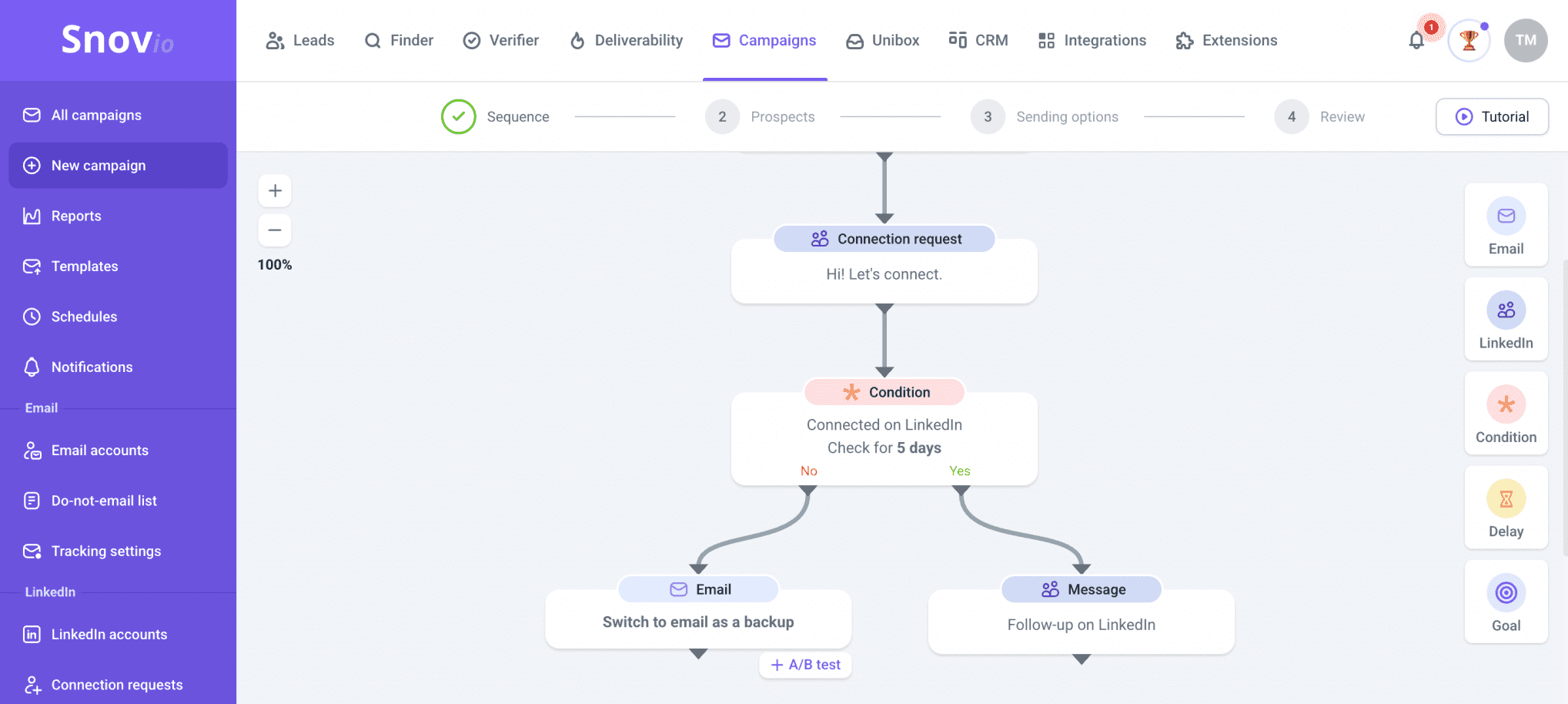
👍What I like: Drag-and-drop campaign builder with delays and conditions that trigger automated emails + LinkedIn touches; hyper-personalized messaging with AI; Unibox to consolidate all communications with prospects; native CRM with the pipeline generation feature; a user-friendly UI with a pleasant color scheme.
What’s more, within Snov.io’s platform, you can track deliverability, bounces, clicks, opens, and even reply interest levels based on three sentiments: Interested, Maybe, and Not Interested. Plus, it lets you A/B test and optimize your sales outreach campaigns on the fly.
👎What I dislike: LinkedIn automation is an add-on that should be purchased separately. On the other hand, you can buy the slot even on a free plan, which lets you save costs.
Snov.io helps us build and test campaigns with multichannel sequences and personalized copy. […] I chose Snov.io because it offers everything I need in one platform, from lead lists and ICP targeting to smart sequences that can be adapted based on recipients’ responses. Plus, the built-in CRM is an excellent option, especially if you don’t have the budget for a separate system.
Head of Sales at Zenit

Apollo.io
Apollo.io is another multichannel outreach automation tool that helps sales teams run coordinated email and call campaigns from a single platform.
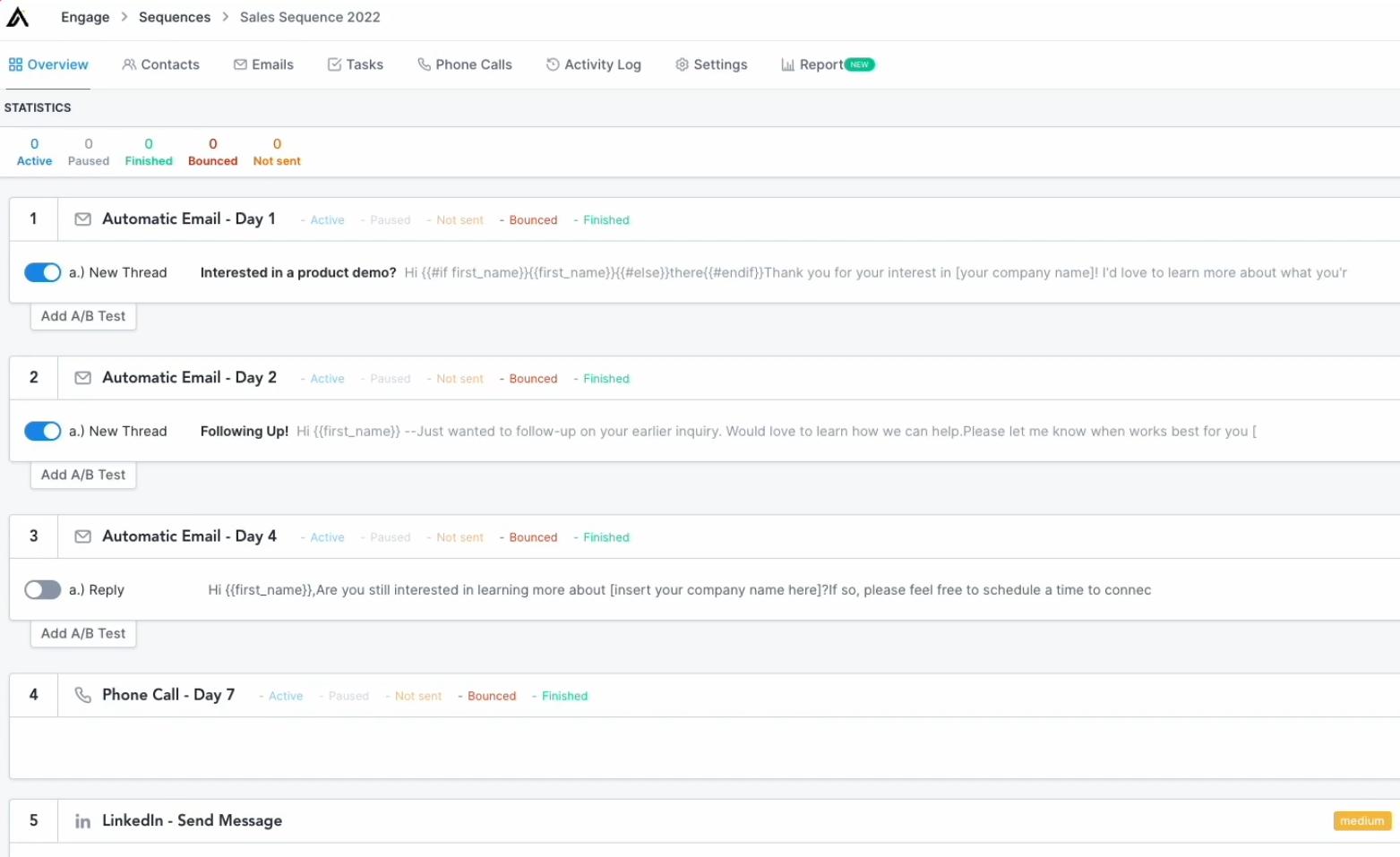
👍What I like: Built-in Dialer for cold calling; AI Assistant; workflow templates.
👎What I dislike: LinkedIn tasks have to be performed manually; native CRM functionality is very limited; the tiny font makes UI elements hard to read.
Klenty
Klenty focuses on structured multichannel outreach, helping teams build step-by-step sequences across email, calls, LinkedIn, and messaging apps while prioritizing cadence control and consistent follow-ups.
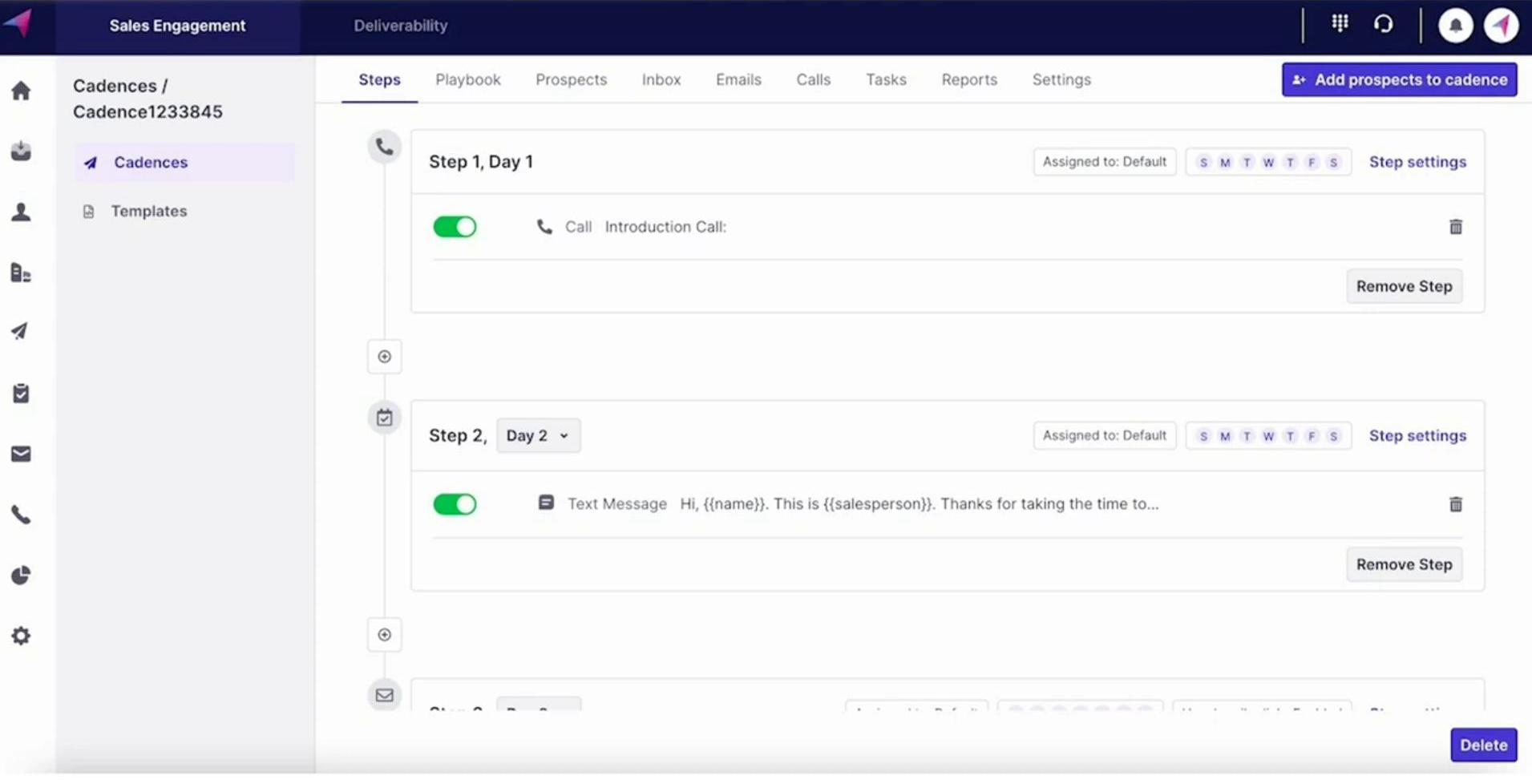
👍What I like: A wide variety of email templates, Rep 360° feature for sales leaders to evaluate SDR’s performance on cold calls; AI-driven user research and agentic cadences.
👎What I dislike: Dialer Suite costs extra; not very intuitive UI; only quarterly or annual subscriptions.
Reply.io
Reply.io allows teams to combine email, LinkedIn, calls, and SMS into coordinated sequences that keep prospect engagement consistent and scalable.
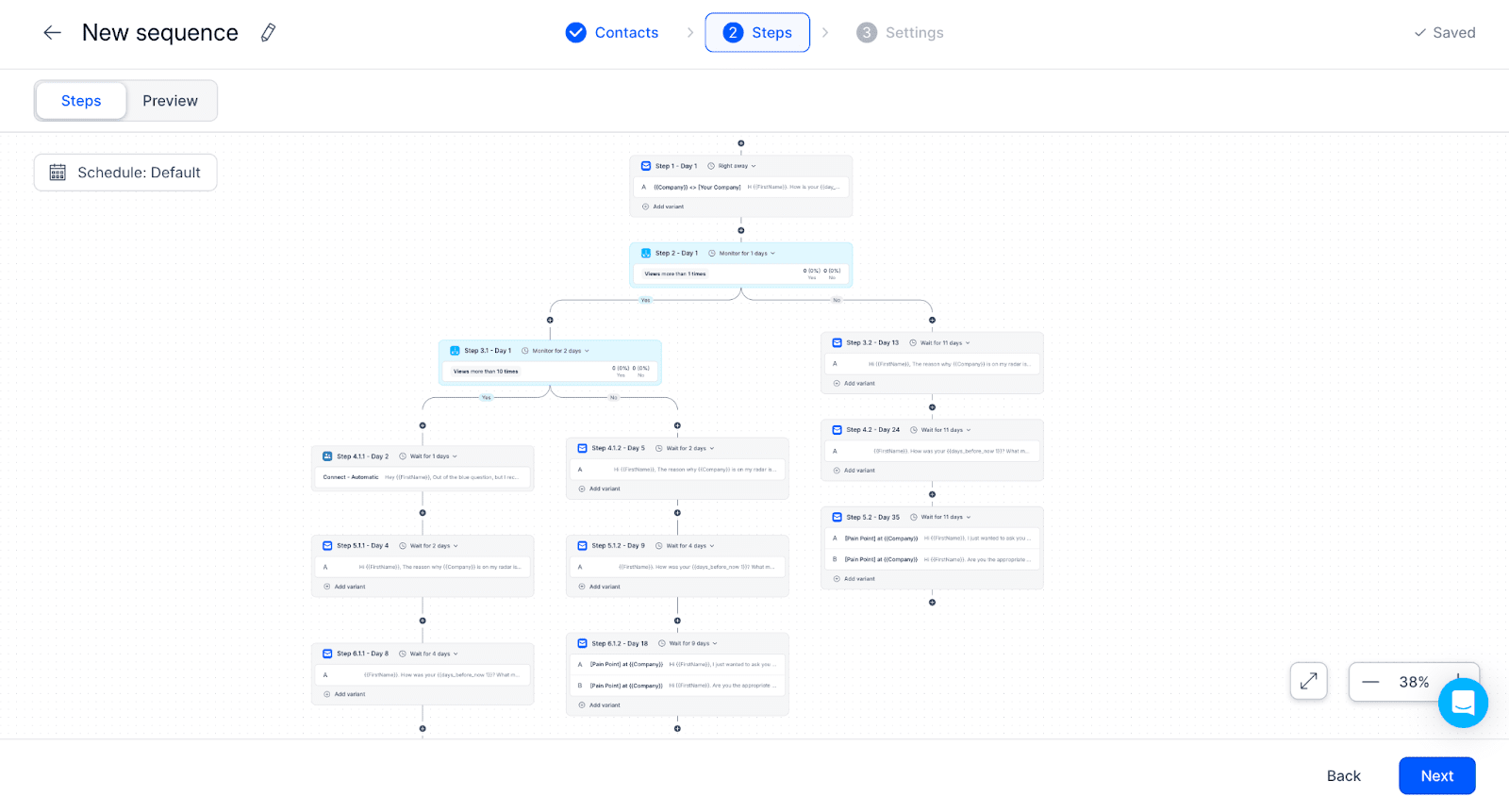
👍What I like: All-encompassing functionality for phone, LinkedIn, SMS, and cold email outreach; unlimited emails; Jason AI SDR Agent; AI response generation.
👎What I dislike: A steeper learning curve than in other sales outreach software; design feels a bit overloaded with too much of everything; LinkedIn, calls, and SMS add-ons cost extra, making it too expensive for smaller sales teams.
La Growth Machine
La Growth Machine helps sales teams design highly personalized sequences across email, LinkedIn, and other channels, ensuring consistent follow-ups and smarter touchpoint timing.
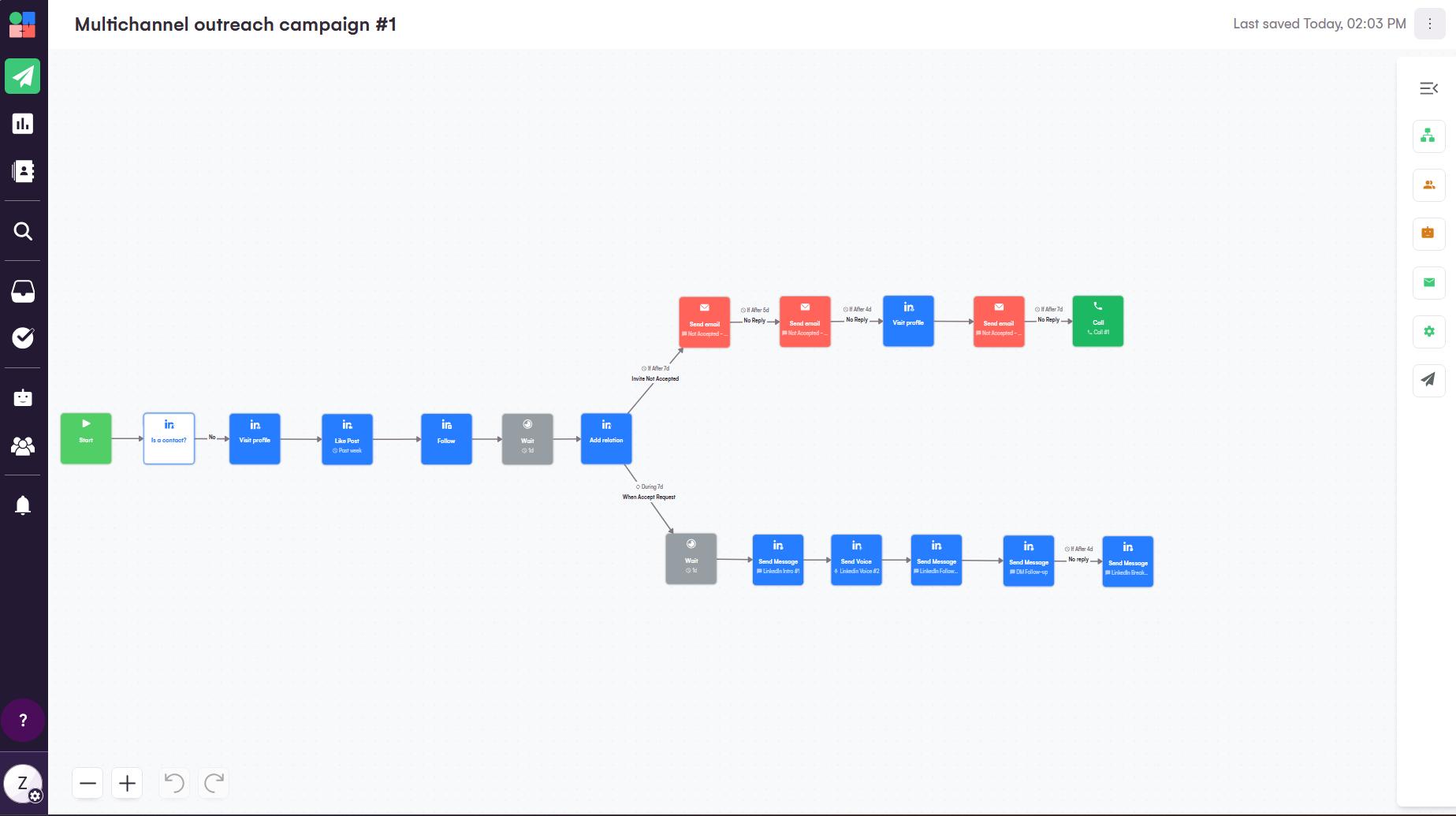
👍What I like: Buying signals from LinkedIn in real time; covering other channels like X (formerly Twitter) for social selling; AI-powered voice messages; AI writing assistant.
👎What I dislike: Calls are available only from the Pro plan ($135) and up. The design looks a bit outdated.
Key takeaways for successful sales outreach in 2026 and beyond
Sales outreach in 2026 has three key drivers: hyper-personalization, relevance, and automation.
Particular tactics that work for different channels:
- Email: Personalized emails (from subject lines to closings); quick reaction to buyer intent and psychological biases; automated email drip campaigns.
- Phone: Personalized scripts (with the first 30 seconds being the most critical); proper timing (the “golden hour” is between 8 a.m and 9 a.m.); respect for prospects’ legal rights.
- LinkedIn: Extra touches to warm up leads before messaging; personalized notes in connection requests; shorter messages (up to 75 words).
Among the best tools for multichannel outreach automation are:
- Snov.io – Best for SMBs and startups, placing a spotlight on LinkedIn + email automation
- Apollo.io – Best for mid-sized companies prioritizing cold calls + emails
- Klenty – Best for sales teams heavily relying on email, phone, and WhatsApp outreach
- Reply.io — Best for large businesses ready to invest more in a quartet of email, LinkedIn, SMS, and calls
- La Growth Machine — Best for scaling teams interested in social media outreach on Twitter (X) + LinkedIn
If you’re primarily focused on the tandem of LinkedIn and email outreach, try Snov.io multichannel campaign automation and enjoy getting more leads and closed deals.