
TL;DR: Is Saleshandy worth it in 2026?
Saleshandy is worth considering if you need a high-volume cold email outreach with inbox rotation, a unified inbox for replies, and built-in deliverability tooling. However, if you want to incorporate LinkedIn outreach into your strategy, Saheshandy won’t cover your needs.
For this scenario, I recommend trying one of the best Saleshandy alternatives – Snov.io. Refer to this table to see a quick comparison of Saleshandy vs Snov.io:
So, in a nutshell, while Saleshandy works fine for cold email outreach, Snov.io offers a much more robust feature set for a similar price. If you want a more in-depth exploration of both tools, read further.

In this post, I analyzed one of the most popular cold-emailing platforms, Saleshandy, to see whether it meets the expectations that today’s B2B teams place on sales engagement tools.
For this Saleshandy review, I looked into the solution’s email sequencing depth, warm-up and sending safeguards, lead sourcing and reporting capabilities, as well as Saleshandy pricing plans. I also cross-checked its feature set against a cheaper Saleshandy alternative, Snov.io, to determine whether the reviewed platform is worth the price.
Outline:
What is Saleshandy?
Saleshandy is a cold email and sales engagement platform designed to help teams find leads, run automated email sequences, rotate sending inboxes, and manage replies from a unified inbox.
The core Saleshandy features are:
- Automated cold email campaigns.
- Email personalization + AI assistance and templates
- Deliverability toolkit with a warm-up and inbox placement test.
- Lead Finder with email and phone number lookup.
- CRM for managing prospects in a Kanban view.
- Powerful integrations with popular CRMs, Google Workspace, and other apps.
I’ll dwell more on the key Saleshandy features in one of the following sections of my review.
Who is Saleshandy best for?
Thanks to the Saleshandy feature set, this solution is a good fit for:
- Lead generation agencies managing multiple client campaigns
- SDR and BDR teams focused primarily on cold email
- Founders and small teams looking for a cost-effective sending and reply-management platform
On the other hand, this platform doesn’t cover the needs of the following types of users:
- Teams that are focused on more channels for cold outreach, not just email.
- need multichannel sequences with LinkedIn and email combined
- Organizations looking for a full lead management system and want to include LinkedIn outreach automation in their strategy, not just email finding.
- Users who want extensive functionality without the need to buy multiple add-ons or connect lots of third-party tools
To help you understand whether this platform is a suitable solution for your team, I tested several core Saleshandy features myself.
My honest Saleshandy review
After analyzing what Saleshandy offers to its users, I’d love to share my firsthand insights on this platform.
To start with, the core strength of this tool is cold email automation. Saleshandy provides two opportunities to streamline your email campaign creation.
You can build your sequence manually or rely on Saleshandy’s AI sequence copilot to build it for you. All you need to do is provide the full description of your business, its offer, target audience, and campaign goals – and the AI assistant will create a sequence for you.
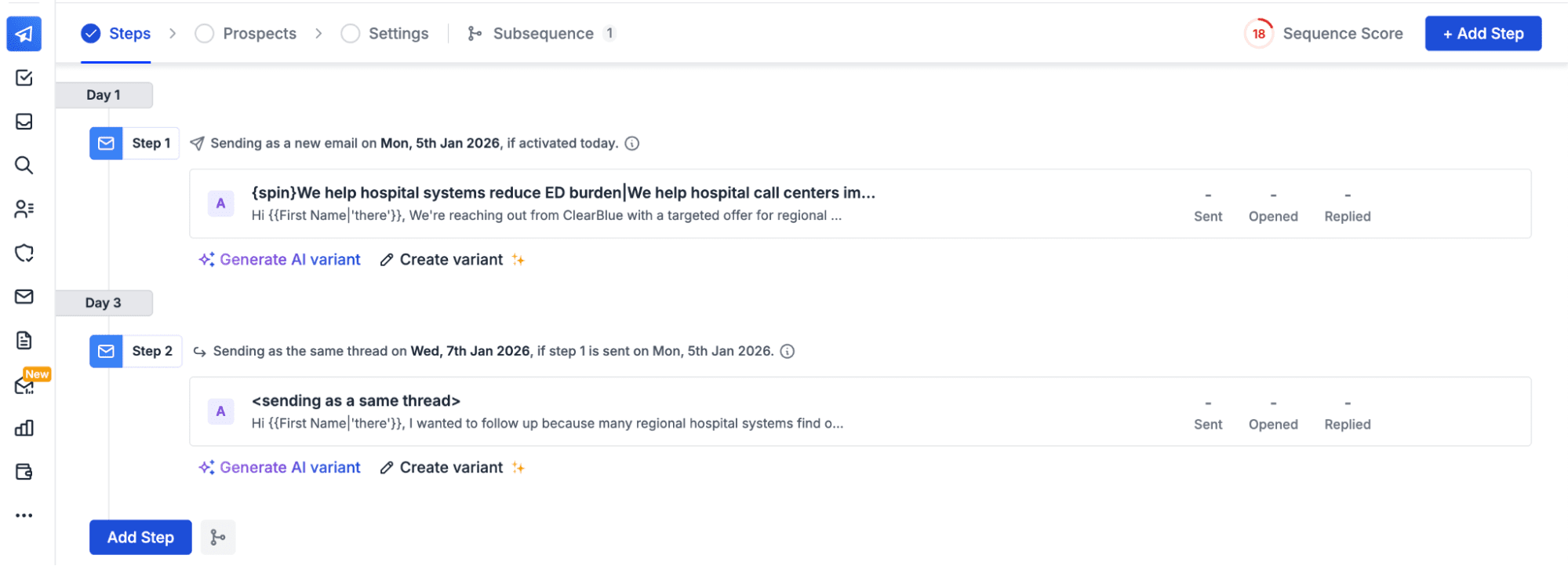
But while this sounds good on paper, in my experience, the result is far from ideal. The AI works well only for a very rough draft. If you want a sequence and a copy that will bring in prospects, you have to build the sequence yourself.
Among other Saleshandy features are email warm-up and deliverability controls. The platform helps you warm up your account, rotate accounts, check spam rate, and improve your overall inbox placement rate.
Plus, the platform helps with email infrastructure setup, so you can get to automated email sending as soon as possible.


Another core Saleshandy feature I find effective is a unified inbox, which centralizes replies across multiple inboxes. It’s especially useful if you’re running many sending accounts or managing replies across teams or clients. But for the unibox to work properly and securely, you’ll still need clear ownership rules and response processes in place.
Last but not least – Saleshandy offers a lead finder with email and phone number lookups, plus real-time email verification, ensuring fresh results.
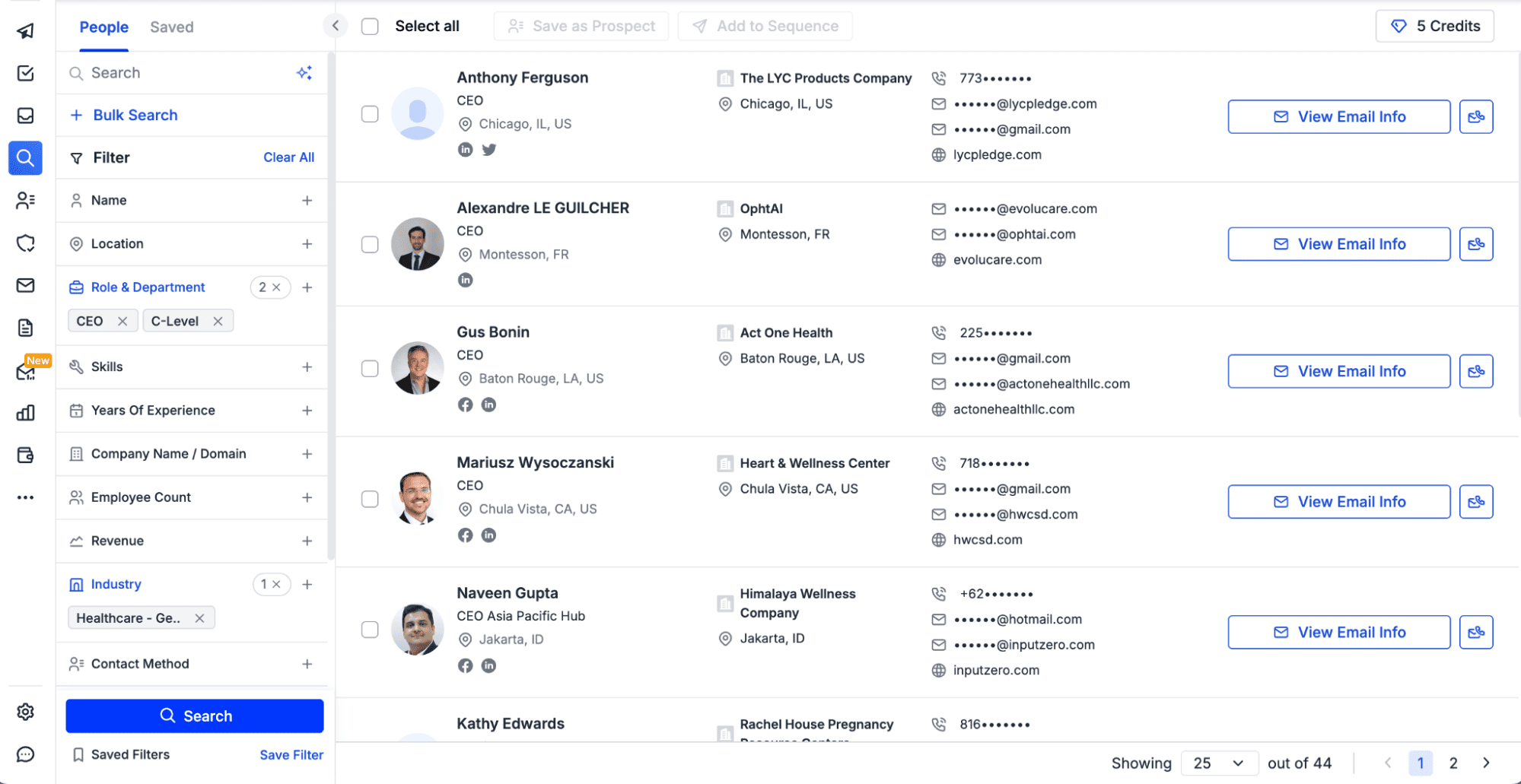
As for the lead discovery process, it worked fine for me. I was able to find relevant prospects from Saleshandy’s vast database and get targeted email addresses from LinkedIn. After double-checking, I could enjoy several valid contacts on my list.
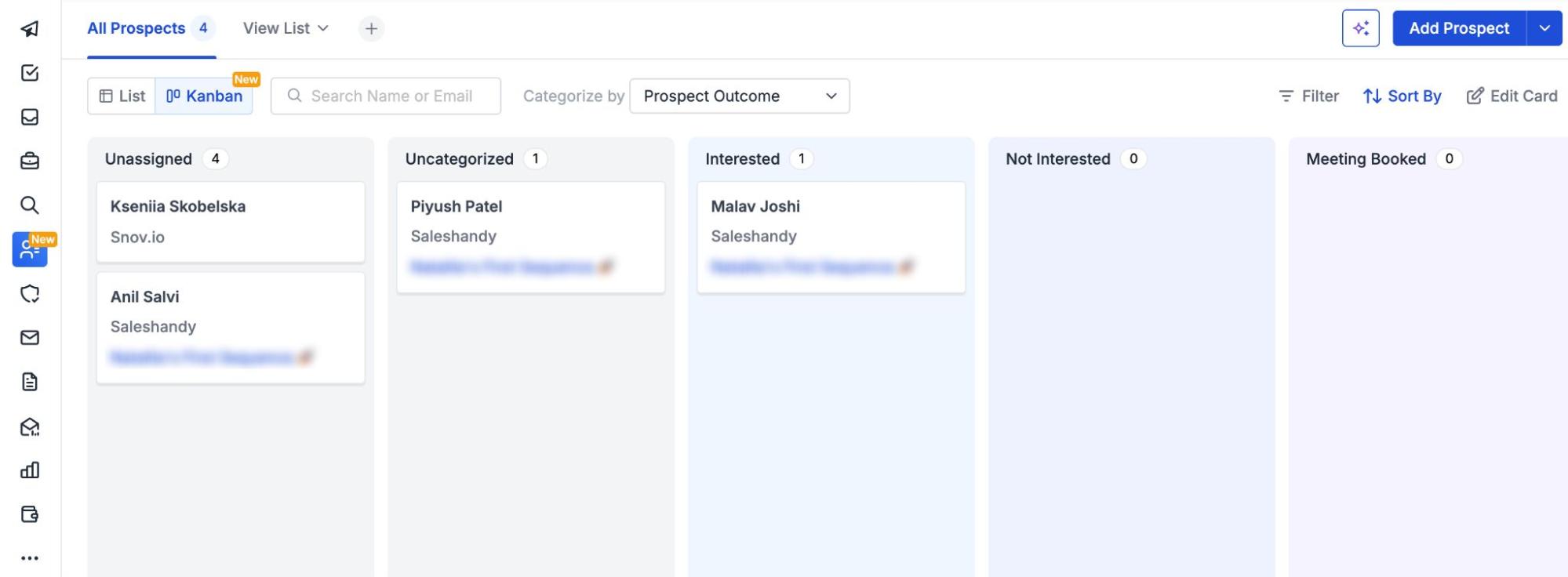
Among the Saleshandy features and tools, I also tested its CRM interface. Needless to say, it feels quite intuitive thanks to the Kanban view.
On the downside, this platform doesn’t offer automated campaigns for other channels besides email. In my opinion, in 2026, it looks more like a limitation, since businesses are trying to capture leads where they’re most active. A multichannel approach, in this case, may increase your chances of contacting targeted prospects.
For example, if we compare Saleshandy vs Snov.io, with Saleshandy, I have to make first contact, engage, and warm up my lead via email only. So, if my first email bounces or goes to spam, I’ve already likely lost this lead.
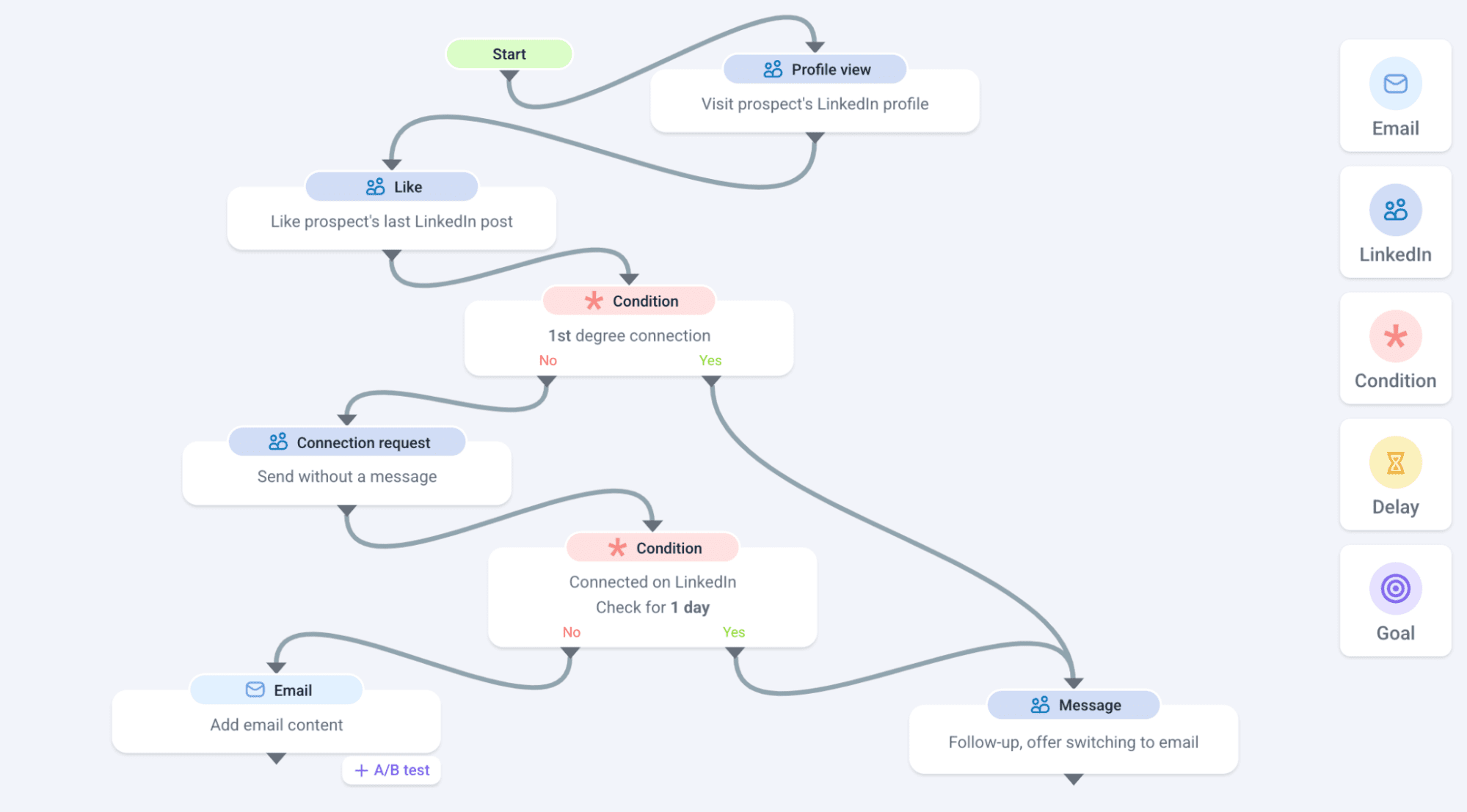
Meanwhile, with Snov.io, I can warm up my contacts via LinkedIn and continue conversations via email.
That said, the platform also lacks an essential feature for B2B sales teams – lead enrichment, which you may find in the Saleshandy alternatives. For instance, while using Snov.io for lead generation, you can benefit from a powerful Clay + Snov.io integration to expand your knowledge about your prospects.
💡Find out how to get the most out of Clay and Snov.io integration and start building your perfect sales stack:
Saleshandy review from other users
Saleshandy reviews are consistently positive on major review platforms. In particular, on G2, Saleshandy has a solid 4.6/5-star rating.
Users are mostly satisfied with the tool’s core functionality and customer support.
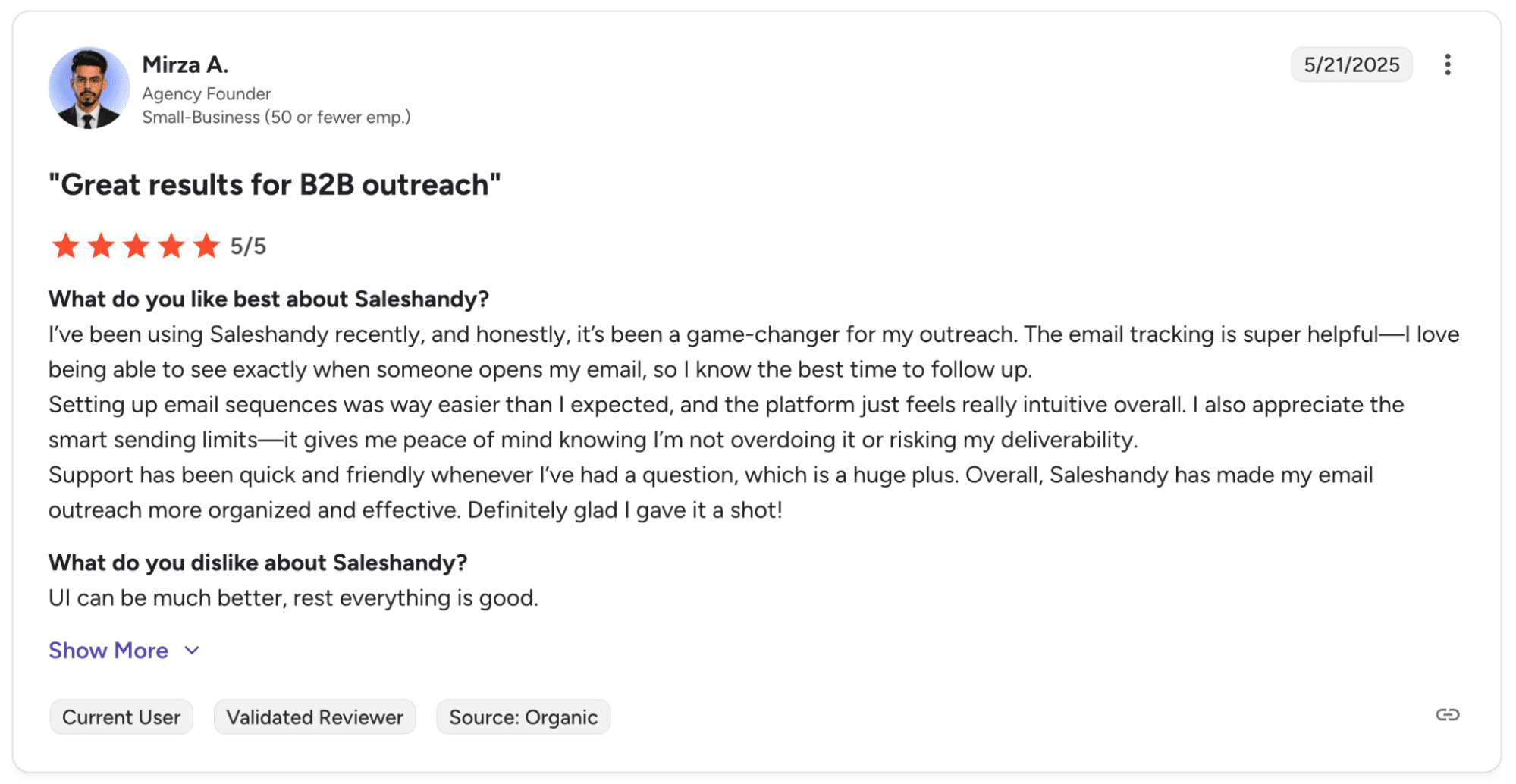
Naturally, users who focus all their efforts on cold email find that the tool helps them meet their goals.
Some, by contrast, point out the same Saleshandy’s limitations I encountered – lack of native CRM integrations, steep learning curve, and restricted testing capabilities.
Others have noticed problems I haven’t personally witnessed, but they definitely have to be taken into account. It seems the platform has issues with Outlook inboxes, so be prepared to do some tinkering if you use Outlook.
Overall, the general sentiment is positive towards the platform’s value for money and ability to save time on high-volume email outreach. Common complaints include the interface’s complexity, deliverability issues, and constraints that may arise as workflows expand beyond email.
Saleshandy pricing breakdown
Saleshandy pricing varies based on sales needs. The types of plans include those focused on cold emailing and B2B lead generation.
- The Outreach Starter plan covers entry-level sending and automation, and costs $36 per month.
- The Outreach Pro plan covers higher sending limits, more inboxes, and added AI credits, and costs $99 per month.
- The Lead plans cover email and phone discovery and vary by the number of prospects that can be processed. They start from $59 per month.
- Users can also buy additional email accounts for $4 per account per month and additional domains for $14 per year.
Needless to say, Saleshandy pricing is lower with annual billing; plus, prices increase as sender rotation and prospect limits expand. Moreover, this platform offers a 7-day free trial for users to test its features.
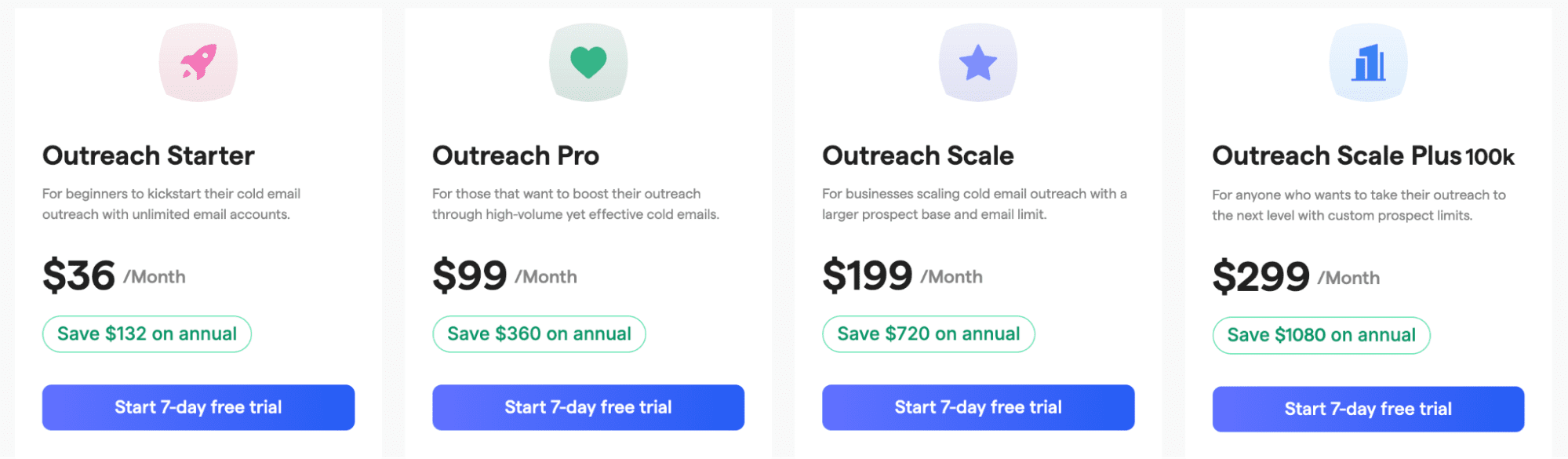
While the tool seems adequately priced, you should consider hidden costs before buying. Not direct fees, but operational costs can appear as the usage grows:
- Additional Lead Finder or verification credits
- Inbox placement testing beyond the included limits
- Domain and inbox management for deliverability
Plus, if you want to include more than just email in your outreach strategy, or manage deals in the CRM, you’ll need to add the costs of third-party tools to the equation.
Saleshandy pros and cons
Based on my analysis, I can name the following pros and cons of this platform:

Saleshandy’s key benefits are:
- Strong cold email sending setup suitable for large volumes. Saleshandy includes unlimited email accounts with sender rotation limits that scale by tier, starting with its entry plan.
- Unified inbox for reply handling. This tool provides a centralized view of conversations across connected accounts, so you don’t need to switch among accounts.
- A variety of deliverability tools. Warm-up is included in the lowest tier, plus inbox placement testing is available on higher tiers.
- “Build-you-bundle” positioning. Saleshandy allows users to configure its feature set based on their specific outreach goals.
All these benefits make this platform really effective for B2B sales teams that need to send many cold emails without compromising their sender reputation.
Saleshandy’s key limitations are:
- Email-first focus limits reach. Saleshandy features are focused on cold email execution. So, if you want LinkedIn or another social network to step inside the same automation flow, you’ll need a separate system.
- Credits-based add-ons can complicate forecasting. Lead Finder, AI credits, and email verification are bundled as limited-credit offerings, which can lead to unpredictable costs at scale.
- The complex interface can slow down your team’s onboarding. With such a convoluted interface, 7 days of a trial period may not be enough for users to understand how to properly reach leads.
Given these drawbacks, it’s fair to ask whether there’s a stronger alternative. In my next chapter, I’ll break down the most competitive one.
What is the best Saleshandy alternative in 2026?
Well, there are many similar options on the market. But if you’re looking for the most cost-effective Saleshandy alternatives, you should consider Snov.io. This lead generation and outreach automation platform provides a unified toolset that covers sales from the first lead to the final handshake.
When comparing Saleshandy vs Snov.io, Snov.io offers more functionality at the same price.
Let’s see how it works, depending on a use case:
- Cold email is your primary outbound channel
Saleshandy is a strong fit when email is the core of your outbound motion. Meaning your team sends large volumes of cold emails every day, relies on multi-step email sequences, and measures success mainly through reply rates and meetings booked from email.
That is – if you already have clean lead lists or source data elsewhere and simply need a reliable system to send, rotate inboxes, and manage replies efficiently.
Meanwhile, Snov.io can offer robust multi-step email-building capabilities, AI email builder functionality, in-depth email campaign analytics, PLUS lead discovery and enrichment included in a single pricing tier.
Given that Snov.io and Saleshandy pricing plans for basic usage look similar, Snov.io appears to be a more cost-effective option.
- You need sender rotation and reply management at scale
If you operate dozens or even hundreds of sending inboxes, Saleshandy’s sender rotation and unified inbox become major advantages. Instead of logging into multiple mailboxes, your team can monitor replies in one place, assign conversations, and keep follow-ups consistent.
At the same time, outbound teams that prioritize volume and structured sales pipeline visibility will benefit from Snov.io’s Unibox, Sentiment analysis capabilities, PLUS a built-in CRM, which not only tracks conversations, but also lead+deal activity, providing a more complete sales engagement workflow.
- You run agency-style outreach operations
Saleshandy works well for agencies handling multiple client campaigns in parallel. If your agency already has established lead sources and focuses on execution, reporting, and reply handling rather than prospect research, Saleshandy can serve as a scalable email-sending backbone.
But with Snov.io, you’re getting strong team collaboration features, prospect research, deal management, PLUS multichannel campaigns. If your outreach strategy combines email with LinkedIn actions, such as profile views, connection requests, and follow-ups, Snov.io’s Multichannel Outreach Tool allows you to orchestrate these touchpoints within one campaign.
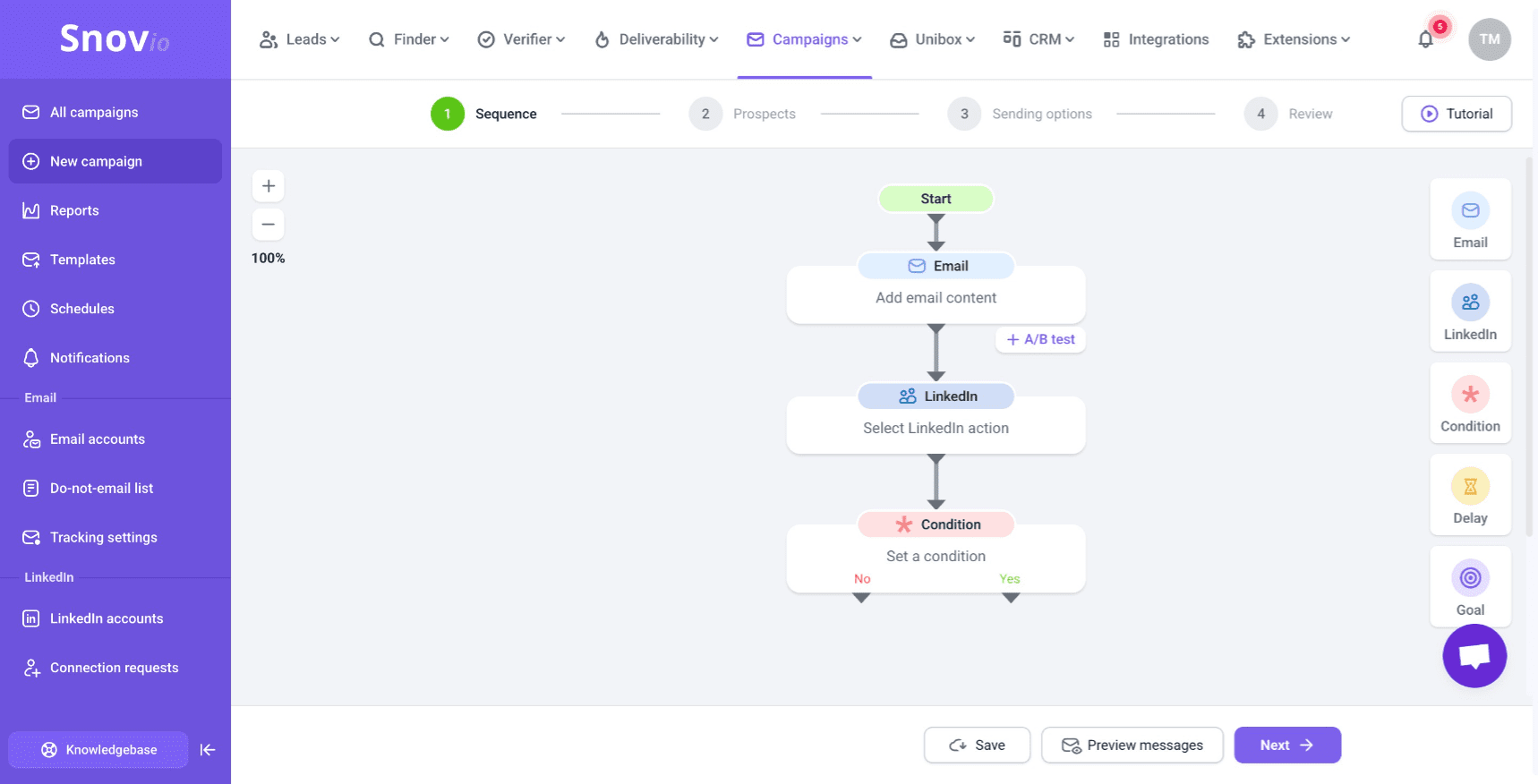
So, if you compare Saleshandy vs Snov.io in terms of outreach opportunities, Snov.io offers more. With this tool, you don’t rely on email alone; you can engage prospects where they are most responsive. With Saleshandy, you’re bound to a single channel, which is not ideal for the 2026 market landscape.

Should you choose Saleshandy in 2026?
After testing the platform for this Saleshandy review, I can confidently say you can use this tool for cold email scaling and agency workflows. Its main strength is that it allows users to build highly intricate and versatile email sequences. Its major limitation, however, is the lack of native multichannel automation, lead enrichment, and CRM capabilities.
If the tool’s feature set isn’t enough for your needs, consider Snov.io – one of the best Saleshandy alternatives in 2026. Unlike Saleshandy’s pricing plans, Snov.io tiers include all lead generation plus outreach automation tools under one roof, making this platform a cost-effective solution for your sales process.