At first glance, email verification looks innocent. But then the 4 letters — GDPR, or General Data Protection Regulation — change everything. In fact, non-compliance can drag you into hefty fines of up to €20 million or 4% of your global annual revenue (whichever is higher).
This guide will help you stay on the lawful side: from choosing the right tools to executing a GDPR-compliant email verification workflow with them.
Disclaimer: I’m not a lawyer, and this article is for informational purposes only and isn’t legal advice. Also, besides GDPR, country-specific laws apply, so contact your data protection officer or a qualified lawyer for a comprehensive legal consultation.
TL;DR: Your GDPR-compliant email verification checklist
To save you some time, I’ve rounded up the whole article into a tick-it-off checklist. GDPR fines can hit €20M, so here’s a 1-minute version of how to stay safe.
| Stage | What to do |
|---|---|
| Before you begin | • Treat all emails as personal data and document where each address comes from • Define your legitimate interest as a legal basis • Apply the data minimization principle (minimize it to emails only) |
| When you verify | • Pick a compliant tool by checking the Data Processing Agreement, retention period, security measures, sub-processors, and international data transfers • Review the verification results and decide what to delete and keep • Create a re-verification schedule for regular list cleaning |
| After verification (GDPR compliance for outreach) | • For cold emails: Tell people where you got their email addresses • For marketing emails: Get valid consent and use double opt-in • For all emails: Make opt-outs easy and honor people’s right to object from any communication channel |
Want to verify emails right away with GDPR compliance in mind?

Format
Type
Server status
Auto-generated
Catch-all
Is email verification GDPR-compliant?
Yes, it can absolutely comply with GDPR standards. GDPR doesn’t prohibit email verification itself, but it focuses on how you handle someone’s personal data in the meantime.
It mainly depends on:
- Where and how you collected email addresses
- Whether you have a lawful basis for personal data handling
- How many other details you share
- Whether you’re using a GDPR-compliant service or tool
- How long the email addresses are stored
- And other decisive factors that either ensure compliance or get you disqualified from the legal field
General Data Protection Regulation (GDPR) is a data privacy and security law enacted and imposed by the European Union (EU). However, GDPR applies even if your business is based elsewhere and you want to verify emails of EU residents (not necessarily EU citizens).
Why verification counts as data processing in the first place
Under GDPR Article 4(2), personal data processing covers any operation performed on personal data, whether automated or manual. This includes collecting, storing, structuring, consulting, using, disclosing by transmission, erasing, etc.
How does email verification fit into this definition, you ask?
When you verify an email address, you actually perform several of these operations at once:
- When you enter one address or upload an email list to a verification service provider in bulk → That’s disclosure by transmission (in this case, you’re the data controller, and the verifier is the data processor)
- When you run SMTP email validation and query the recipient’s mail server → That’s use, which actually reveals (discloses) the address to that server’s operator
- When you check syntax, the domain, and MX records → That’s both consultation and use
- When you categorize emails as valid, invalid, risky, or others → That’s recording and structuring
- When you remove invalid email addresses from the verified list to clean it up → That’s erasure
There’s no “too-small-to-count” exception. Even a single millisecond operation counts as data processing if it involves personal data. However, not all email addresses qualify as such.
Which email addresses are personal data under GDPR
The quickest way to tell is by checking whether the address relates to an identifiable living person. If it does, it unmistakably falls under GDPR requirements. But even if it seems unrelated to anyone, the answer may not be as straightforward.
In the table below, compare the types of emails that may be counted as personal information and regulated by GDPR, depending on context.
| Address type | Example | Is it personal data? | Explanation |
|---|---|---|---|
| Personal addresses (with names, initials, pseudonyms, numbers, etc.) | anna.schmidt87@gmail.com or licorne2000@laposte.net | ✅ Yes | Identifies an individual directly. |
| Employees’ work emails | a.dubois@company.fr | ✅ Yes | Directly identifies a person. A B2B context doesn’t change this. |
| Role-tied business addresses | ceo@company.pl | ✅ Yes | Points to someone holding a specific role. |
| Generic corporate addresses | support@company.cz | ❌ Usually no, but context-dependent | Relates to a brand, not a person, in most cases. |
| Disposable or temporary addresses | y7u8@trashmail.de | ✅ Yes | May still belong to an identifiable person, even if used temporarily. |
| Non-existent or fake addresses | test@nietbestaand.nl | ❌ No | Relates to no living person. |
| Addresses of deceased people | — | ❌ Usually no, but country-dependent | GDPR Recital 27 excludes deceased people, though national laws may apply (e.g., in France or Italy, where heirs and others may exercise certain rights concerning the deceased). |
For example:
The same address can be company data in one context and personal data in another. Take info@company.dk shared by a large support team in Denmark. It’s corporate data. But owned by one person? It becomes personal.
That’s why it’s safer to treat both business and personal email addresses as personal data when verifying them. Doing so helps you stay compliant with GDPR standards.


What verification can and can’t do for GDPR email compliance
A verification process primarily checks technical signals to ensure addresses are valid (read how email validation works), boosting data quality. Despite that, it doesn’t help you tackle other legal problems upstream or downstream.
To better understand what to expect from email verification, consider what it can and can’t do.
| What GDPR email verification can do | What GDPR email verification can’t do |
|---|---|
|
✔️ Check mailbox existence, MX records, syntax, and other technical validity signals
✔️ Remove invalid email addresses with typos or fake addresses
✔️ Regularly clean your lead list and help you maintain data hygiene
✔️ Reduce bounce rates and protect your sender reputation
✔️ Overall, support the data accuracy principle (GDPR Article 5(1)(d))
|
➖ Make an illegally sourced or purchased list lawful
➖ Create a legal basis for collecting people’s contact info and reaching out to them
➖ Comply with other regulations like the ePrivacy Directive or national email marketing laws (e.g., Electronic Communications Law in Poland or Marketing Practices Act in Sweden)
➖ Prove that someone agreed to receive your cold or marketing emails
➖ Guarantee 100% accuracy (e.g., unknown results)
|
For example:
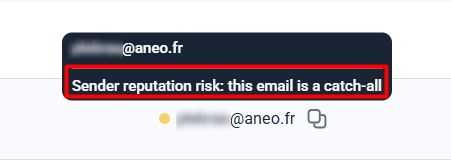
GDPR-compliant email verification services or tools may help you flag catch-all emails as “risky,” exposing you to sender reputation risk (e.g., it can be a spam trap that accepts all mail). In this situation, Snov.io’s Email Verifier warns you about “Sender reputation risk” when it identifies an address as a catch-all.
How to choose GDPR-compliant email verification tools
I’ve put together a checklist of questions to ask email verification providers, based on key GDPR principles and corresponding articles.
| Aspect | What to ask a provider |
|---|---|
| DPA (and possible data reuse) | Is a DPA available? What are the clauses? Will uploaded addresses be used for other purposes like databases or analytics? |
| Data retention | How long are uploaded emails and results kept on your platform? Can I delete them on demand? |
| Data protection | What technical and organizational measures do you implement for data security? What is the incident notification process in case of a data breach? |
| Sub-processors | Who processes the data? Do you use sub-processors? |
| International data transfers | Is your information transferred internationally? What transfer mechanism is used? |
Let’s go through each one in detail.
Data Processing Agreement
GDPR Article: 28 (Processor)
Definition: A GDPR Data Processing Agreement (DPA) is a legally required contract between a data controller (the party that decides why and how personal data is processed) and a data processor (a third party that processes the data on the controller’s behalf).
How to approach it:
Your email validation service provider usually becomes a data processor when it verifies addresses on your behalf and under your instructions. GDPR requires a DPA for that relationship. So, make sure the provider offers one to guarantee GDPR compliance.
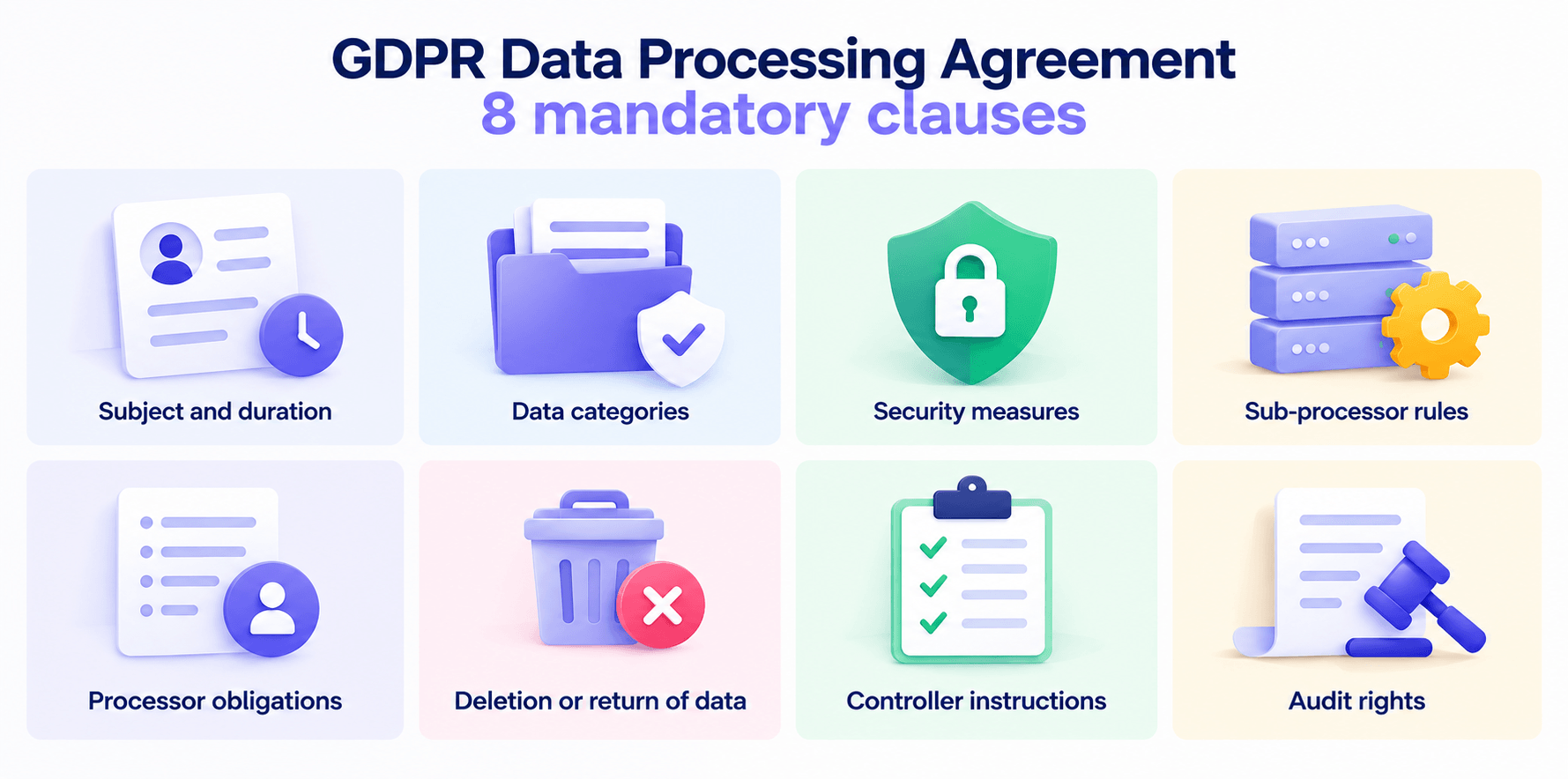
A solid DPA document should cover the following mandatory clauses:
- Subject and duration
- Data categories
- Processor obligations
- Controller instructions
- Security measures
- Sub-processor rules
- Deletion or return of data
- Audit rights
DPAs are not just a formality — they’re a compliance backbone under the GDPR. They protect both parties, ensure transparency, and demonstrate accountability in how personal data is handled. If your organization shares personal data with a third party for processing, make sure you have a well-drafted DPA in place.
Advocate at JK Attorney’s

You usually don’t need to sign a separate agreement with a GDPR-compliant email verification provider. The DPA is often part of their Terms of Service, which you accept when creating an account.
Watch out for providers that use your uploaded email addresses for their own purposes, such as growing their databases. In this case, they may become data controllers or joint controllers, which can change your GDPR obligations. Always check how the provider uses your data.
→ Read more about who is who during personal data processing: data controller, joint controller, and processor.
Data retention policy
GDPR Articles: Art. 5(1)(e) (storage limitation); Art. 28(3)(g) (deletion or return of data); Art. 17 (right to erasure)
Definition: A data retention policy determines how long a provider stores the data and what happens to it afterward. Under GDPR Article 5(1)(e) specifically, personal data must be retained no longer than it’s necessary for the purpose it was processed for.
How to approach it:
- Double-check that the DPA obliges your provider to delete or return all data at the end of the service, after all the emails are verified
- Clarify whether you can ask for on-demand deletion yourself and how such erasure requests are handled
- Make sure the provider clearly specifies the retention period (e.g., “validation results will be deleted within X days from the upload”)
With Snov.io Email Verifier, for example, the results are cleared from the bulk verification page 30 days after the upload.
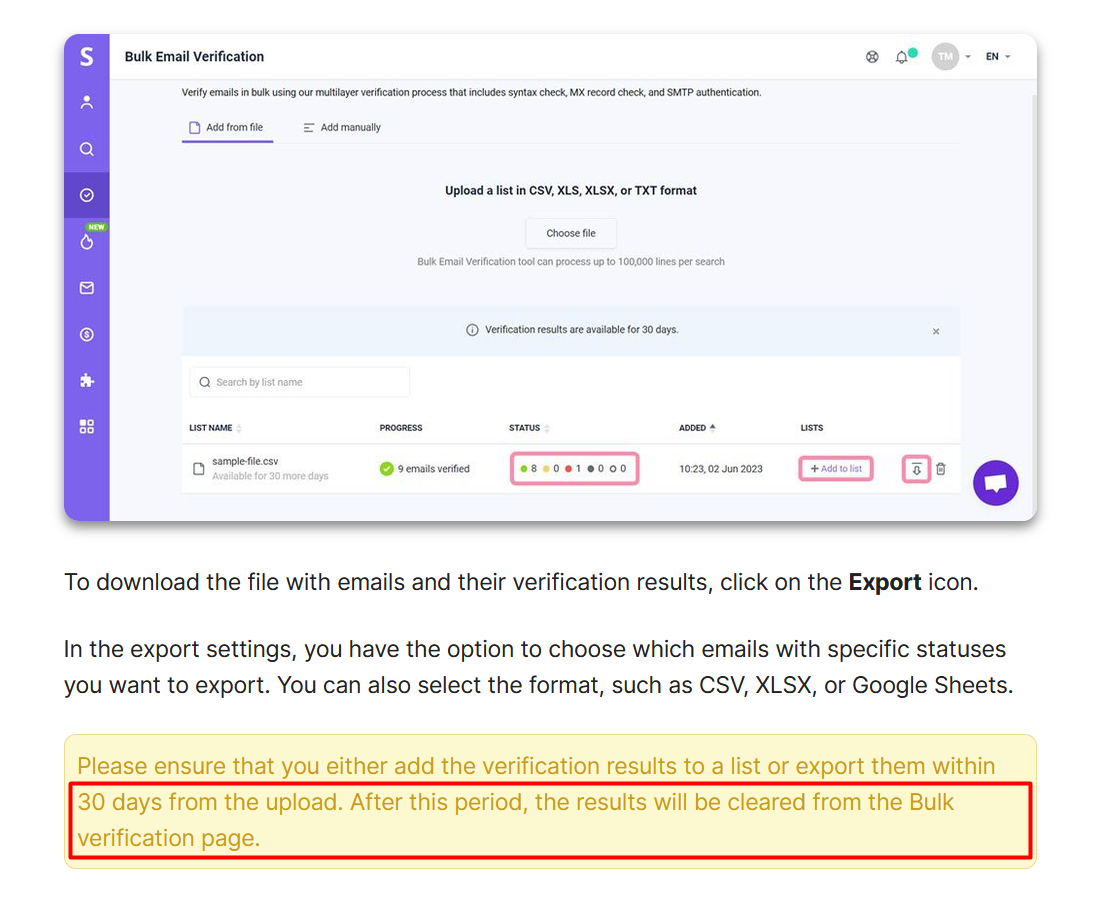
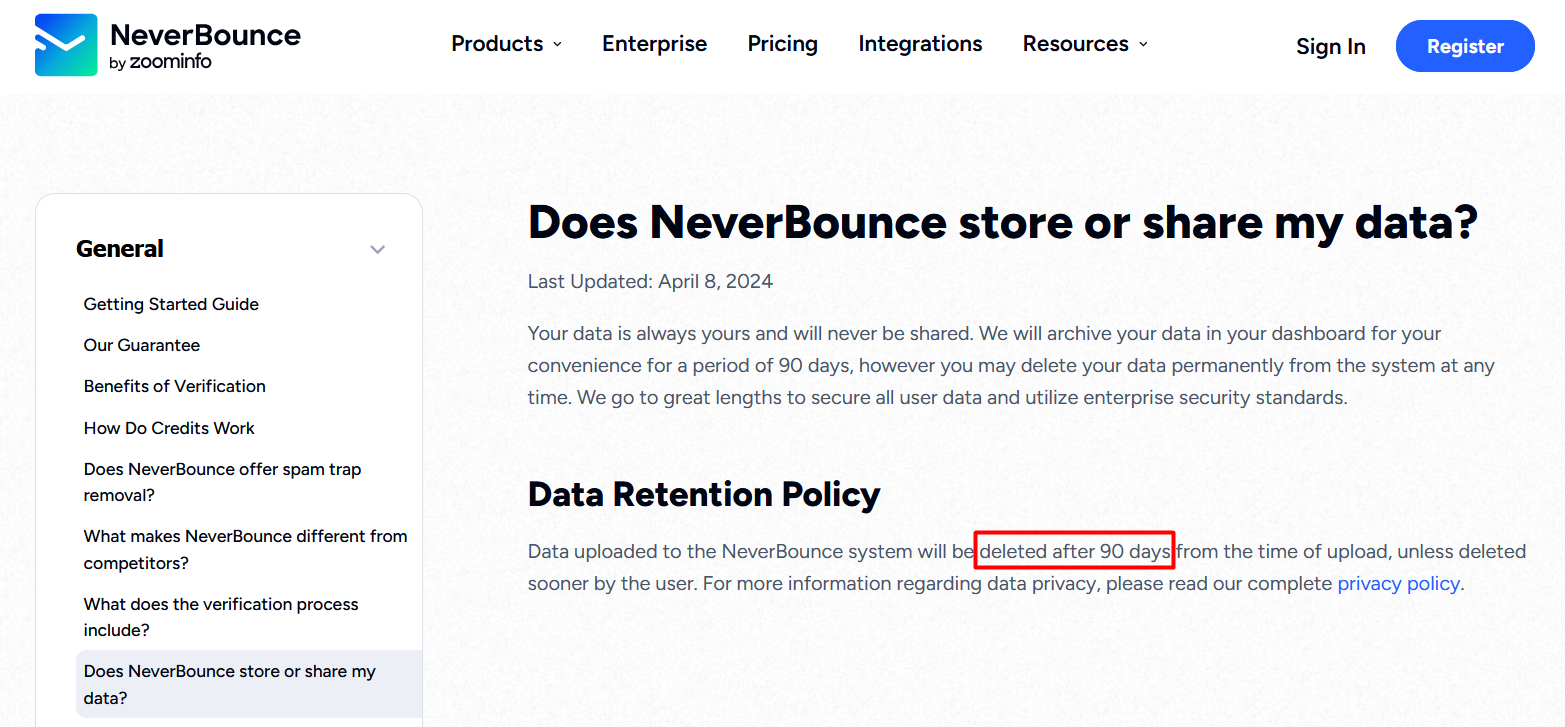
In comparison, another GDPR-compliant email verification tool, NeverBounce, keeps the data for 90 days, according to their “Data Retention Policy.”
Use an API or other methods (e.g., software development kits (SDKs) or web widgets) for real-time verification if you’re worried about retention risk. Since addresses are verified as they come in during such checks, there’s no need to upload and store email lists.

Data protection measures
GDPR Articles: Art. 32 (security of processing), Art. 25 (data protection by design and by default), Art. 33(2) (notification of a personal data breach)
Definition: These are the technical and organizational measures a provider implements to safeguard data against unauthorized access, cyberattacks, leaks, or other data loss (e.g., physical damage to data centers).
How to approach it:
- Scroll through official providers’ websites to see whether they have easy-to-find, transparent privacy policy pages in place and how they handle data privacy
- Clarify how the data breach process is handled
- Ask about security measures: data encryption, employee confidentiality commitments, transfer impact assessments (TIAs), etc.
For example:
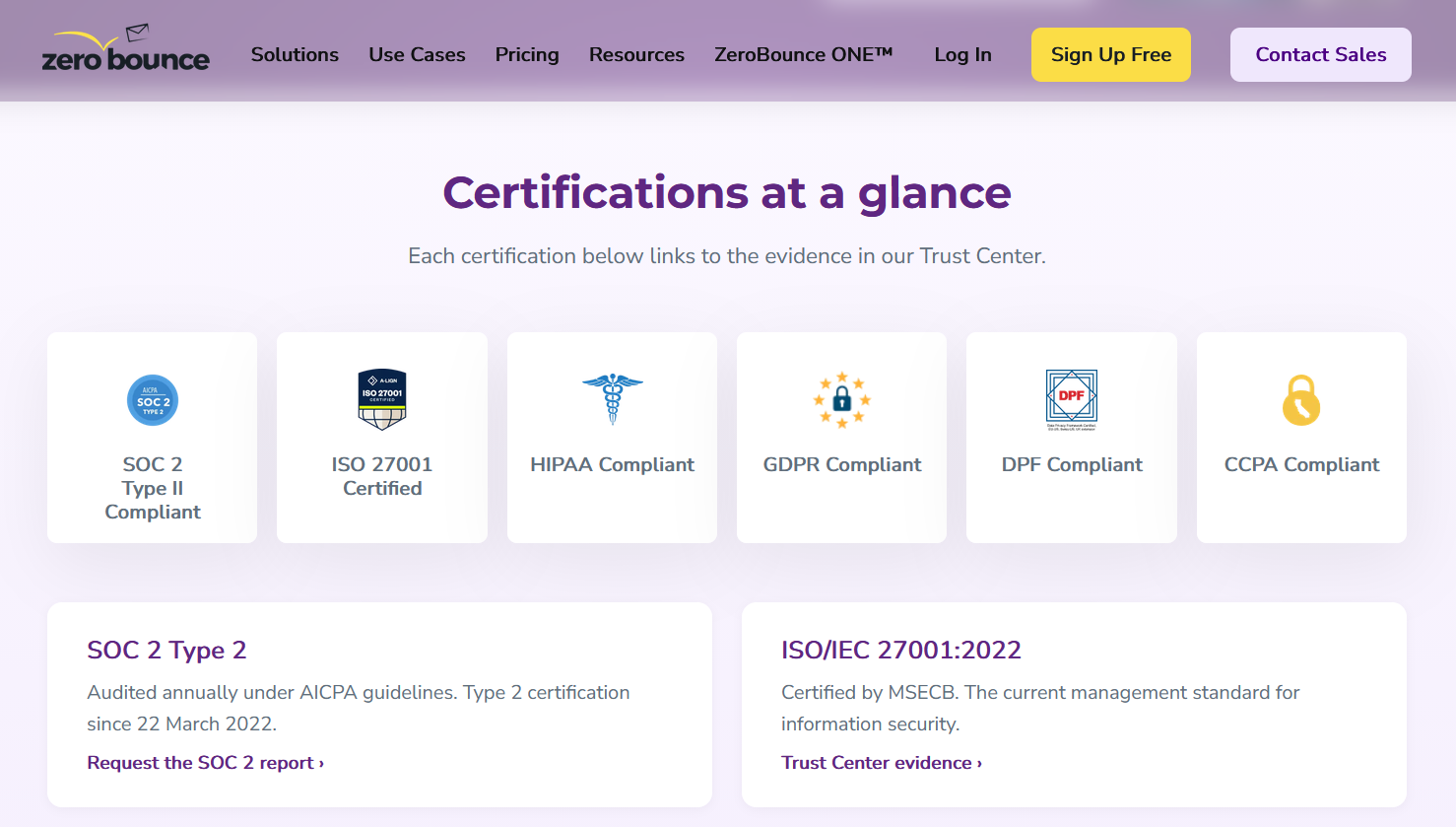
ZeroBounce is one of the GDPR-compliant email verification services with SOC 2 Type II and ISO 27001 certifications, among other safety-first accreditations.
The number of personal data breach notifications increased by 22% in 2026 compared to 2025. That’s why companies are implementing SOC 2, ISO 27001, or other frameworks and standards as cybersecurity measures.
Mind: These aren’t GDPR-required certificates, but they do contribute to overall data protection.
Sub-processors
GDPR Article: Art. 28(2) and (4)
Definition: A sub-processor is a company or individual a data processor engages to process personal data on your behalf. It can be a cloud host, an infrastructure vendor, or even another email validation tool or service provider.
How to approach it:
- Ask for the public list of sub-processors (if any), including what each does and where and how it operates
- Make sure the same data protection obligations pass down the chain
- Check whether sub-processors are mentioned in the DPA
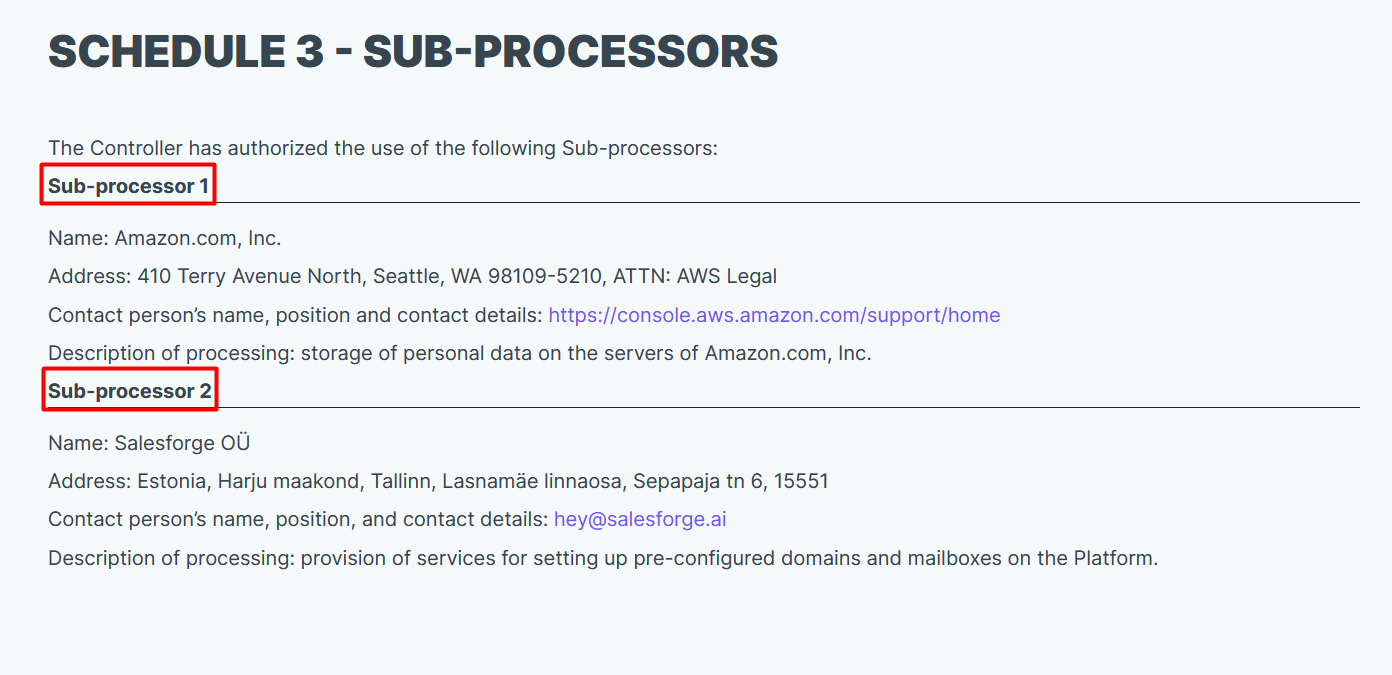
For example, Snov.io provides a list of its sub-processors on its DPA page for transparency and GDPR compliance.
International data transfers
GDPR Articles: Art. 44–50 (Chapter 5)
Definition: An international data transfer happens when personal data is sent to, or accessed by, a company in a country outside the European Economic Area (EEA).
How to approach it:
- Clarify the transfer mechanism
- Find out where the provider and its sub-processors host and access data
- If the provider relies on the EU-US Data Privacy Framework, check that it’s actually certified
For example:
Just like many other GDPR-compliant email verification service providers, Bouncer answers the transfer-related question (“Is your information transferred internationally?”) on their “Privacy Policy” page.
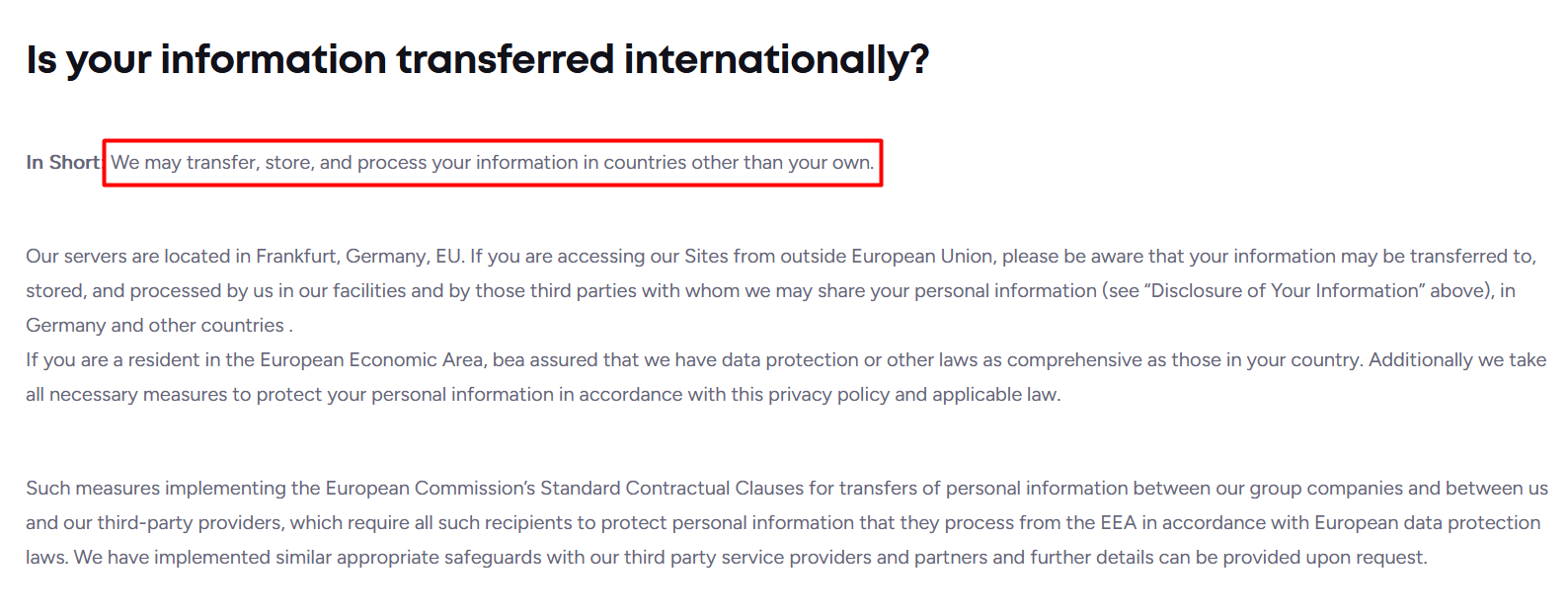
Note: If a provider can’t clearly explain how it stores, protects, or shares your data, it’s worth reconsidering your choice.
A step-by-step guide on GDPR email verification
In this section, I’ll guide you through the email verification process step by step, with GDPR compliance in mind.
But first, make sure you can identify and document the source of each email address:
- Signup form
- Partner
- Referral
- Inbound request
- B2B data provider
- Public source, etc.
Don’t verify email addresses if you can’t explain where they came from. Under GDPR’s accountability principle (Article 5(2)), you must be able to prove compliance if EU customers or regulators ask.
Step 1. Establish a lawful basis
Under Article 6 of the GDPR, “Lawfulness of processing,” you must have a valid legal basis for processing personal data, including verifying email addresses. Here are the six legal bases recognized by GDPR:
| Legal basis | GDPR Article | Meaning |
|---|---|---|
| Consent | 6(1)(a) | You have freely given, specific, informed, and unambiguous permission from the individual to process their personal data for a specific purpose. |
| Contract | 6(1)(b) | You need to fulfill a contract with the person or take steps at their request before entering into a contract. |
| Legal obligation | 6(1)(c) | You must comply with a legal obligation that applies to you. |
| Vital interests | 6(1)(d) | Processing is necessary to protect someone’s life or other vital interests. |
| Public task | 6(1)(e) | You need to perform a task in the public interest or exercise official authority vested in you. |
| Legitimate interests | 6(1)(f) | Processing is necessary for your legitimate interests, provided those interests are not overridden by the individual’s rights and freedoms. |
For GDPR-compliant email verification, legitimate interests (Article 6(1)(f)) can often be a suitable legal basis. For example, you may have a legitimate interest in keeping your contact data accurate and reducing bounced or misdirected emails.
However, you need to show that your interest is justified and doesn’t outweigh the individual’s rights. To do so, conduct and document a three-part Legitimate Interests Assessment (LIA):
- Part 1 — Purpose test: Is your interest legitimate?
- Part 2 — Necessity test: Is verification necessary for that purpose?
- Part 3 — Balancing test: Does the person’s interest override yours?
Use the LIA template below to work through each test and document your answers.
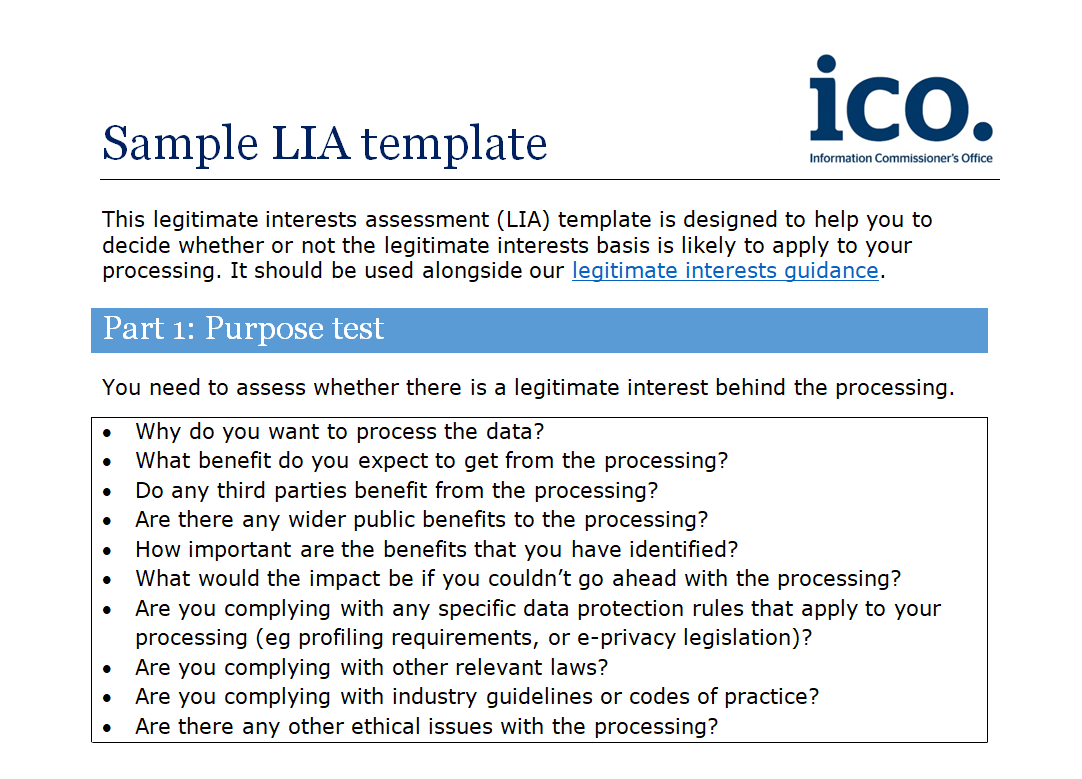
→ Download the LIA template for quick access to start answering the questions and ensure compliance with GDPR.
Step 2. Ensure data minimization — don’t share unnecessary data
Under Article 5(1)(c), GDPR’s data minimization principle requires you to collect and share only the personal data necessary for a specific purpose.
For email verification, the provider typically needs only the email address. That means you should avoid sharing additional personal details, such as:
- Full names
- Companies
- Locations
- Phone numbers
- Job titles, etc.
Compare the following.
Before minimization: First Name | Last Name | Email | Phone | Company | Buying Intent | Notes
After minimization: Email
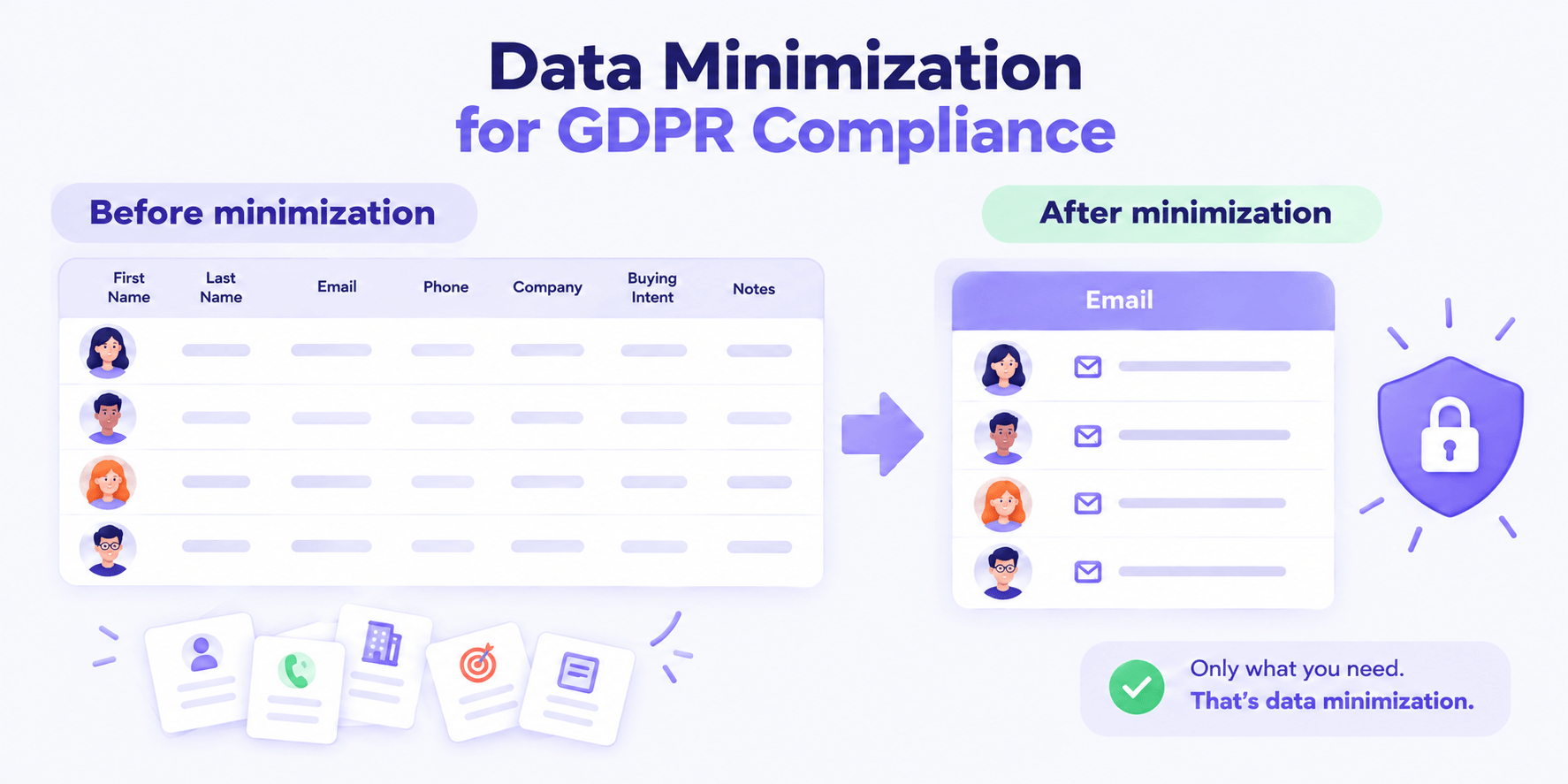
If an email verification service asks for names or other contact details, find out why they’re needed and whether you can skip those fields.
An email may already contain someone’s name (e.g., giulia.rossi@company.it). That’s fine, as long as you’re not sharing additional information unnecessarily.
Avoid upload tools that automatically map name columns or add internal IDs from your CRM. Instead, split files so you don’t upload extra details, then match the results back to your records using the email addresses themselves.
Step 3. Verify with a GDPR-compliant tool
You already know what to pay attention to when choosing GDPR-compliant email verification tools from the previous section. Now, it’s high time to pick one and start validating emails.
I’ll use Snov.io’s Email Verifier to show you how it works. I tested it on a list of French prospects’ email addresses, starting with the Single Email Verification feature to check each address individually.
The results were color-coded. Green for valid addresses, yellow for those that couldn’t be verified with certainty (including catch-all and greylisted emails), and red for invalid ones.
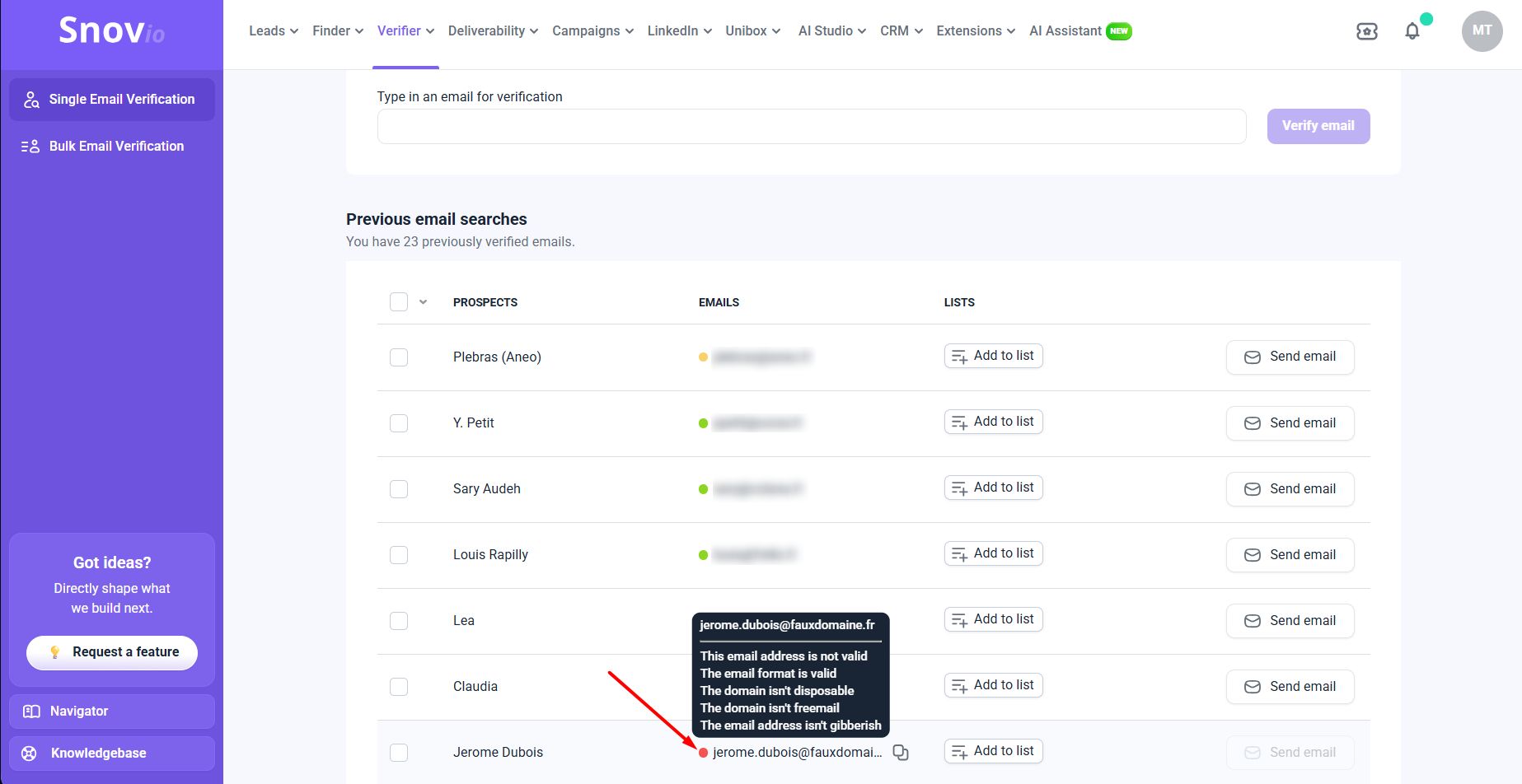
Since checking emails one by one isn’t practical for larger lists, I also tried the Bulk Email Verification feature. It lets you verify multiple addresses at once by pasting them into the tool, separated by line breaks.
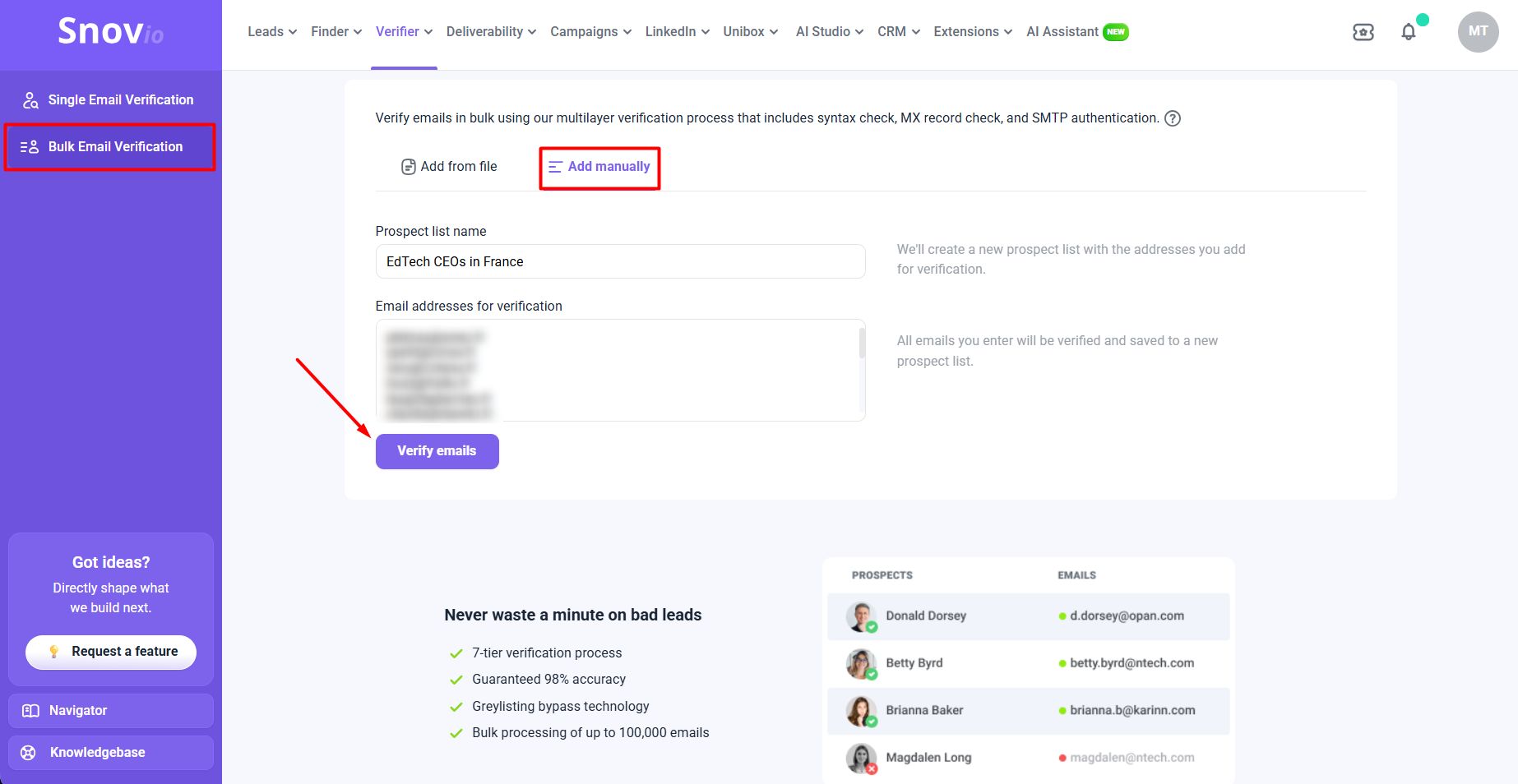
Alternatively, Snov.io lets you upload email addresses in a file (up to 100,000 contacts) in a CSV, TXT, XLS, or XLSX format.
Step 4. Review the results and decide what to keep and delete
Why do you need this revision-and-decision stage, anyway? The goal is to keep data amounts as minimal as possible (again, it’s GDPR’s data minimization principle) and prevent unnecessary info from piling up in your CRM or other systems.
Review the most typical verification results and expert-recommended actions for GDPR email compliance, as shown in the table below.
| Result | Meaning | Recommended action for GDPR compliance |
|---|---|---|
| Valid | The mailbox exists and accepts mail. | Keep, but only send messages if you have a legal basis for outreach. |
| Invalid | The mailbox or domain doesn’t exist. | Delete to prevent re-import and re-verification of invalid email addresses. |
| Catch-all | The domain accepts all addresses, so mailbox existence can’t be confirmed. | Treat as risky. Send messages in small batches, monitor bounce rates carefully, and get rid of addresses that repeatedly fail. |
| Disposable | A temporary address from a throwaway service. | Remove from your cold outreach or email marketing lists. It’s unlikely to be a durable contact. |
| Role-based | A shared mailbox (e.g., sales@ or marketing@). | Keep only if outreach is relevant to the company or role. |
| Unknown/unverifiable | The server didn’t respond reliably (timeout, greylisting). | Retry with another GDPR email verification tool. If you still get an “unknown” or “unverifiable” result, delete it from the list. |
| Syntax error/typo | Mistyped address. | Find the correct address — don’t guess, because otherwise you may end up sending messages to the wrong person. |
For example:
When using Snov.io’s Email Verifier, you can hover over the result to see more details on whether it’s a catch-all, gibberish, or a disposable email address, as in the screenshot below.
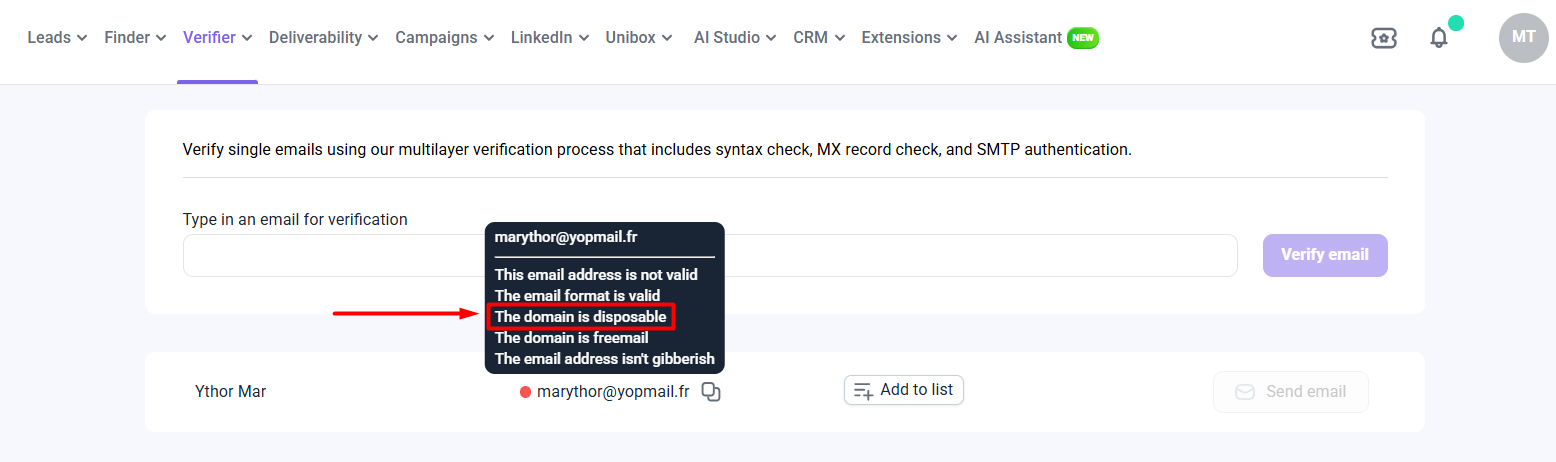
You can then choose which addresses to keep. In my case, I saved all emails marked as “valid” to my prospect list, “EdTech CEOs in France,” on the Snov.io platform.
Step 5. Re-verify emails and clean up your list regularly
Under GDPR Article 5(1)(d), you’re obliged to ensure personal data is accurate and up to date. But that’s not the only reason for re-verification. Since 23% of all emails become invalid within just 1 year, you’re exposed to deliverability and sender-reputation risks.
Re-validating emails and tidying up your list isn’t only a GDPR-first practice. It’s also a deliverability must-do. If you want your outreach to stay GDPR-compliant and bounce rates to stay low, I recommend the “3-30 rule”: re-verify every 3 months and before every campaign if the list is older than 30 days. Also, create a sunset policy for inactive addresses. If prospects haven’t engaged with your messages within your retention period, delete them to avoid a pointless and endless “re-verification loop.
Email Deliverability Specialist at Snov.io

So, here are several rules of thumb for regular email list cleaning:
- Re-verify and clean up your active list every 3 months
- Re-verify and clean up your list before any campaign if it’s older than 30 days
- Re-verify and remove inactive addresses to avoid reverifying them endlessly
If someone has asked to be removed from your list or clicked the “Unsubscribe” button, don’t add them back or re-verify their address for outreach. Ignoring these requests puts you at risk of GDPR non-compliance.
What next? Compliance after verification: GDPR email requirements for outreach
Verifying addresses in line with GDPR doesn’t automatically make your cold outreach or email marketing compliant. Just because an address is valid doesn’t mean you have permission to contact its owner.
Before emailing EU customers, check these 3 additional requirements to avoid the risk of GDPR non-compliance.
Inform data subjects where you got their data
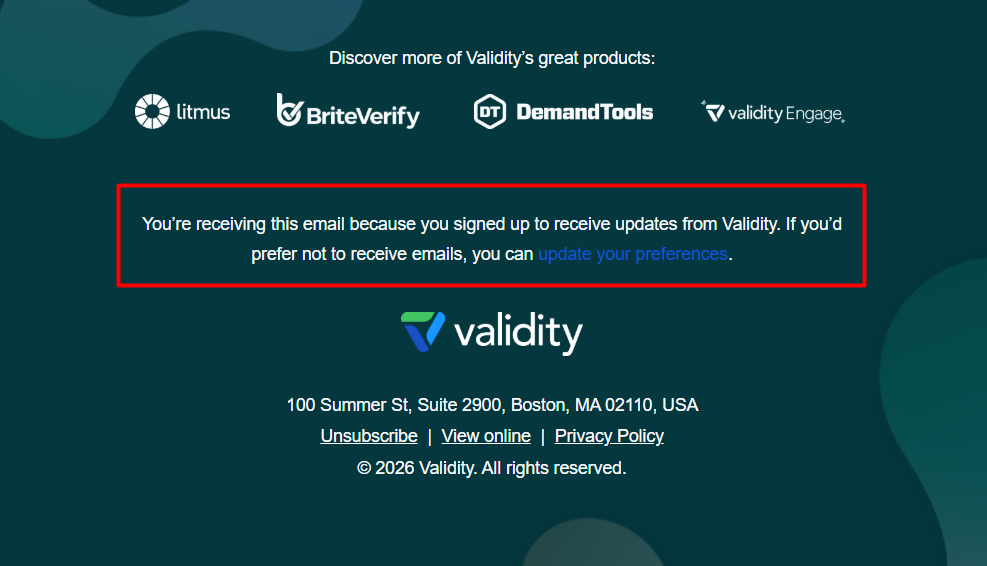
If someone shares their email address directly, such as through a newsletter sign-up form, GDPR Article 13 applies. You must explain how you’ll use their personal data when you collect it, usually through a privacy notice.
For example, you might remind subscribers why they’re receiving your emails:
“You’re receiving this email because you signed up for our newsletter.”
But what if you found it elsewhere and want to send a GDPR cold email?
That’s where GDPR’s Art. 14 comes in. It applies when you collect personal data from another source, such as a company website or LinkedIn profile, rather than directly from the person.
In this case, you generally need to inform them within 1 month of collecting their data, or at your first communication if you contact them sooner.
Here’s how you can phrase it, depending on the source:
- Company website → I found your email address on the [Company’s Page]
- Event attendee list → Your contact details were in the attendee list for [Event, Date]
- Social media channel → I came across your profile on [LinkedIn/Facebook/Instagram] and found your work email
- B2B database provider → Your contact details were provided by [Provider]
- Another person → [Person’s Name] suggested I get in touch with you
And here are several examples of mentioning it in cold emails:
Why you’re getting this email: I found your work email on your “Team” page and reached out to discuss our possible cooperation.
P.S.: In case you’re wondering how I found you…Your contact details come from your LinkedIn profile.
You don’t need a lengthy explanation in your email. Just mention it naturally, as shown above.
Make your opt-in mechanism more GDPR-compliant
To stay compliant with GDPR email marketing requirements, you generally need recipients’ consent, although the exact rules depend on applicable laws. Under GDPR Article 4(11), it must be “freely given, specific, informed, and unambiguous.” This means you can’t rely on pre-ticked boxes (Recital 32).
But what’s the best way to obtain it: single or double opt-in?
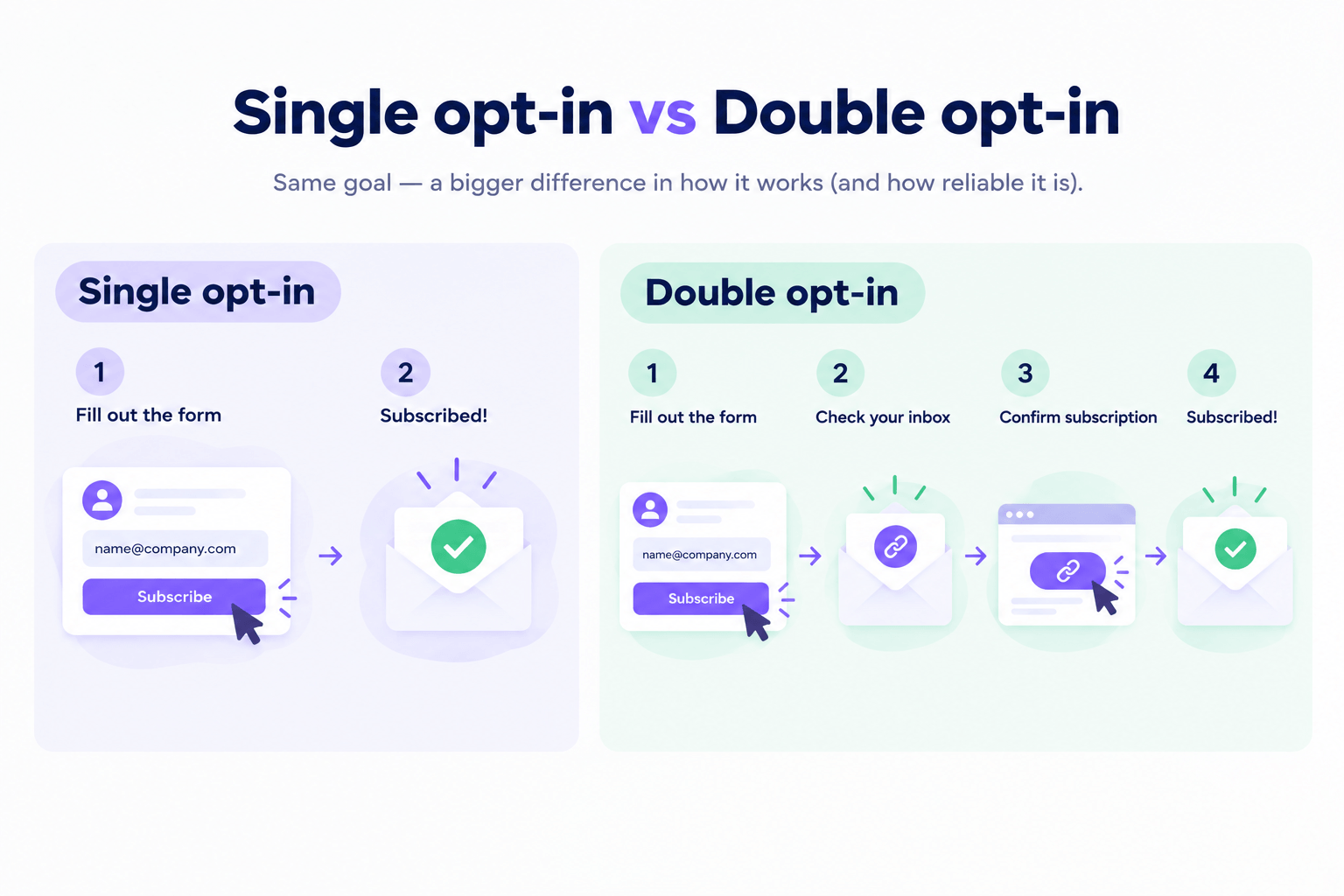
With a single opt-in mechanism, the person submits a form and gets subscribed straight away. A double opt-in presupposes the second step — a confirmation link. That makes it 100% irrefutable proof that the person actually agreed to receive your messages.


Often cited as a “GDPR double opt-in,” it isn’t technically a GDPR rule itself. Yet, some EU countries may have their national regulator guidance or court rulings that require it in practice.
For example:
A double opt-in mechanism has been the de facto standard in Germany since the Federal Court of Justice approved it in 2011. Austrian courts follow the same approach.
In Germany, cold emailing isn’t just “aggressive marketing”; it is a strictly regulated activity under the Gesetz gegen den unlauteren Wettbewerb (UWG)/ Act Against Unfair Competition and the General Data Protection Regulation (GDPR).
If you mess this up, you aren’t just losing a lead; you’re inviting an Abmahnung (cease-and-desist) and administrative fines. If you claim you have consent, the law says you must prove it. In German courts, this almost exclusively requires a Double Opt-In (DOI) record (log of the confirmation email, timestamp, and IP).
Founder and CEO of CircleX

Let people easily opt out and honor their objections
Regarding an opt-out mechanism, every marketing message should have a simple, intuitive unsubscription option. On top of that, various email providers may set their own rules. For instance, Gmail requires bulk senders (5,000+ emails/day) to add a one-click unsubscribe button.
For opt-outs in GDPR cold email outreach, use phrases like these:
- If you’d rather not hear from me, just type 2 letters “no,” and I won’t contact you again
- Not relevant? Reply “unsubscribe,” and I’ll remove you right away
- No hard feelings if this isn’t for you. One-word reply (“stop”), and I’ll stop messaging you
- If this offer isn’t relevant, reply “pass,” and I won’t bother you with any messages ever again
For example:
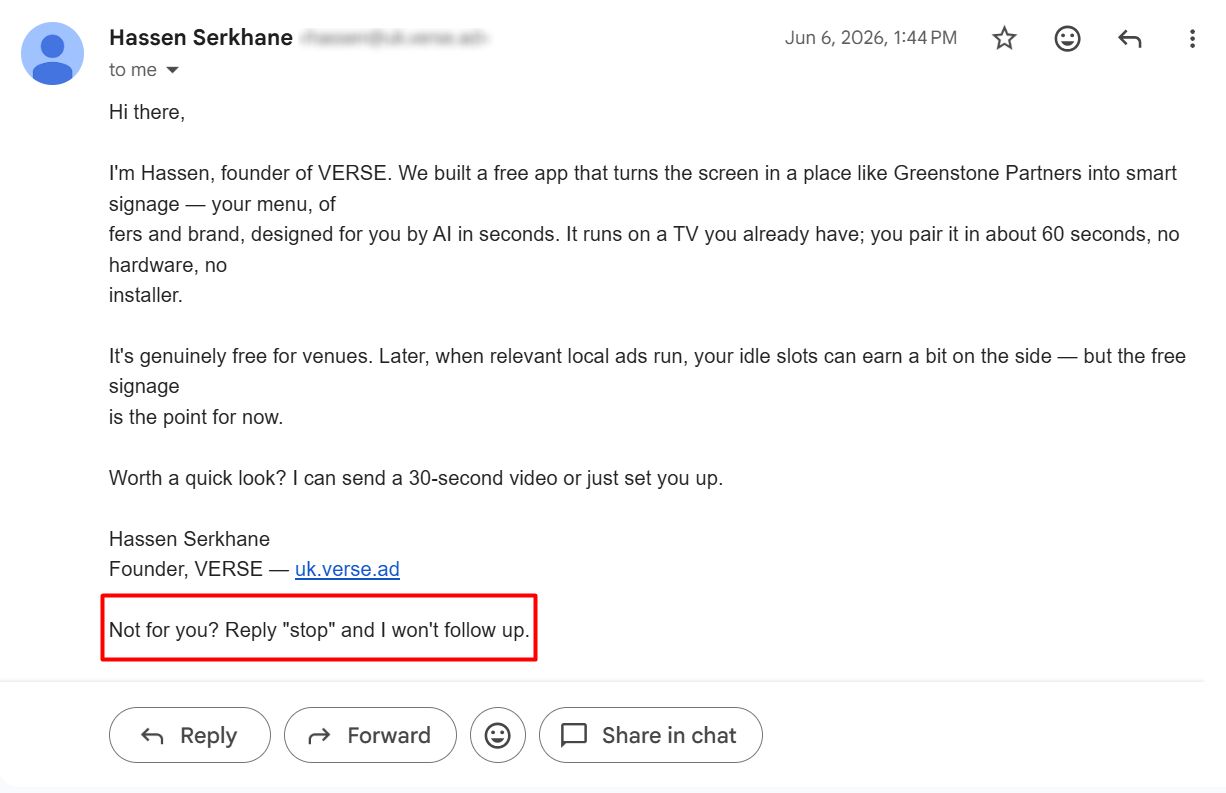
Also, remember that under GDPR Article 21, people have an absolute “right to object” to direct marketing. Once someone objects, you should:
- Stop reaching out immediately
- Accept opt-outs from any channel, whether it’s a “no” response via email, a support ticket, or even a LinkedIn message
- Create a suppression list and keep only email addresses and opt-out dates so the same prospects aren’t re-added later
Don’t forget to exclude suppressed contacts from every next email verification and outreach sequence.
Remove opt-outs immediately, not at the next list refresh. The upside most people miss: Compliant targeting forces a tighter, more relevant list. Tighter lists convert better anyway — compliance and performance point the same direction.
GTM Engineer at Geonode

Key takeaways
GDPR doesn’t ban email verification, but it’s still counted as personal data processing. So, your step-by-step workflow to verify emails in a GDPR-respectful way is this:
- Determine a lawful basis for it: Your legitimate interest
- Use GDPR’s data minimization principle: Cut down the amount of shared personal data
- Choose a compliant tool or service: Check a Data Processing Agreement, retention policy, data protection measures, info on sub-processor(s), and mechanisms for international transfers
- Work on the results: Decide which addresses to keep and which to delete from your list
- Re-verify emails regularly: Develop a regular list-cleaning habit
Finally, remember that GDPR email verification is only the first step toward GDPR-compliant outreach.