TL;DR: What is LinkedIn event marketing
LinkedIn event marketing is the type of marketing that involves the implementation of LinkedIn tools and targeted ads to promote and host events. LinkedIn events tool can power your B2B lead generation when executed right:
- Start by choosing the event type that fits your goals.
- Launch your promotion 2-4 weeks before the actual meetup and share it across channels.
- Use Snov.io to find attendees’ emails and set up automated personalized email sequences to follow up based on their engagement.
- Repurpose event content and continue nurturing leads with automated outreach.
Common mistakes to avoid during LinkedIn lead generation:
- No post-event follow-up (warm leads go cold fast)
- Weak title/description/visuals (“what’s in it for me?” isn’t clear)
- “Create it and hope” promotion (no plan, no reminders)
- No clear CTA (no next step like booking a call, downloading a resource, joining a community)
Bottom line: Plan early, promote everywhere, engage before the event, and run a structured post-event nurture flow—this is what turns LinkedIn events into a repeatable pipeline and long-term relationships.
LinkedIn event marketing is a valuable way to enhance your strategy and fuel B2B lead generation. Yet, without proper planning, you risk losing promising opportunities before they turn into deals.
In this article, you will learn how effective LinkedIn events with strategic marketing and automation turn attendees into lasting business relationships.
What are LinkedIn events, and why do they matter
LinkedIn event marketing is a way to bring professionals together, both online and in person, for networking and sharing ideas. It gives you the tools to organize, promote, and run these occasions directly on the platform people already trust.
Types of LinkedIn events
LinkedIn offers flexible event formats so you can choose the one that best matches your goals and marketing strategy. Each type can support different objectives, from brand awareness to targeted LinkedIn lead generation. Let’s take a closer look:
- LinkedIn live events
These are streamed directly on LinkedIn and allow you to interact with attendees in real time through comments and reactions. They’re ideal for thought leadership sessions, Q&A panels, fireside chats, or product launches.
You can choose from two options: public or public with a registration form.
Pick the type that fits your goals and audience.
- External events
These are hosted outside LinkedIn and promoted on the platform. Attendees join via an external broadcast link provided by the organizer. Best when the event requires tools or platforms not supported by LinkedIn Live.
- In-person events
These are more traditional, offline meetups, such as conferences, networking events, or seminars. You can use LinkedIn to promote them and engage attendees. They’re especially effective for building personal connections and deepening relationships with your network.
Why use LinkedIn events
LinkedIn event marketing works because attendees come ready to engage professionally, creating quality leads and authentic follow-up opportunities.
- Professional context
LinkedIn users don’t just tolerate business content; they actively seek it out. When someone joins your event, they’re already in “professional mode”, making them far more receptive to your message.
This mindset shift is huge when it comes to LinkedIn lead generation because attendees are genuinely interested in learning, not just passively consuming content.
- Powerful audience targeting
Here’s where LinkedIn event marketing gets interesting. Yes, you can target by job title and company size, but events have a social amplification effect that’s incredibly valuable. When your ideal customer shares it, it reaches their network of similar professionals.
- Full lifecycle engagement
Every event gives you something precious: legitimate reasons to reach out. You can reference specific questions someone asked or continue a discussion from the chat. This kind of personalized LinkedIn outreach feels natural rather than intrusive.
- Strong LinkedIn lead generation potential
A successful LinkedIn marketing strategy treats events as relationship-building tools, not one-time presentations. Each of them becomes a way to deepen existing connections while attracting new prospects who are genuinely interested in what you offer.
When done right, you can create a cycle: great content attracts quality attendees, and meaningful follow-up turns attendees into connections. Those connections then become your biggest advocates for future meetups. It’s LinkedIn lead generation that actually feels human.
Event formats that work well on LinkedIn
LinkedIn events thrive when they serve a clear purpose for your audience.
- Community or brand-building occasions
Fireside chats, expert panels, or interviews that create value and encourage discussion. These are great for boosting visibility and thought leadership.
- Talent branding meetups
Career talks, recruiting sessions, and campus tours that showcase your company culture and attract talent.
- Product launches
Live demos and Q&A sessions to create buzz around new offerings.
- Targeted-audience occasions
Highly specific sessions for a certain industry, company, job function, or region. Perfect for account-based marketing and niche networking.
By choosing the right format and combining it with consistent promotion, you can turn meetups into a repeatable part of your LinkedIn marketing strategy.
How to launch your LinkedIn events: A step-by-step setup guide
Here are some simple steps for planning and setting up LinkedIn events effectively.
Define the goal of your event
Don’t rush into planning before you know what you’re trying to accomplish. Taking time to clarify the event’s purpose upfront will prevent you from wasting time fixing problems later.
Pick one specific goal instead of trying to achieve multiple things at once. Decide whether you want to introduce your brand to new people, collect contact details from potential customers, or showcase your expertise to others in your industry.
Choose your hosting profile
Next, decide whether you’re hosting from your personal profile or company page (you’ll need super admin or content admin access for pages). If you’re planning to go live, check if you meet these eligibility criteria:
- At least 150 followers/connections, a 30-day-old account
- Good standing with community policies
- Location outside mainland China
For live streaming, you’ll also need an account with one of LinkedIn’s preferred partners, like StreamYard, Restream, Socialive, Switcher, or Vimeo. Set this up and sync it with your account before you start.
Set up your event
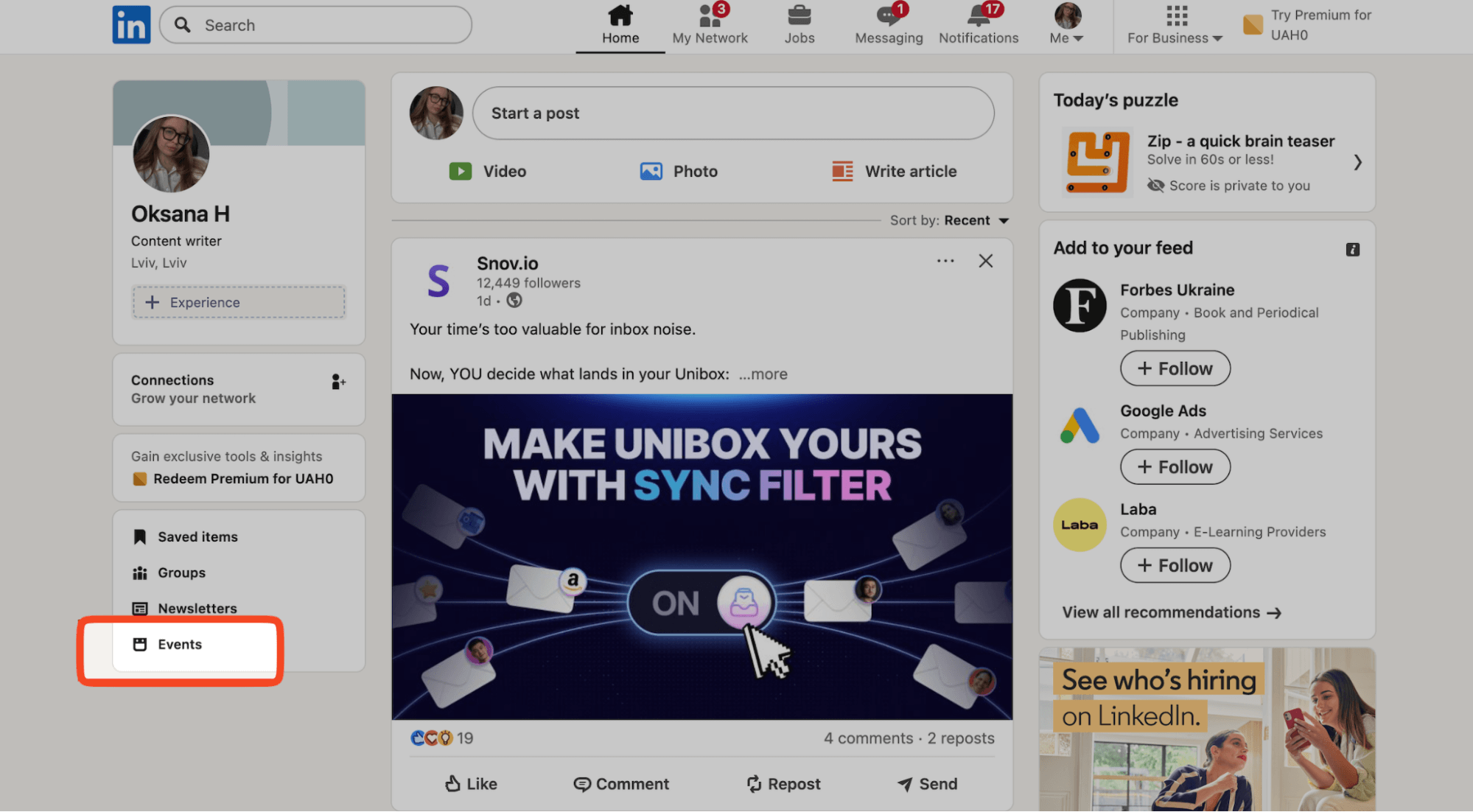
Navigate to events: Click the Home icon, then select Events from the left sidebar.
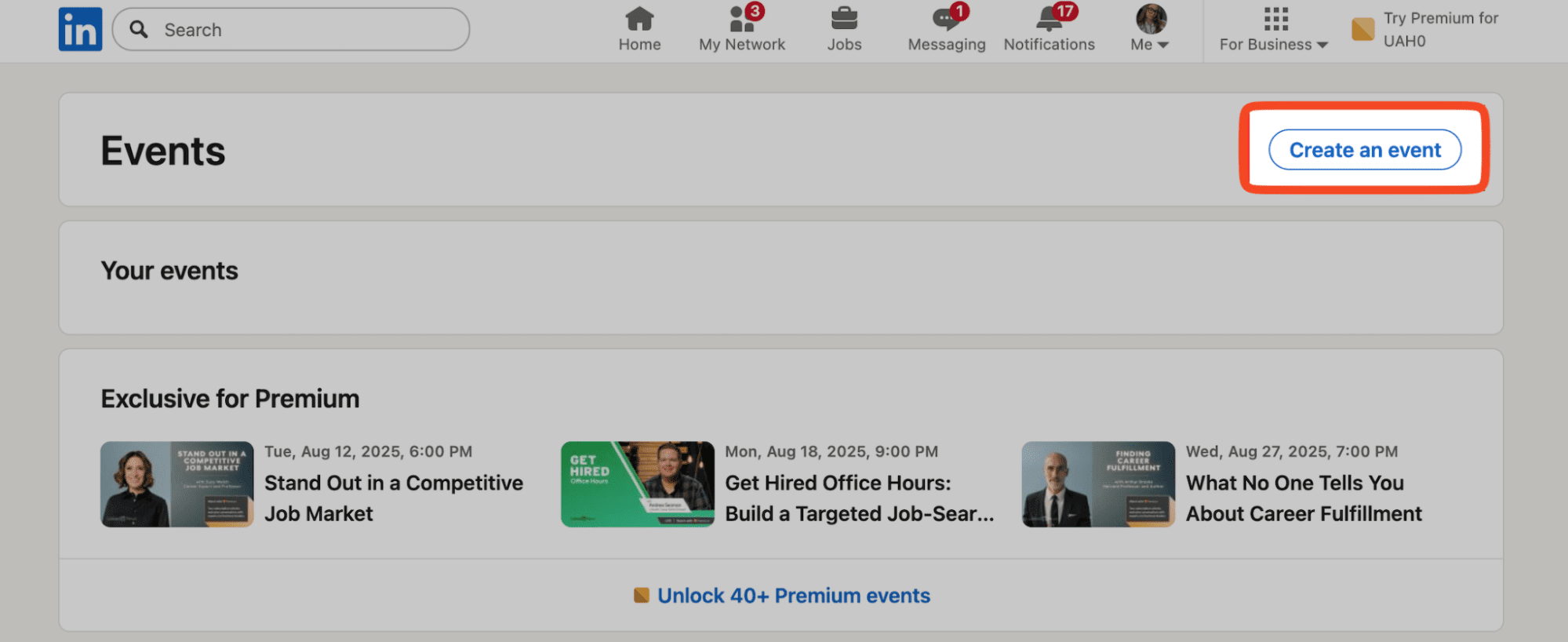
Next, hit Create an event.
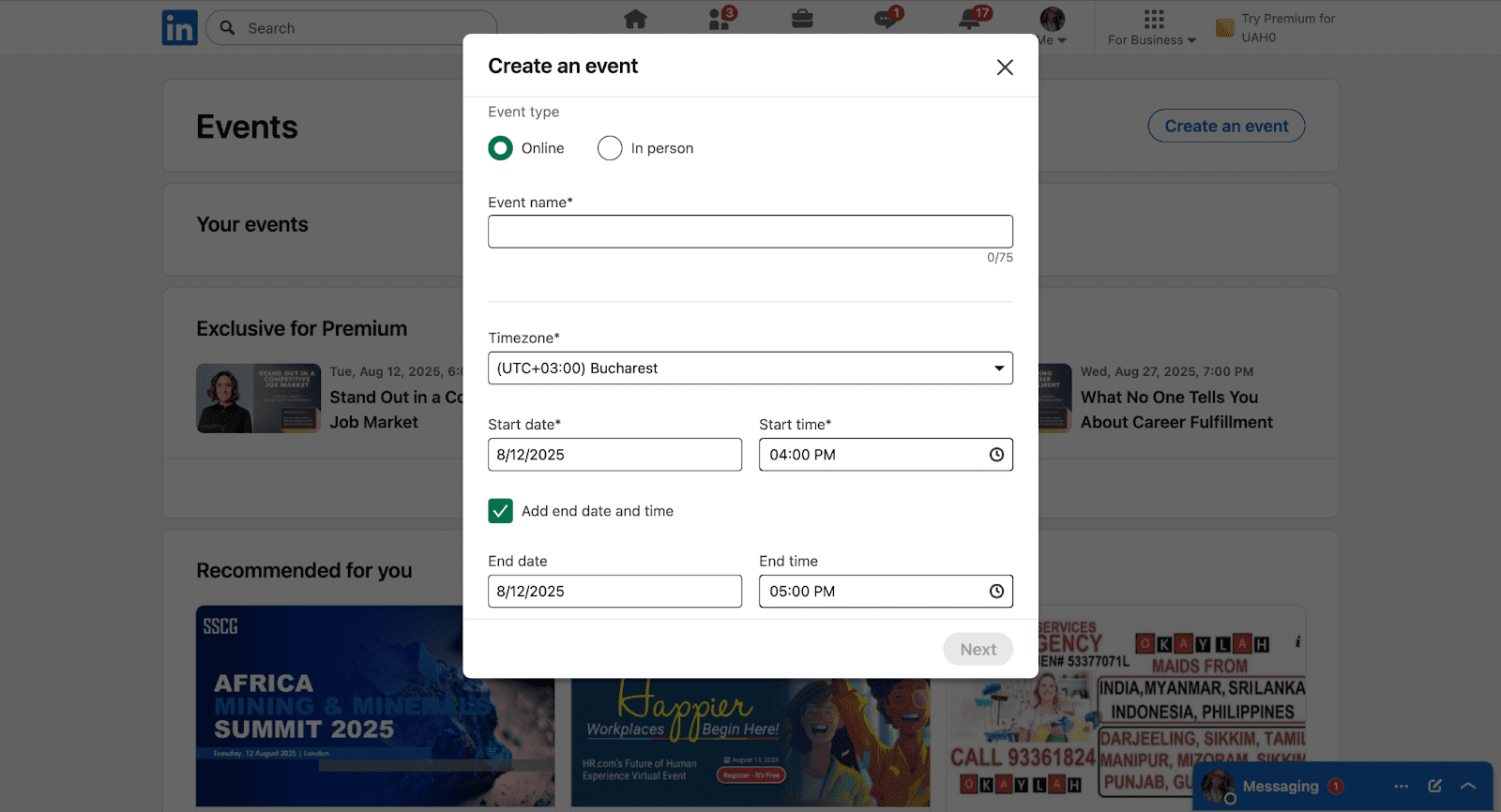
Fill in the details: Add the title, date, time, description, and speakers. Choose between the online and in-person formats (if you see “LinkedIn Live” as an option, you’re eligible for live streaming). Upload your cover image and double-check that everything looks professional.
Write your launch post: Don’t just hit “post” and walk away. Write something compelling in the “Share your thoughts” section to announce your event. This initial post often determines early momentum.
Hit post and start promoting: Once it’s published, share the unique event URL across your network and encourage early registrants to invite their connections.
Effective LinkedIn event promotion strategy
Your LinkedIn event marketing results aren’t decided during the actual event, but in the preparation phase that happens weeks before.
Think about it: would you rather scramble at the last minute to fill seats, or have a waitlist of engaged professionals eager to attend? The choice is yours, and it starts with how you approach the pre-event phase.
Plan your LinkedIn events ahead of time
Launch your event 2-4 weeks earlier than scheduled.
Here’s why: Those extra weeks give you enough time to execute a proper LinkedIn marketing strategy without feeling rushed. You can plan your content, set up your promotions, and reach out to the right people. Plus, you’ll have time to set up LinkedIn ads that actually convert, rather than rushing through a last-minute campaign that wastes your budget.
Promote your LinkedIn events across multiple channels
Use your event’s unique URL to promote across multiple channels.
Every LinkedIn event automatically gets its own landing page. This URL becomes your most valuable marketing tool because it works like a dedicated website.
The smart approach is to start where your professional audience already gathers:
- Post the event on the company page with engaging visuals that stop the scroll.
- Share it with your personal network, where people already trust you and your recommendations.
- Use LinkedIn’s organic targeting to reach specific job titles, industries, or locations that match your ideal attendee profile.
But don’t stop your LinkedIn event marketing there. Your email list, other social platforms, and even your website visitors should be aware of your meetup. The more places you promote it, the more registrations you’ll get.
Approach your invitations in a strategic way
Combine direct invitations with smart advertising to fill your event.
Start with your first-degree connections. Since these people already know you, they’re more likely to attend. Both profile owners and page admins can send these direct invitations.
Next, turn early attendees into your marketing team by encouraging them to invite colleagues from their networks. People are far more likely to attend something recommended by someone they trust than something they discover through an ad.
For serious scale, ads are essential for effective LinkedIn event marketing. These ads display occasion details directly in people’s feeds. They display the name, host, date, and time upfront. This makes it easy for busy professionals to say yes immediately.
Leverage multi-channel outreach
Use email prospecting alongside your event promotion to reach more qualified leads.
Your LinkedIn marketing strategy becomes more powerful when you add cold outreach. The Snov.io LinkedIn Email Finder works for two powerful scenarios: collecting prospects from competitor events AND finding email addresses for your own attendees.
Snov.io helped us collect more than 80,000 leads in a month, accelerating our search for emails while reducing the cost per lead
CMO at Belkins

This multi-channel approach ensures you’re meeting prospects where they’re most responsive. Here’s the exact process:
Use LinkedIn’s search bar with keywords related to your industry. For example, “sales automation” or “marketing strategy.

Click the Events filter to see only them.
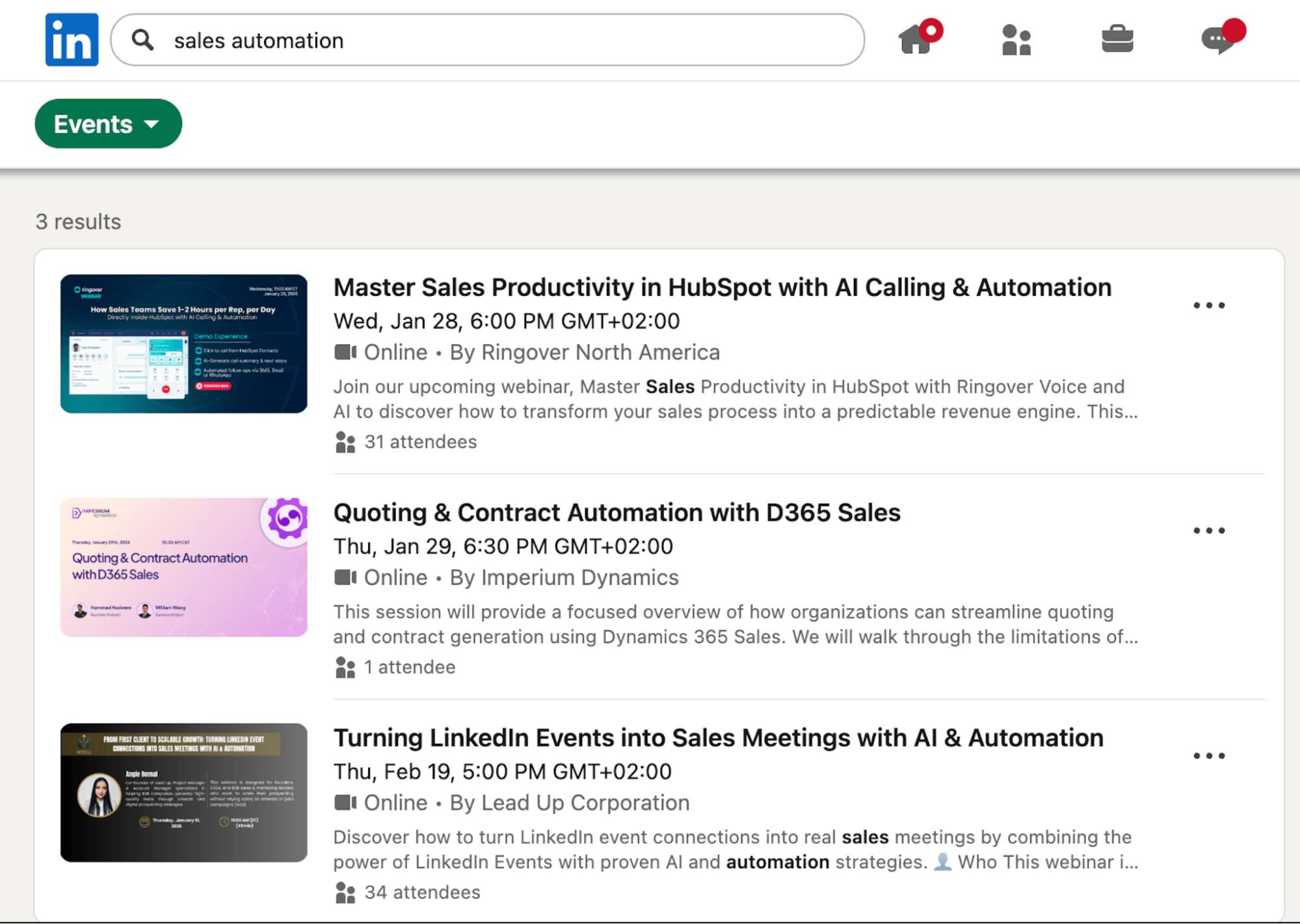
Click the event where your ideal leads would go, then click the Attend button. Then, go to the Attendees section in the event menu.
Use the LinkedIn email scraper extension to save these attendees to your prospect list.
💡 Bonus tip
When you save prospects using the extension, it works the same way as manually viewing profiles. Each saved prospect counts toward your daily profile view limit.
To keep your profile in good standing, we recommend staying within these safe limits:
Free account: about 150 prospects per day
Premium account: about 500 prospects per day
Sales Navigator: about 1,000 prospects per day.
Build anticipation by actively engaging before LinkedIn events
Engage registered attendees to ensure they actually show up and participate.
Pre-event engagement is about relationship building that pays dividends. The goal here is to transform casual registrants into invested participants who attend ready to engage.
Try these tactics:
- Run polls to understand your audience’s biggest challenges or priorities. This provides valuable insights while making attendees feel heard.
- Ask thought-provoking questions related to the meetup topic to get conversations started early.
- Share behind-the-scenes content or speaker insights to build personal connections.
Most importantly, maintain regular communication through the event feed, aiming for updates twice weekly. This keeps you top-of-mind and demonstrates that you’re invested in delivering value.
Make the value crystal clear
Clearly communicate what attendees will gain from the event.
Busy professionals need to understand your value proposition immediately. They don’t have time to guess what the event is about or why they should attend. So, make sure these points are clear:
- What specific problem you solving for them
- Why you’re the right person to solve it
- Who will benefit most from attending
- What tangible outcomes can they expect
Your headline is especially important for LinkedIn events. It’s often the first thing people see, and it determines whether they read more or scroll past. Focus on the outcome you’re promising, not just the topic you’re covering.
Key takeaways
LinkedIn events offer great opportunities for networking and lead generation on the platform. But only if you approach them strategically, here are our key recommendations:
- Plan LinkedIn events 2-4 weeks ahead.
- Use multiple channels to promote it.
- Engage your attendees before the event starts.
- Make the value clear to everyone who sees it.
Following these steps helps ensure your event attracts the right audience and achieves meaningful results.
So, how can you convert these leads? Let’s take a closer look.
How to turn LinkedIn event attendees into long-term business results
Your LinkedIn event just ended, but the real work is just beginning. The conversations that sparked during the meetup? Those are seeds that need nurturing. The connections you made? They’re not going to follow up with themselves.
This stage is where you stand out and turn one interaction into a business relationship.
Repurpose your event content for LinkedIn lead generation
Extract 5-10 short video clips from your recording to create weeks of LinkedIn content that drives new leads.
Don’t let your event content vanish without a trace. That hour of valuable insights you just delivered? It’s pure gold for your ongoing LinkedIn lead generation efforts.
Start by posting the full replay to your company page. Next, extract the best moments into shorter clips. Did you share an important statistic? Create a 30-second video around it. Did you solve a common industry problem? Turn that segment into its own post.
Short clips often do better than full recordings because they’re quick to watch and easy to share. People can fit a 30-second video into a coffee break, but a full hour needs planning.
Build useful resources
Create 2-3 tools (e.g., checklists, templates, or guides) tailored to your event content.
Your attendees came for solutions, so give them tools they can actually use. Create actionable resources, such as checklists or step-by-step guides, based on what you covered.
For example, if your meetup was about improving sales processes, create a “Sales Process Audit Checklist”. This positions you as the go-to expert while providing genuine value.
Share these resources in multiple formats, such as a LinkedIn carousel post or a PDF. People consume content differently, and you want to meet them where they are.
Keep the conversation going
Keep the conversation going after your LinkedIn event ends to maintain engagement.
The communication doesn’t have to end when you log off. Create ongoing engagement:
- Post thought-provoking questions related to your event topic.
- Ask attendees to share their implementations, challenges, or success stories in the comments.
This builds a community around your expertise and keeps your content in their feeds.
Automate your follow-up
Use Snov.io’s LinkedIn automation and email sequences to follow up with attendees efficiently.
Most people either don’t follow up at all or send generic messages that get ignored. The key is balancing persistence with personalization.
Start with strategic segmentation. Segment your LinkedIn event attendees based on engagement level. Someone who asked questions should get a different follow-up than someone who didn’t.
Then, leverage multi-channel outreach. Snov.io’s LinkedIn automation creates sequences that combine both LinkedIn and email. This way, you don’t have to pick just one platform.
Here are examples of different sequences based on attendee behavior:
- High-engagement sequence: Begin with profile visits and post likes. Then send a personalized email that references their question and includes relevant resources.
- General attendee sequence: Begin with automated LinkedIn profile engagement. Then send a thank-you email with key takeaways and follow-up content.
- No-show sequence: Send them the recording via email. Use automation to engage with their posts and build rapport for future events.
Choosing the right sequence keeps attendees engaged and supports ongoing relationship building.
Learn more about automating your LinkedIn outreach for maximum engagement:
LinkedIn event marketing mistakes to avoid
Even with the best intentions, it’s easy to make mistakes that sabotage your success. Here are the most common pitfalls that can derail your event marketing efforts.
Neglecting post-event communication
Many LinkedIn events end with radio silence afterward. This creates a huge missed opportunity. Attendees showed up because they’re interested in what you have to offer. Without a proper follow-up sequence, warm leads go cold quickly.
We recommend setting up automated nurture campaigns to keep the conversation going after your event wraps up.
Weak messaging and graphics
Event descriptions often become afterthoughts, but they’re actually your main sales pitch. Vague titles, boring descriptions, and low-quality images are quickly scrolled past. Your event needs to clearly answer the question: What’s in it for me?
Use attention-grabbing headlines, explain the specific benefits attendees will receive, and invest in professional-looking visuals.
Lack of a promotion strategy
Simply creating an event and hoping attendees will find it rarely works. Without consistent promotion across your network, company page, and other channels, even great events can fail to take off. We recommend starting the promotion at least two weeks in advance and sending regular reminders leading up to the event.
No clear call-to-action
Events that don’t guide attendees toward a specific next step miss the point entirely.
Whether it’s booking a consultation or joining a community, provide a clear next step for attendees to take action.
We also strongly suggest making this call to action prominent and repeating it throughout your event.
Key takeaways
LinkedIn event marketing is a great way to connect with your audience and generate leads. By staying active before and after your event, you can build stronger relationships.
Automation helps you keep communication personal while reaching more people. Try Snov.io to find contacts and send personalized emails at scale.