TL;DR:
AI doesn’t replace sales and marketing professionals. Instead, it allows them to generate warmer leads, launch more precisely targeted campaigns, and create highly personalized and relevant messages.
In this article, we explore how you can start using AI-enhanced outreach tools today and what benefits they have to offer. We also provide tips on overcoming the challenges you may encounter along the way.
Wouldn’t it be great to have an assistant who handles all of the boring email marketing tasks for you? Like sifting through data to understand what information is relevant to a particular client right now, or creating supporting visuals for your next email campaign.
Well, today, any marketing professional, from a junior marketer to a CMO, can afford such an assistant. They simply need to embrace AI in email marketing.
Outline:
What is the role of AI in email marketing automation?
AI enables marketers to streamline tasks that would otherwise require human cognitive abilities. In other words, we can outsource complex tasks that involve language understanding, learning, reasoning, and problem-solving to AI assistants.
In email marketing, in particular, AI aids in content creation, audience segmentation, send-time optimization, and the analysis of campaign performance. Contrary to the common misconception, a proper use of AI doesn’t make outreach feel robotic. Instead, it frees up time for human employees to focus on building relationships with prospects that feel more human than ever.
Not convinced? Let’s examine what AI in email marketing can do in more detail.
Smart segmentation and targeting
AI analyzes tons of customer data (behavioral, demographic, and more) to uncover patterns that are invisible to the human eye. These patterns are later used to create dynamic segments.
For example, instead of sorting leads based on location, the algorithm groups contacts based on similar pain points. Doing this manually would require time, effort, and constant revision, because prospects’ pain points are constantly changing.
Thanks to AI marketing automation, marketers don’t have to go through this elaborate process. Segments update in real-time as customer behavior changes. Using smart segmentation for outreach campaigns ensures that messages are always relevant.
Automated lead scoring
Running data about prospects through predictive analytics allows AI to predict which leads are more likely to convert. The algorithm evaluates past behaviors, engagement patterns, or the prospect’s stage in the funnel. This scoring enables marketers to prioritize leads, tailor their outreach more effectively, and close deals more quickly.
➡️Need more information about lead scoring? Check out our beginner’s guide.
Content creation and personalization
Gen AI plays a huge role in AI email personalization. But its capabilities go far beyond just writing email text. It can create custom visuals, like banners or personalized images. They can significantly enhance engagement – without the design team’s involvement.

Inserting a relevant video into a marketing message can do wonders for the campaign’s conversion rate.

Benefits of AI for email marketing
Sure, all of the above sounds pretty good if you’re an email marketer pressed for time. However, you may wonder what the tangible benefits of AI in email marketing are. Here’s what you can expect if you adopt and properly use AI-enhanced marketing and outreach tools.
-
Increased open and click-through rates
Thanks to AI, companies can run automated lead-nurturing campaigns that adapt to recipients’ behavior. Consequently, prospects get the right message at the right time – even when marketers are offline.
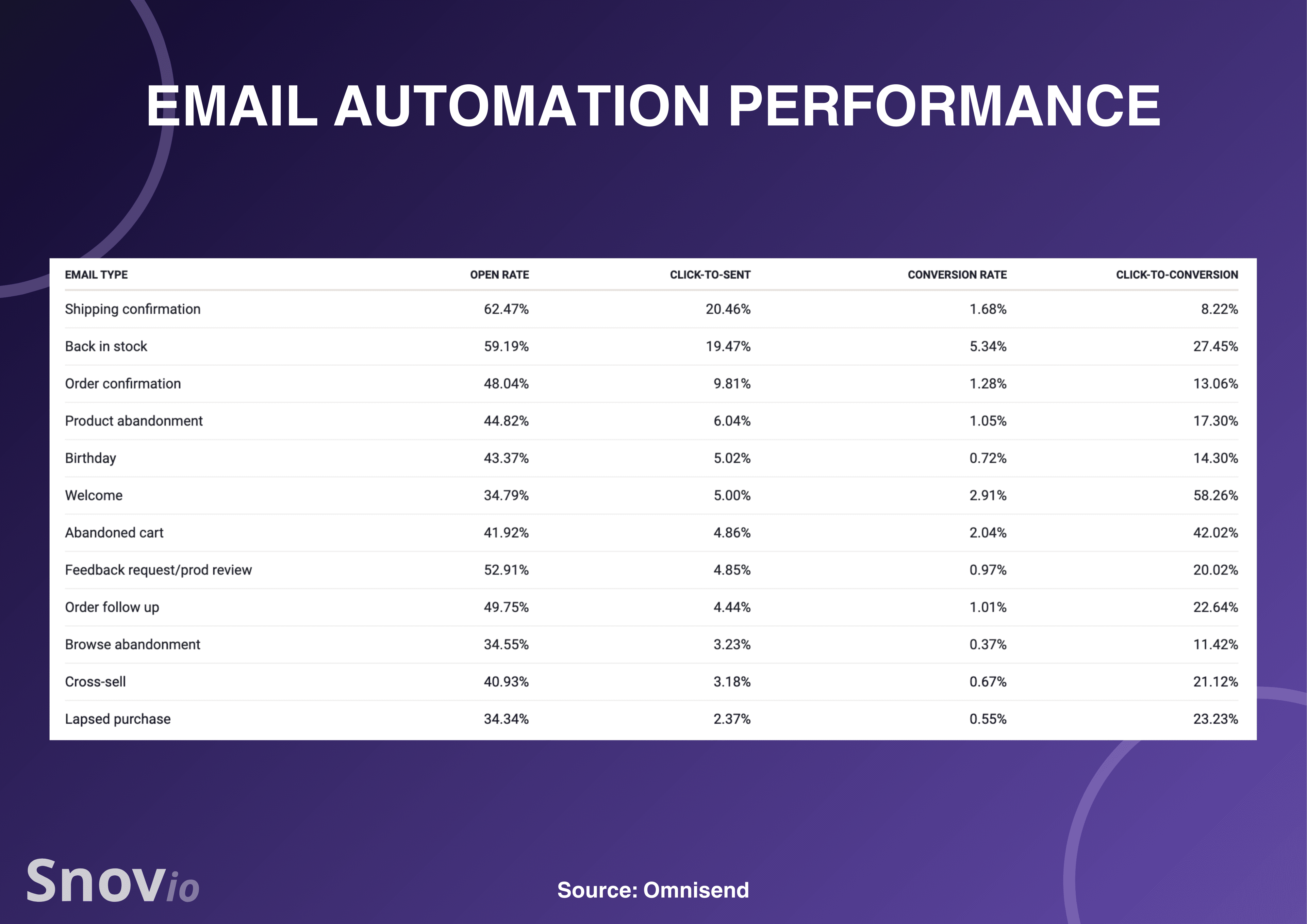
With personal occasion-based emails, you’ll create exceptional engagement within your audience.
-
Better campaign scalability
AI in email marketing allows for easily scaling personalized email campaigns – no matter how many recipients you have. It helps diversify email subject lines and body text to avoid triggering spam filters. It also tailors dynamic content blocks by user behavior or stage in the funnel. For example, during an automated lead-nurturing campaign, a SaaS buyer receives a trial-extension offer, while a lead still in the research phase receives a helpful eBook.
This means you won’t have to spend time setting up numerous email drip campaigns for each new segment of the audience.
All found leads fall right into our email campaigns and receive personalized emails automatically without much interference on our side. As a result, Snov.io email campaign automation brought us a 110% increase in revenue.
CEO of Populus Sales

-
Continuous optimization
AI tracks campaign performance in real-time, learning from it. Instead of waiting until a campaign ends to make changes, it suggests tweaks as data comes in. You’ll be able to benefit from improvements like email subject line optimization earlier and start gaining more revenue.
💡Pro-tip: Not sure how to interpret campaign analytics to improve your outreach results? Learn which stats to pay attention to and how to use them for campaign optimization from this video:
But that’s not all. Using predictive analytics in marketing can help you estimate a prospect’s future behavior. With such valuable information on hand, it will be much easier to craft personalized offers or launch an upsell campaign.
-
Smarter resource allocation and faster innovation
As mentioned earlier, AI email automation frees up time for sales and marketing professionals to focus on more strategic tasks. By outsourcing a significant amount of work to software, your team can innovate faster. For example, McKinsey predicts that AI could yield a 5-15% increase in marketing productivity.
How to implement AI in marketing automation workflows
Now, you’re probably wondering how you can start experiencing these benefits firsthand. Let’s look at actionable ways you can integrate AI into your email marketing automation workflows.
- Configure AI-enabled lead nurturing journeys
Stop relying on one-size-fits-all email drip campaigns. Your prospects are unique, so your nurture sequences should be too.
Integrate AI with your CRM and website analytics. AI will create a complete view of each prospect, including their industry, company size, past email engagement, and downloaded content. Use this information to optimize nurture paths for your prospects.
💡 Pro-tip:
Want AI to configure a personalized email campaign for you to help nurture the most valuable leads? Use the following prompt for Claude.ai:
“You’re a [your position] at a [your company’s specialty and size]. Create a 4–6 step nurture campaign sequence to engage and convert leads that fit your ICP: [brief description of your ICP].
The sequence should include email and LinkedIn touchpoints, span 2–3 weeks, and aim to educate, build trust, and drive a discovery call. Use a friendly, helpful tone. Each message should be short, personalized, and focused on delivering value.”
Even the free model will provide a solid sequence for you, but it works best with the pro version of Claude.
- Automate lead scoring for optimal follow-ups
The follow-up can make or break the case. Enable lead scoring in your automation platform. AI can analyze a prospect’s entire interaction history – including email opens, website visits, form submissions, and even the speed of their responses – to assign a dynamic score indicating the likelihood of their conversion.
Set up AI-triggered alerts for sales reps. Let’s say a prospect’s lead score jumps dramatically, or they engage with a specific high-intent piece of content (like a demo video or pricing page). AI will immediately notify the relevant sales rep, as well as suggest the best time to contact this prospect.
It can even draft the first letter of the personalized email campaign. The sales rep will only need to review it and hit send.
- Send more personalized email campaigns with AI content generation
Move beyond basic “first name” personalization. Implement dynamic content blocks powered by AI. Connect your product catalog, website browsing data, and customer purchase history to your email automation platform.
AI can then dynamically insert personalized product recommendations, relevant articles, or specific offers into each email.
👉 Pro-tip:
Need a tried-and-true prompt for ChatGPT to help create personalized email campaigns? Try this one:
“You’re a marketing assistant helping craft personalized sales emails. Based on the following information about my company, product, and ICP, suggest tailored product recommendations, relevant articles or resources, and specific offers that would resonate with the lead.
Your goal: to enrich the email copy with dynamic, personalized content that aligns with the lead’s pain points and interests.
My company: [brief description of your company]
Product’s unique selling points: [top 3–5 USPs]
ICP (ideal customer profile): [role, industry, size, key challenges, etc.]
Email topic or goal: [add a goal – e.g., book a call, promote a feature, etc.]
Return the output in bullet format with labels (e.g., Product Recommendation, Relevant Article, Special Offer) so I can easily insert each into my message.”
Allow AI to analyze historical data for CTA and email subject line optimization. The algorithm can use data to suggest which phrases are most likely to drive opens or clicks from your audience.
Just don’t copy and paste them as is. Consider these suggestions as a starting point for adding a personal touch.
How to implement AI in your email marketing with Snov.io
You probably have more important things to do than come up with prompts for different AI models. Snov.io users can start taking advantage of the AI features right away. Here’s a short guide on how to get the most out of our AI-enhanced features:
- Start by creating an ICP for your business with the help of the AI Ideal Customer Profile Generator.
Here, you simply need to add your company profile with details about your product or services.
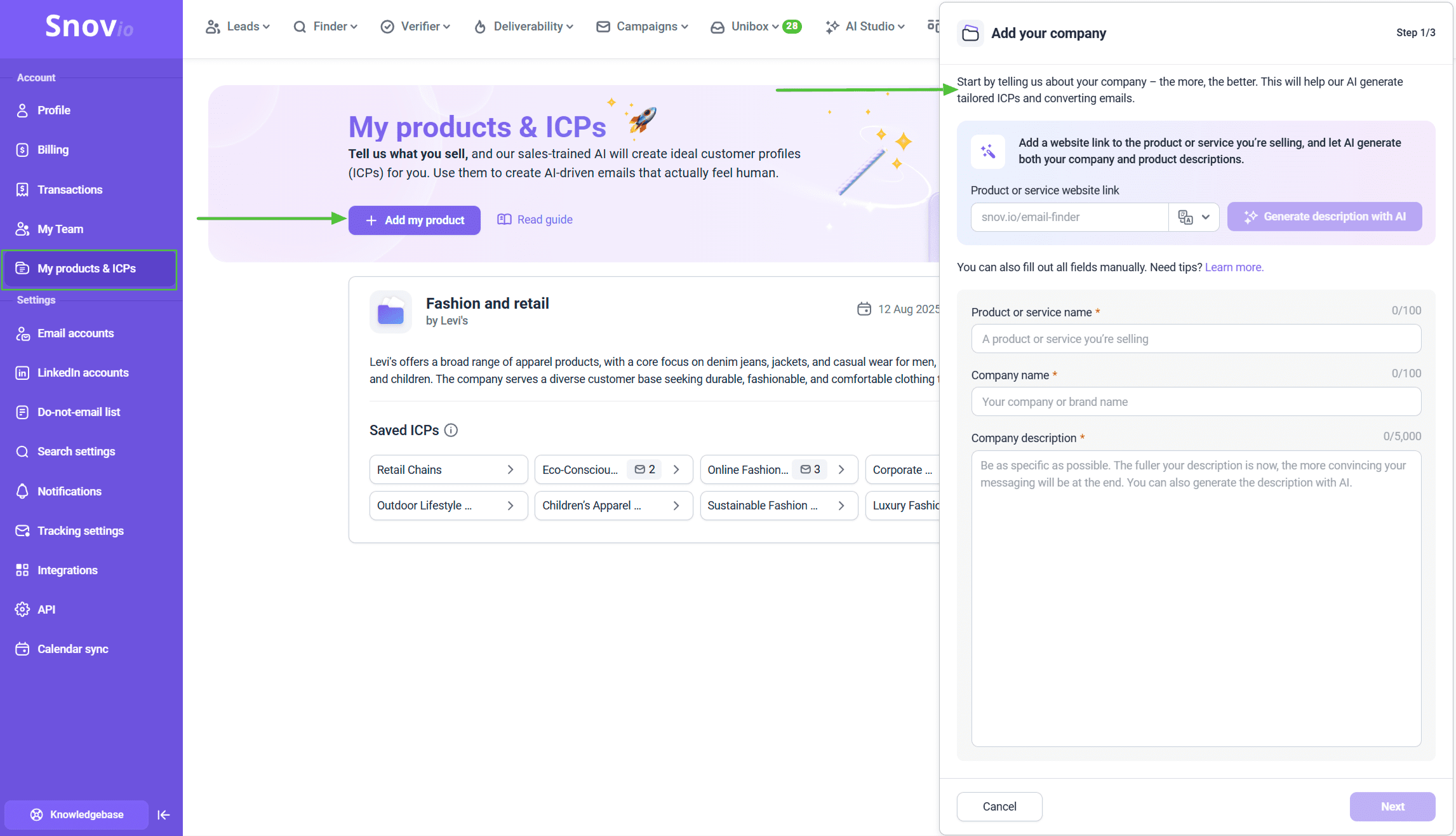
We recommend providing as much context as possible to improve the accuracy of the results. You can generate multiple ICPs.
- Generate highly personalized emails with the ICP-based email builder.
Select a product and the ICP you’ve created in the previous step. We will implement every detail of this content to create an offer and generate personalized emails.
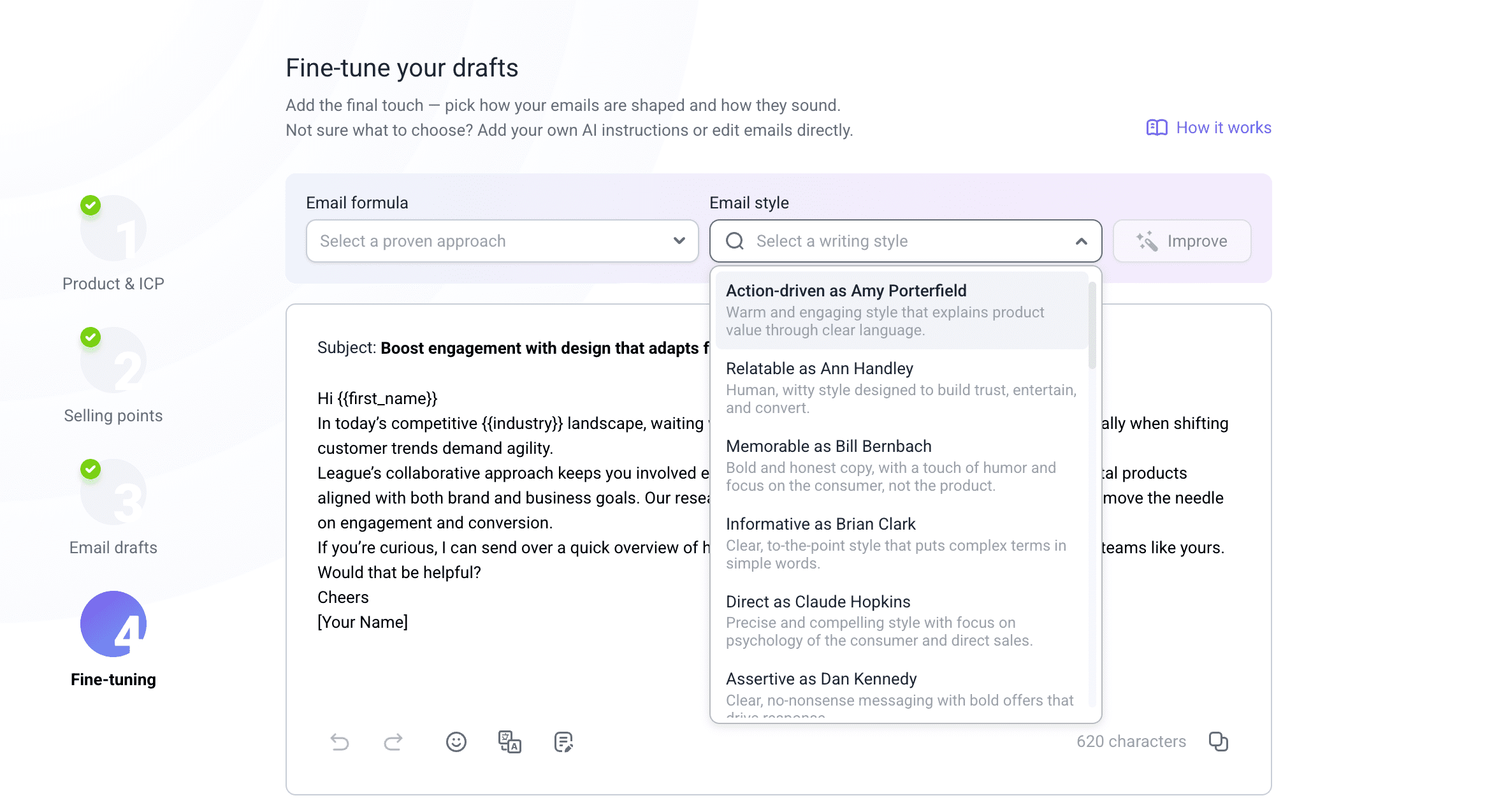
When the email text is ready, you can customize it by picking an email formula you like, changing the style, or adding your own AI prompt.
- Once the email is ready, you can use it in automated lead-nurturing campaigns based on the recipients’ behavior with Snov.io Multichannel Outreach Tool.
You can define triggers and conditions, then let the algorithm influence the content and flow of subsequent emails.
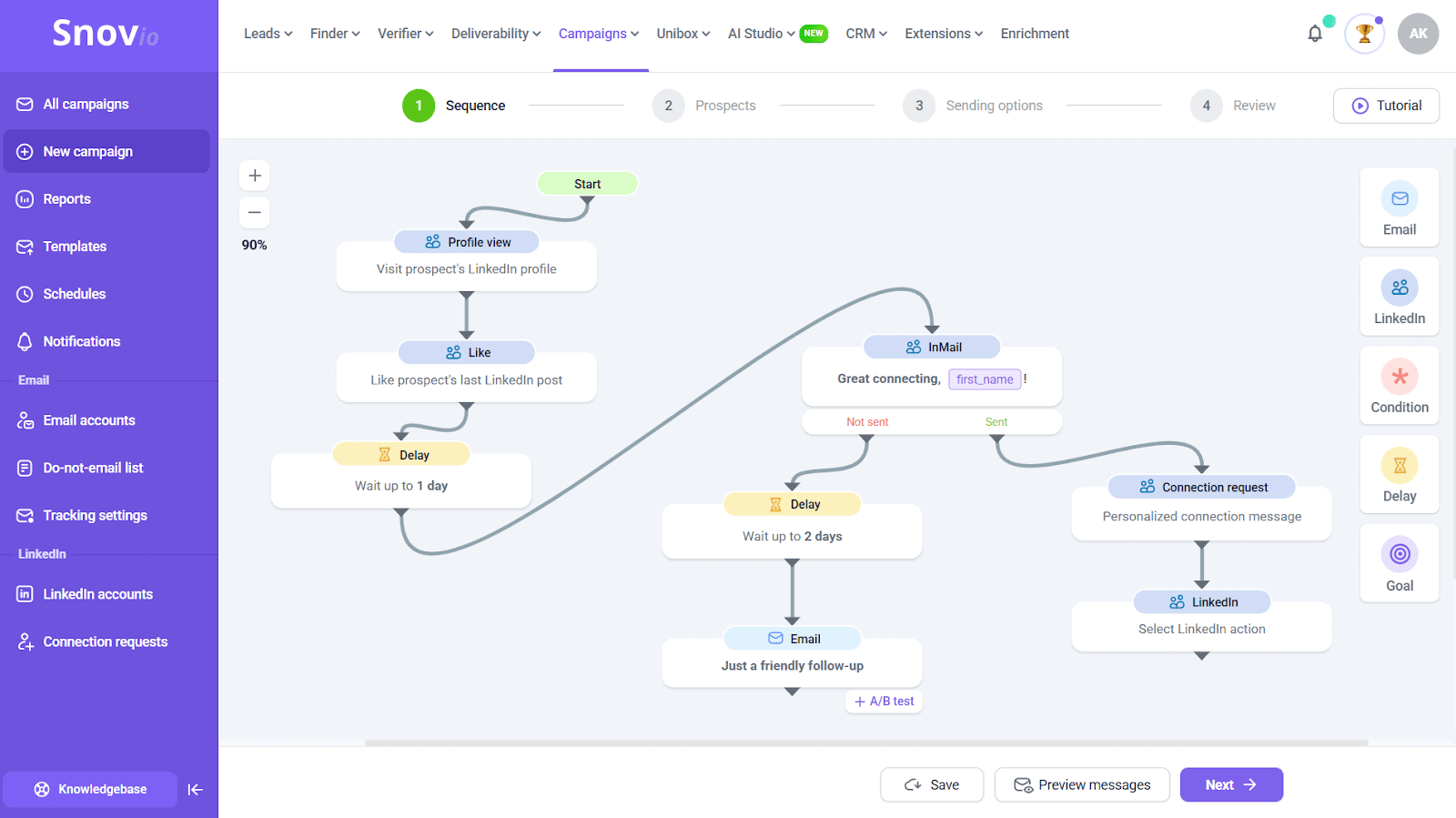
You can also use only one outreach channel, email or LinkedIn.
- Tweak emails with AI writing tools.
If you need to make any changes to your email copy, you can use this option to improve writing or change tone.
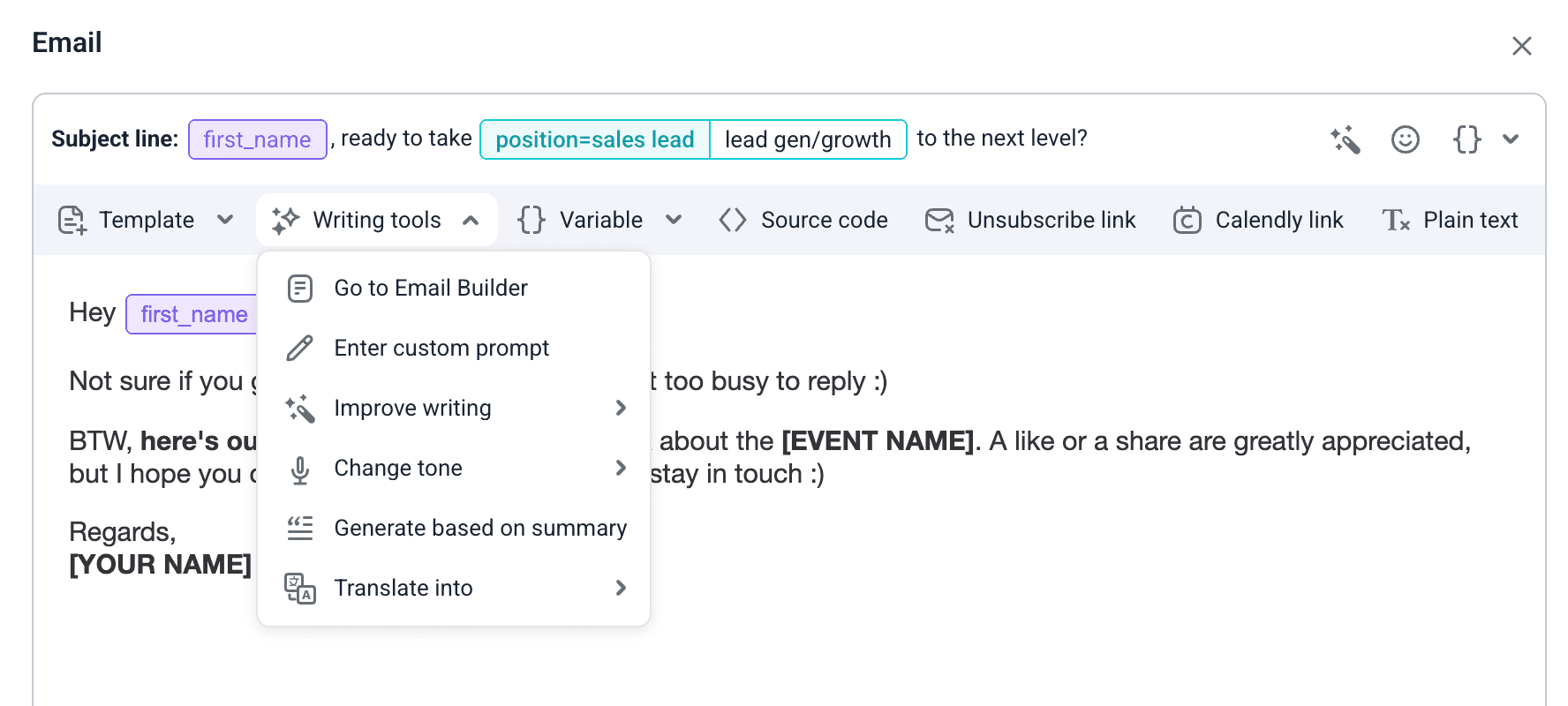
If you need to go back to AI Email Builder, there’s also an option for that.
- Use the Snov.io AI Sentiment Analysis to easily segment and bulk-action prospects based on their interest level.
Once enabled, AI will analyze replies from email campaign recipients. Based on their last reply, the algorithm will assign each a tag: “interested,” “maybe,” or “not interested.” Then you’ll be able to follow up on interested replies while retreating gracefully from “not interested” ones.
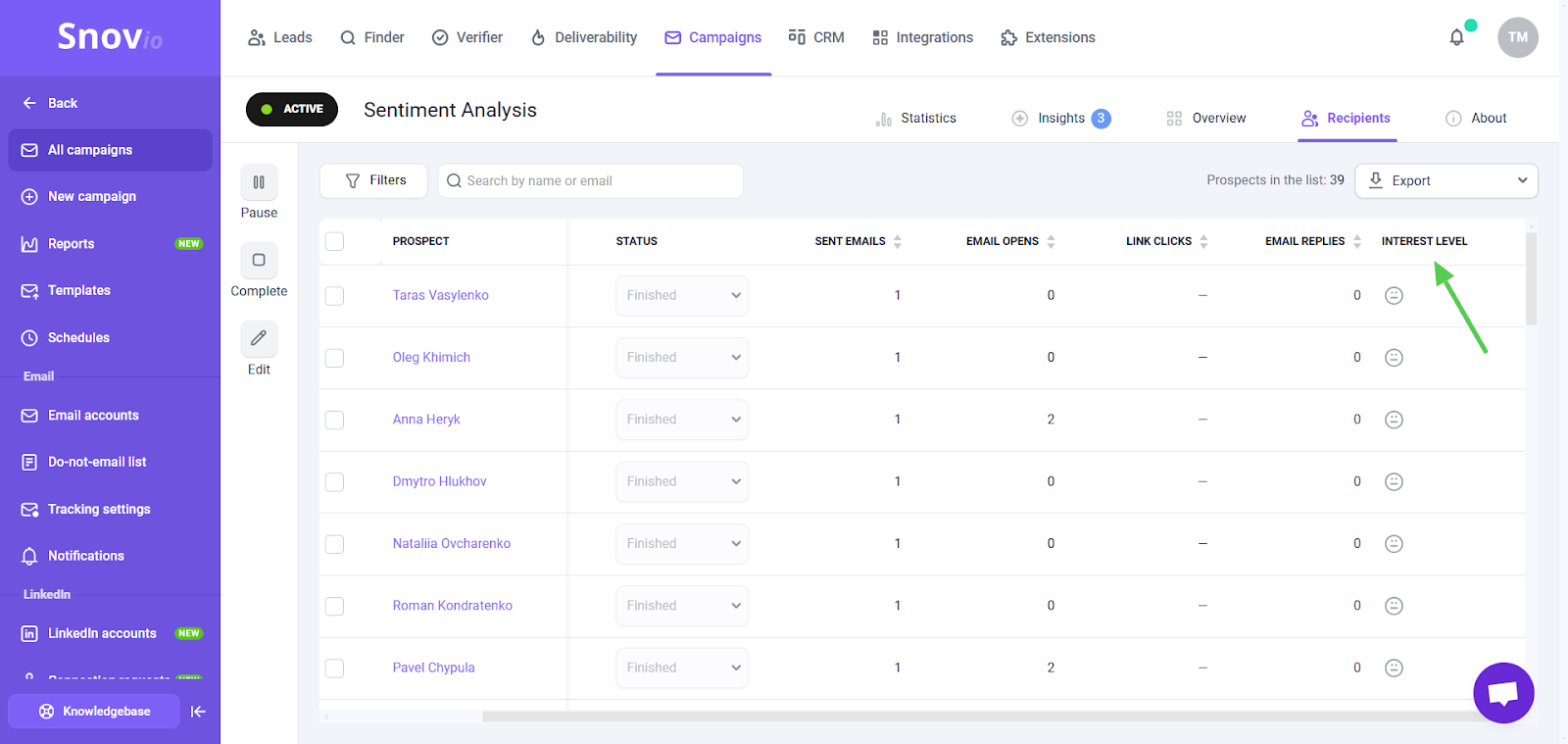
If many leads respond with “Maybe,” it signals a need for clarification or more value in your messaging.

How to avoid common pitfalls of AI in email marketing
While AI brings undeniable advantages to marketing automation, it comes with fine print. In many aspects, AI is still an uncharted territory that marketers must navigate carefully. When implementing AI in email marketing processes, consider the following:
- Data privacy and compliance
AI thrives on data, but with great data comes great responsibility. GDPR, CCPA, and other privacy laws mean marketers must be cautious with how data is collected and processed.
Make sure your tools comply with data privacy laws. At Snov.io, for example, we always stay within legal boundaries when automating outreach.
- Algorithm bias and inaccuracy
AI is only as good as the data it learns from. If your CRM contains messy or biased data, the algorithm will make poor recommendations. Regularly audit and clean your data, as well as double-check AI suggestions.
- Cost and learning curve
Some AI email automation tools can be expensive. Team onboarding takes time. Start with tools that offer a free trial and multiple pricing tiers, such as Snov.io. Try out different automation features to gauge which tier will drive the best results for your investment.
- Overreliance on automation
Over-dependence on AI can dull your brand’s human voice. People can distinguish between AI-generated messages and those written by human professionals. They may tolerate it in some places, but if everything is fully automated, your prospects will quickly stop trusting you.
Use AI to streamline and support genuine, thoughtful communication, not replace it.
- Lack of transparency
Some AI tools resemble magic spells, providing results without explaining how they were reached. This can make it hard to correct possible errors. Select tools that provide a thorough overview of their decision-making process and enable human-in-the-loop reviews.
Key takeaways
With the right AI email automation tools, even small teams can launch targeted campaigns, personalize content at scale, and consistently deliver the right message at the right time.
AI algorithms analyze data to group contacts by behavior or intent, prioritize high-potential leads, and generate tailored email content without the need for design or copywriting teams. As a result, marketers can test new ideas faster, respond to prospects in real-time, and ultimately drive more conversions.
If you’re ready to make your email marketing smarter, faster, and more personal, all the necessary tools are waiting in your Snov.io account.