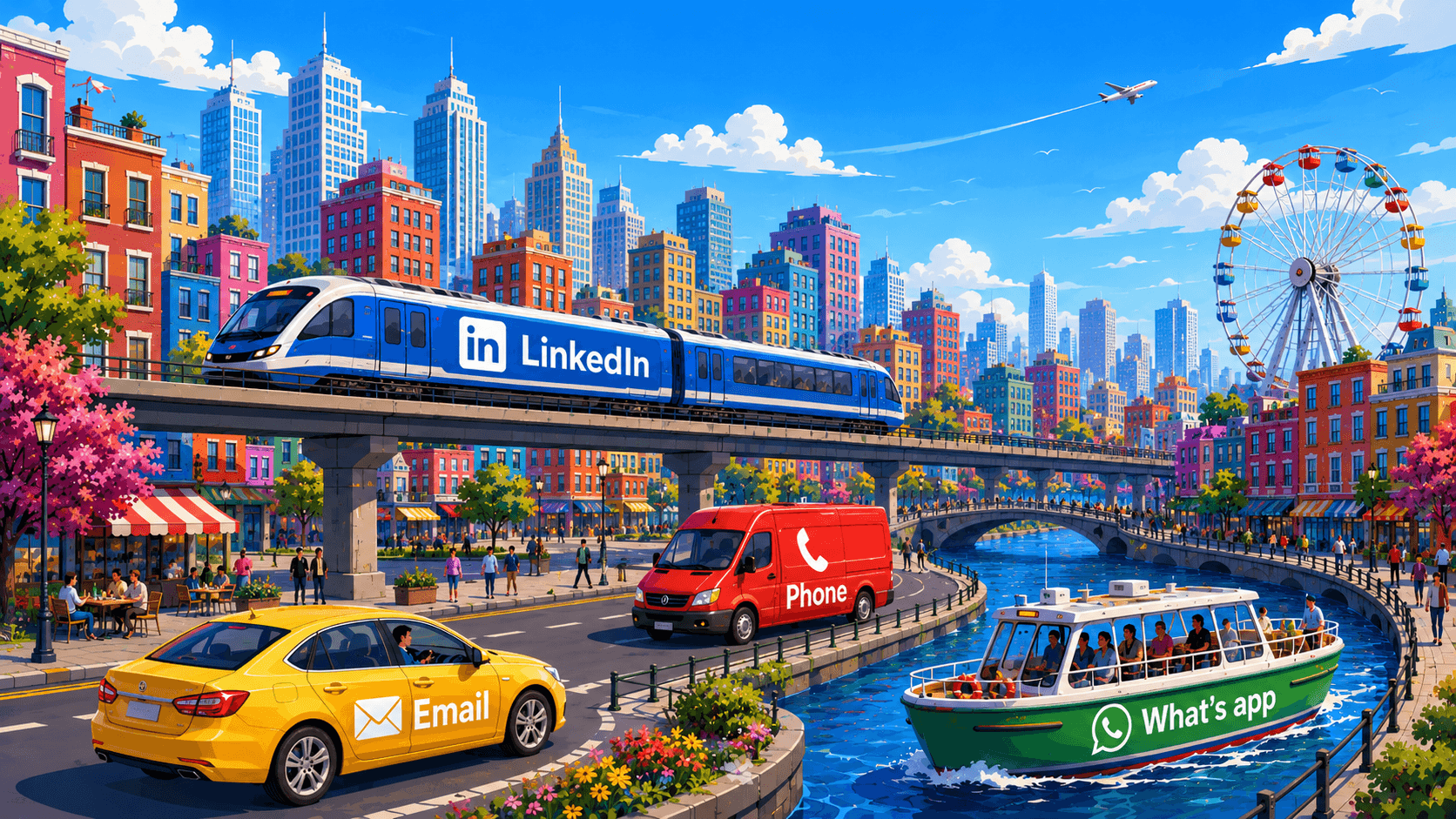
TL;DR: Why do you need multichannel outreach
Using a multichannel outreach strategy allows you to engage prospects across multiple touchpoints, which buyers now expect.
Here are a few aspects that make your multichannel outreach truly effective:
- Pick 2 channels per campaign, matched to your audience. Email plus LinkedIn for enterprise buyers, email plus phone for SMB and high-ticket deals, email plus SMS only for warm leads who have already opted in.
- Plan your sequence before sending anything. Each channel has its own role, and timing matters as much as the message itself.
- Personalize each channel. LinkedIn messages should sound nothing like your emails. When they do, prospects sense automation, and the familiarity you built collapses.
- Let automation handle execution, not strategy. Tools like Snov.io outreach automation platform can branch sequences based on behavior, automate LinkedIn as well as email activity, and pull contacts out the moment they convert.
- Measure the right things. These can include replies and LinkedIn acceptance rates.
- Avoid the common traps. Such as sending touches too quickly, ignoring deliverability, copying messages across channels, and setting sequences you never revisit
The goal here is simple: by the time you make your ask, your name should already feel familiar.
Guides on multichannel outreach will tell you to play the numbers game and show up everywhere. More channels, more touchpoints, more chances. That sounds logical until you realize every other sender is thinking the same thing.
What works is not more channels but the right ones, used in the right order. This way, by the time you make your ask, your name should already feel familiar.
This guide shows you how to get to that point.
Outline:
What is multichannel outreach?
Multichannel outreach isn’t about being everywhere at once. It’s actually a carefully planned sequence of touches across multiple channels, timed so that each one reinforces the previous. I’m emphasizing this distinction because it directly impacts how sales and marketing teams should design their campaigns.
True multichannel outreach works because of a simple cognitive principle: familiarity reduces friction. When a prospect sees your name on LinkedIn before your email arrives, your email doesn’t feel cold anymore. That small shift, from stranger to familiar name, is what the whole approach is built on.
Multi-channel outreach works by creating a strategic, balanced workflow that leverages multiple platforms — like email, LinkedIn, phone, and SMS — to generate qualified leads, rather than relying on a single channel.
Done right, it becomes a core part of a repeatable, scalable sales process that moves prospects from first touch to closed deal with far less friction.
Why multichannel outreach work better than single-channel
Relying on a single channel, such as email alone, limits your ability to engage prospects effectively. Using multiple platforms, on the other hand, increases your chances of connecting and getting a response.
Here are a few simple reasons multichannel outreach beats single-channel:
- Each touch makes the next one land differently. By the time you make a direct ask, you are no longer a stranger.
- Top-performing teams personalize across several channels while lower-performing ones manage less.
- Prospects who do not respond on one channel sometimes respond on another, not because they missed you, but because a different format caught them at a better moment.
- With multichannel outreach, you can achieve 6 to 8 touchpoints more quickly, leading to faster sales cycles. This approach is crucial for capturing buyer attention, as it enables more personalized and relevant interactions.
The result is a sequence where each touch does actual work, making the next step feel earned rather than intrusive.
Key channels
Using different channels and multiple platforms is essential to maximize your reach and engagement in multi channel outreach campaigns.
Here are a few channels worth including in your outreach sequences and how each one fits in:
- Despite claims that email is dead, it remains the backbone of almost every effective outreach strategy. About 73% of buyers prefer to hear from sellers via email, and last year, half of all customers made a purchase directly from an email. The return on investment is also extremely high, often $10 to $50 for every dollar spent.
- LinkedIn works especially well as a warm-up channel. A profile visit or connection request before your second email moves you from a stranger to someone they have already seen. This alone can improve response rates by up to 78%.
For mid-market and enterprise buyers, it also gives them something credible to find when they look you up, and with over 63 million decision-makers on the platform, you are showing up where they already are.
- Phone earns its place after a few email touches. By that point, it is a very different conversation than a cold call out of nowhere. Keep voicemails short: your name, a reference to the email you sent, and a callback number.
- SMS is a narrow use case; it works for warm leads who have already opted in. Sending cold SMS without consent creates legal risk and damages your sender reputation fast.
Each channel plays a different role, and knowing when to use each one is what makes a sequence feel coordinated.
How to build and run a multichannel outreach strategy
Managing multiple sales channels and multiple tools can be challenging, but it’s necessary for effective outreach in today’s sales environment.
Most multichannel outreach fails before a single message goes out. I can’t stress it hard enough: strategy comes first. Here is how to approach it in a few simple, easy-to-follow steps.
Step 1: Define your audience
Before choosing channels or writing a single word, get clear on who you are targeting and why now. Ask yourself:
- Where is this prospect in their decision process?
- What signals suggest they are a good fit right now?
- What does someone in this role actually care about?
Prioritize accounts showing real intent signals: recent funding, a new hire in a related role, a competitor switch.
💡Extra tip
If you are not entirely sure who your ideal customer is, Snov.io’s AI Buyer Persona Generator can provide a clearer starting point.
It builds your ideal customer profile based on your service description and highlights the buyer types most likely to convert.
Step 2: Choose the right channel mix
I’d keep it to 2 channels per campaign. Beyond that, sequences just get harder to manage.
Next, match the channel mix to who you are targeting. Here’s one way to look at it:
- Email + LinkedIn is the right call for mid-market and enterprise buyers. These people research before they respond and will look you up before they ever reply. Having a solid LinkedIn presence means your email lands with some credibility already attached.
The data backs this up as well: 89% of B2B marketers use LinkedIn for lead generation, and 62% say it outperforms other multiple platforms.
- Email + phone works better for SMB founders, high-ticket deals, or anything time-sensitive. At smaller companies, founders and decision-makers often answer their own phones.
- Email + SMS is a narrow, specific use case. It works well for warm leads who have already engaged with you, such as webinar sign-ups, demo requests, or event attendees.
Here is a clue into how to map your ICP to the right combination:
Bottom line: Not every channel works for every audience.
Step 3: Map out the full sequence
Think of your sequence as one conversation happening across multiple places. Each channel plays a specific role at a specific moment, so map everything out before you send anything.
Sales teams should also align their efforts and share data across channels to ensure cohesive, efficient, and impactful multi channel outreach. When everyone is working from the same information, your sequence stays consistent, and your handoffs stay clean.
Also, remember that timing matters just as much as the message itself. If your touches are too close together, they blend into noise. But if they’re too far apart, the familiarity you’re building fades.
So what does a multichannel campaign actually look like? Here is an example to give you a clearer picture:
- Day 1
Personalized email plus LinkedIn profile visit. The visit puts your name in front of them before they open anything. Snov.io can also automate these visits so they happen at the right moment without any manual effort.
- Day 3:
LinkedIn connection request with a short, specific note. Snov.io handles the sending while staying within LinkedIn’s safe limits.
- Day 5:
Follow-up email with a completely different angle: a case study, a pointed question, a fresh reason to engage.
- Day 8:
LinkedIn message if they connected, another email if they didn’t. Snov.io automatically manages this based on what happened in the previous step.
- Day 14
The final email should be short and honest, with one simple next step. It often gets responses from people who ignored earlier messages, as loss aversion tends to kick in.
Once built in Snov.io, the sequence runs on its own and adjusts based on each prospect’s responses.
Step 4: Personalize every touchpoint
Personalization is not optional. Over 50% of customers are frustrated by irrelevant content, and 41% are disappointed when outreach does not reflect their actual needs. People notice when something feels copy-pasted.
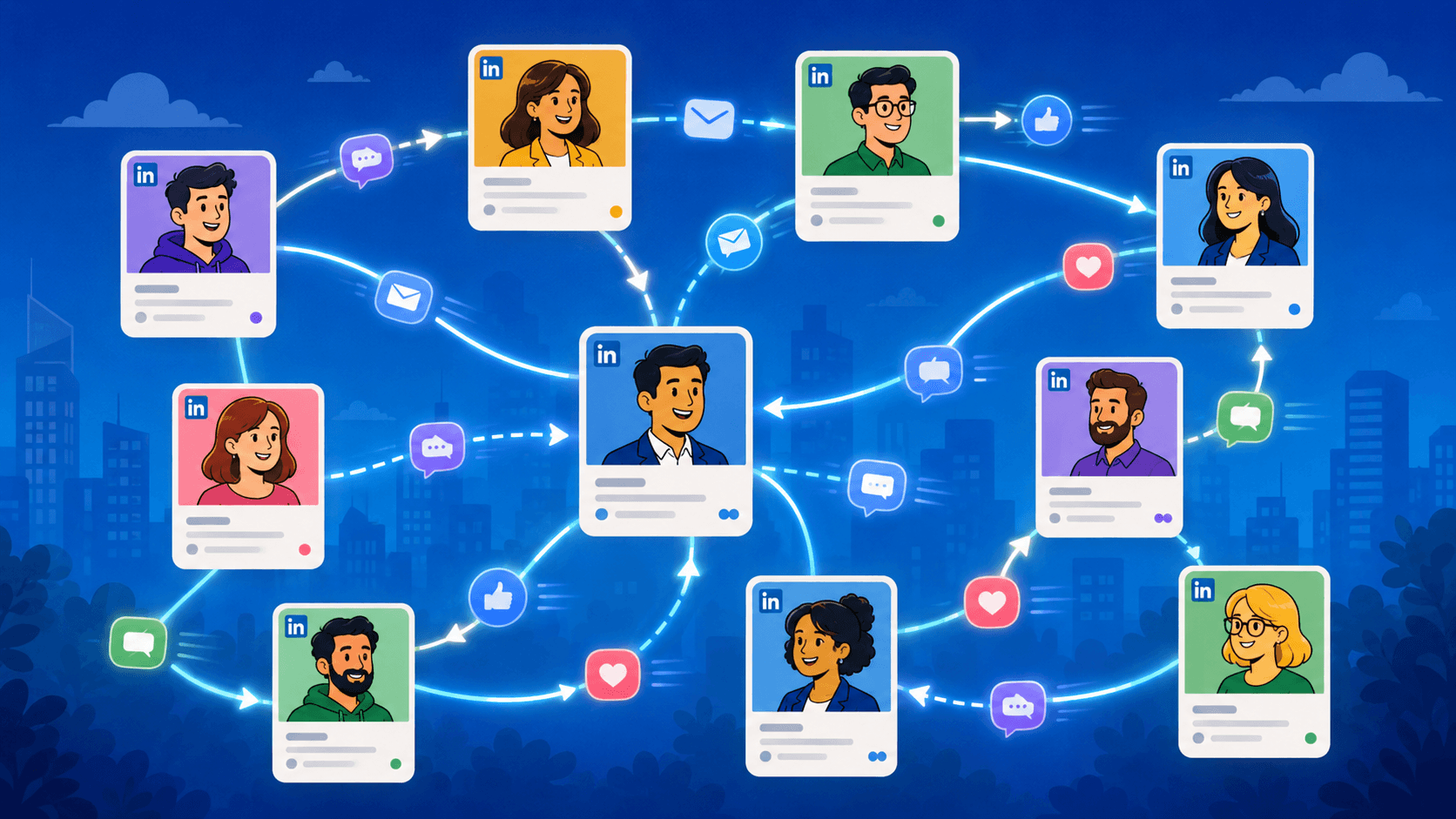
Each channel also has its own pace, and your messaging should reflect that. When a LinkedIn message reads exactly like your emails, it’s obvious they’re automated. That one detail can undo the familiarity you spent several touches building.
But it’s essential to keep your core message and tone consistent throughout your multi channel outreach. Inconsistent messaging across channels can confuse prospects and undermine your campaign’s effectiveness.
A few tips on how to approach each channel:
- Email is where you put the substance. One call to action, a subject line that references something real about their business, and personalization that goes beyond a first name. The subject line and opening line do the heavy lifting. A/B test those two before you touch anything else.
- LinkedIn should sound nothing like your email. Keep it shorter, more conversational, and reference something you wouldn’t include in an email, like a recent post they shared or a comment they made. Small personal touches make it feel human, not automated.
- Voicemail is simple: your name, a reference to the email you sent, and a callback number. Keep it under 30 seconds and do not ask a question. Nobody calls back to answer one.
Looks slightly overwhelming? Snov.io makes all of this manageable at scale. Custom variables make it easy to include details like role, industry, or location wherever you need them. Spintax rotates your intros and calls to action so nothing starts to sound like a template, even across large lists.
Step 5: Leave the rest to automation
Managing multiple sales channels can feel overwhelming and lead to lost contact details and missed prospects. That’s exactly why having a clear system matters from the start.
Automation is where the real leverage comes from. Around 60% of businesses have already embraced it because it simply gets more done with less effort and at lower cost.
When you use multichannel campaigns based on automation, you can deliver timely, personalized messages across email, LinkedIn, and other channels, increasing engagement and conversion. A unified inbox lets you manage replies and conversations across all channels in one place, streamlining your workflow and ensuring no leads slip through the cracks.
And when done right, automated campaigns drive conversion rates 2,361% higher than traditional ones.
Snov.io handles this end-to-end through these building blocks:
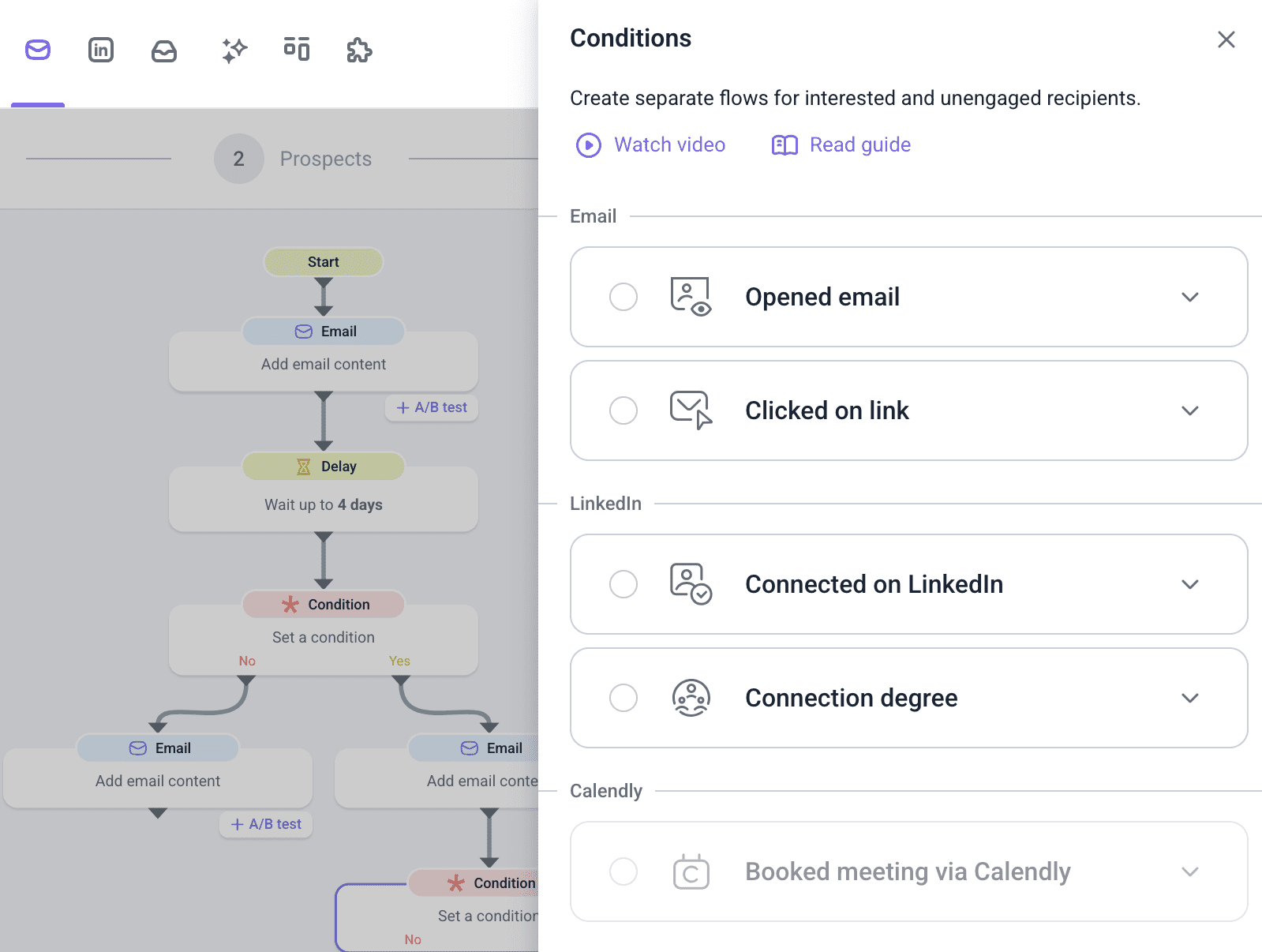
Conditions that branch the sequence based on behavior: opens, clicks, replies, or meeting bookings. Engaged prospects take a straightforward path, and unresponsive ones get a more subtle follow-up.
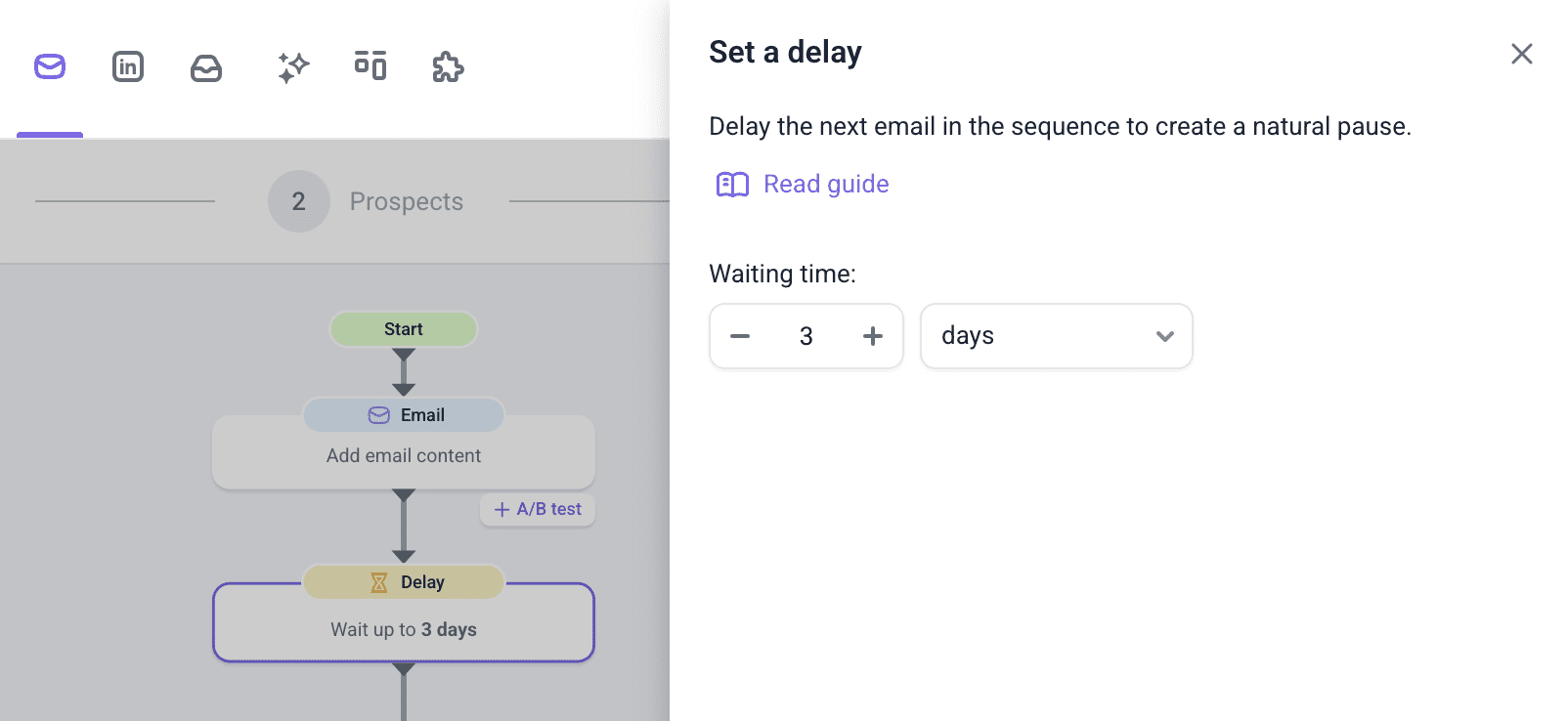
Delays that control pacing between steps based on what just happened, rather than a fixed calendar.
Goals that define what success looks like and automatically pull contacts out of the sequence the moment they convert.
LinkedIn automation runs in tandem with emails within the same sequence. Snov.io automates safe profile visits, post engagement, and follow-ups while managing timing and proxies to keep everything within platform limits.
With Snov.io LinkedIn Automation, we saw a 60% increase in deal closures, our response rate grew by 25%, and we saved 10 hours of work per week
Founder & CEO

Step 6. Measure and diagnose what is not working
I like to think of metrics as a simple funnel. Each layer shows you something different.
At the top, you can track your activity, like how many emails you’ve sent or connection requests you’ve made. Below that, you can see how people are responding, including reply and acceptance rates.
At the bottom are results like meetings booked or deals closed. This is what actually matters.
When something isn’t working, I recommend looking at where it drops off—that’s usually where the problem is.
- Low reply rates (under 2–3%) often mean your messaging or targeting is off
- Low LinkedIn acceptance rates (under 20–30%) usually point to weak personalization or the wrong audience
- High bounce rates (over 10%) signal poor list quality and can hurt your sender reputation
If these numbers look off, fix the issue first before you begin sending again.
I’ve also noticed that open rates can be a bit misleading. For example, at Snov.io, campaigns without open tracking sometimes generated 2x as many replies. That’s why I highly recommend metrics that reflect real engagement, like replies, meetings, and conversions.
Plus, it helps to set clear and measurable goals. Instead of something vague like “get more replies,” aim for a specific target, such as “book eight meetings from 200 contacts in 30 days.” That makes it much easier to see what is working and what needs improvement.
Snov.io brings email and LinkedIn data together in one place, which I find very helpful when running multi-channel campaigns. Having everything centralized makes it easier to diagnose issues and take action quickly.
Bonus section: common mistakes to avoid in multichannel outreach
Even the strongest multichannel sequences can stumble for surprisingly simple reasons. I’m not referring to rare extremes—these are small mistakes that quietly sabotage your multi channel outreach efforts.
Here’s what I recommend avoiding:
- Don’t copy-paste the same message across every channel
This is the most common and costly error. When a LinkedIn message reads like a condensed version of your email, prospects immediately sense automation, and the familiarity you’ve built collapses.
- Don’t add too many touches in a single day
Sending three messages in one day does not come across as persistent; it just feels like too much. Recognition and familiarity need time to develop.
- Don’t set multichannel sequences and forget them
Automated sequences are not “set it and forget it.” If reply rates drop below expectations, your multichannel sequences aren’t performing. Keep an eye on your subject lines, opening lines, and drop-off points. Treat sequences as living campaigns—run A/B tests, measure results, and iterate.
- Don’t ignore bounce rates and deliverability
A bounce rate above 10% can damage your sending domain, affecting every sequence sent from it. Make sure to verify every contact before sending and rely on tools such as Snov.io to monitor your domain health, spam rate, and inbox placement.

You’ll want your domain health in the 75-100% range, spam below 2%, and inbox placement above 90%. To reach and maintain these numbers, consider using a Snov.io warm-up tool, especially when working with new domains.
- Overlooking LinkedIn limits
LinkedIn has daily and weekly limits on things like profile views, connection requests, and messages. If you go over them, you risk temporary restrictions or even getting your account blocked. At Snov.io, we recommend basing your activity on your SSI score:
- SSI below 20 → daily limit of 10 actions
- Gradually increase by 5–10 actions per week as your SSI grows
- SSI 40+ → safely perform 30–40 actions per day per category
Snov.io keeps an eye on your Social Selling Index and gives personalized tips on how much you should do each day. Plus, because it follows safe automation practices, your SSI score can grow naturally as your sequences run.
Key takeaways
Multichannel outreach works when every touch has a reason to be there. Pick your channels based on who you are targeting, build your sequence before you send anything, and treat timing as seriously as copy. Review what is working, fix what is not, and never let a sequence run untouched for too long.
I encourage you to try building your first multichannel outreach sequence in Snov.io. Here, everything from LinkedIn automation to email delivery and performance tracking lives in one place.