TL;DR:
This cold email statistics report combines industry benchmarks with insights from 10+ million emails analyzed by Snov.io. Here are the highlights selected by our editor:
- The average cold email open rate in 2026 is 27.7%.
- Personalized cold emails achieved higher open rates (20.79% vs. 14.96%) in Snov.io’s dataset.
- Disabling open tracking increased reply rates from 1.08% to 2.36%.
- Wednesday between 7 a.m. and 11 a.m. delivers the highest reply potential.
- A 2-email sequence with one follow-up generates the highest response rate (6.9%).
- Emails with fewer than 100 words performed best at scale, while emails without attachments achieved lower bounce rates.
To boost metrics, focus on deliverability, utilize advanced personalization techniques, and segment your list effectively. Schedule sequences based on your audience’s timing preferences and test your campaigns regularly.
Support your metric optimization with powerful email outreach solutions, such as Snov.io’s cold outreach automation.
Cold emails remain one of the most cost-effective strategies for generating leads and driving sales. Especially when done smartly. But how do you know whether your messaging strategy is working? Are your metrics competitive, or do your emails land in the spam folder instead of the primary inbox?
In this guide, we’ll break down the latest cold email statistics for 2026, so you can compare your performance with existing benchmarks. Learn the average response rate for cold emails, what open rate is good for your industry, and other stats to measure your success and grow faster.
What you’ll learn:
- General cold email statistics
- Cold email open rate statistics in 2026
- Cold email response rate statistics in 2026
- Cold email conversion rate statistics in 2026
- Cold email timing, frequency, and delivery insights
- Cold email copy statistics
- How to improve your cold email metrics: tips and tools from Snov.io
General cold email statistics
Let’s start with some key B2B cold email statistics and broader market trends shaping outreach performance in 2026:
- In B2B, about 61% of decision-makers prefer email as the primary channel for outreach.
- 37% of decision-makers receive more than 10 emails per week.
- However, 20% claim none of them are relevant.
- 73% of decision-makers claim personalization matters for cold outreach.
Cold email is predominantly used in B2B lead generation business activities, while in B2C, you’ll hardly find reliable data. Why? Because most research in this area focuses on newsletters, marketing drip campaigns, and other permission-based campaigns rather than on cold outreach itself.
This issue lies within strict compliance boundaries. Sending cold emails to individual consumers is heavily restricted by laws like CAN-SPAM and GDPR. That’s why most B2C campaigns target people who’ve already opted in.
But we still managed to find several useful B2C cold email marketing statistics. According to the Emailtooltester report:
- 38% of surveyed consumers prefer companies to contact them by email.
- On average, people receive 15 cold emails per week.
- 51.4% of them come from companies in the health and beauty industry.
- 44.7% of the surveyed consumers consider messages to be trustworthy, while 36.2% of respondents don’t trust them at all.
The takeaway is clear: people are still open to email communication, but generic outreach is far less likely to succeed.

Cold email open rate statistics in 2026
Looking into the relevant cold email effectiveness statistics may provide valuable insights on how to improve your subject lines, sender reputation, and overall targeting strategy.
The open rate is the first sign of how your campaigns perform. This metric shows whether your message reaches the right people and sparks their interest.
Average cold email open rate (B2B vs B2C)
The latest B2B cold outreach stats reveal:
- The average cold email open rate for B2B across all industries is 27.7%. Due to better personalization and sender authorization practices, this metric has increased over the last few years. In 2019, for instance, the average open rate for cold emails was only 16.6%.
- The average cold email open rate among C-level executives is 28.1%.
- For non-C-level executives, this rate is 27.3%.
For B2C, according to Emailtotester’s report:
- 51.4% of them come from companies in the health and beauty industry.
- 44.7% of the surveyed consumers consider messages to be trustworthy, while 36.2% of respondents don’t trust them at all.
While open rates vary across industries and audiences, they all have one thing in common: you need to reach the right people first. Using an email finder helps ensure your outreach starts with accurate prospect data.
|
💡 Expert tip Based on our analysis of over 44 million emails sent through our platform between February and March 2025, we found that turning off open tracking more than doubled reply rates—2.36% compared to just 1.08%. We recommend tracking other metrics, such as links or meetings booked via Calendly, to ensure your campaigns perform best. |
What is a good open rate for cold emails?
According to Belkin’s recent report:
- In general, a good open rate for cold emails in 2026 is considered to be above 45%.
- Businesses operating in the software industry have the highest open rates – 47.1%.
- The lowest average open rates are shown by companies in the consumer goods (19.3%) and banking (19.7%) industries.
Below are cold email benchmarks for various industries that you can use as reference points; aim for higher metrics to indicate strong performance.
*Based on Belkin’s 2024 study
Cold email subject line statistics
Subject lines directly influence whether email recipients decide to open a message.
Here’s what numbers tell us about their impact on open rates based on Snov.io data and industry reports:
- According to Snov.io’s 2026 research, personalized cold email subject lines achieved a 20.79% open rate, compared to 14.96% for generic emails.
- Emails containing emojis had a slightly lower open rate (17.63% vs 18.13%) but a higher click rate (2.97% vs 1.22%) and a higher reply rate (0.64% vs 0.48%).
- Using spam-trigger words was linked to a much higher bounce rate (3.43% vs. 1.53%).
- According to Zippia’s research, approximately 64% of people decide whether to open an email based on the subject line, while 33% do so based on a catchy subject line.
- Zerobounce provides a bit higher percentage: 43% of people will engage with a message that has an attention-grabbing subject line.
- Interestingly, based on Mailchimp’s study, subject lines that include both recipients’ first and last names have the most positive impact on open rate (33%).
- Using just last names in subject lines brings a 17% open rate.
- Using only first names in subject lines generates only a 9% open rate.
- According to a study conducted by Yesware, subject lines that include numbers generate 45% higher open rates.
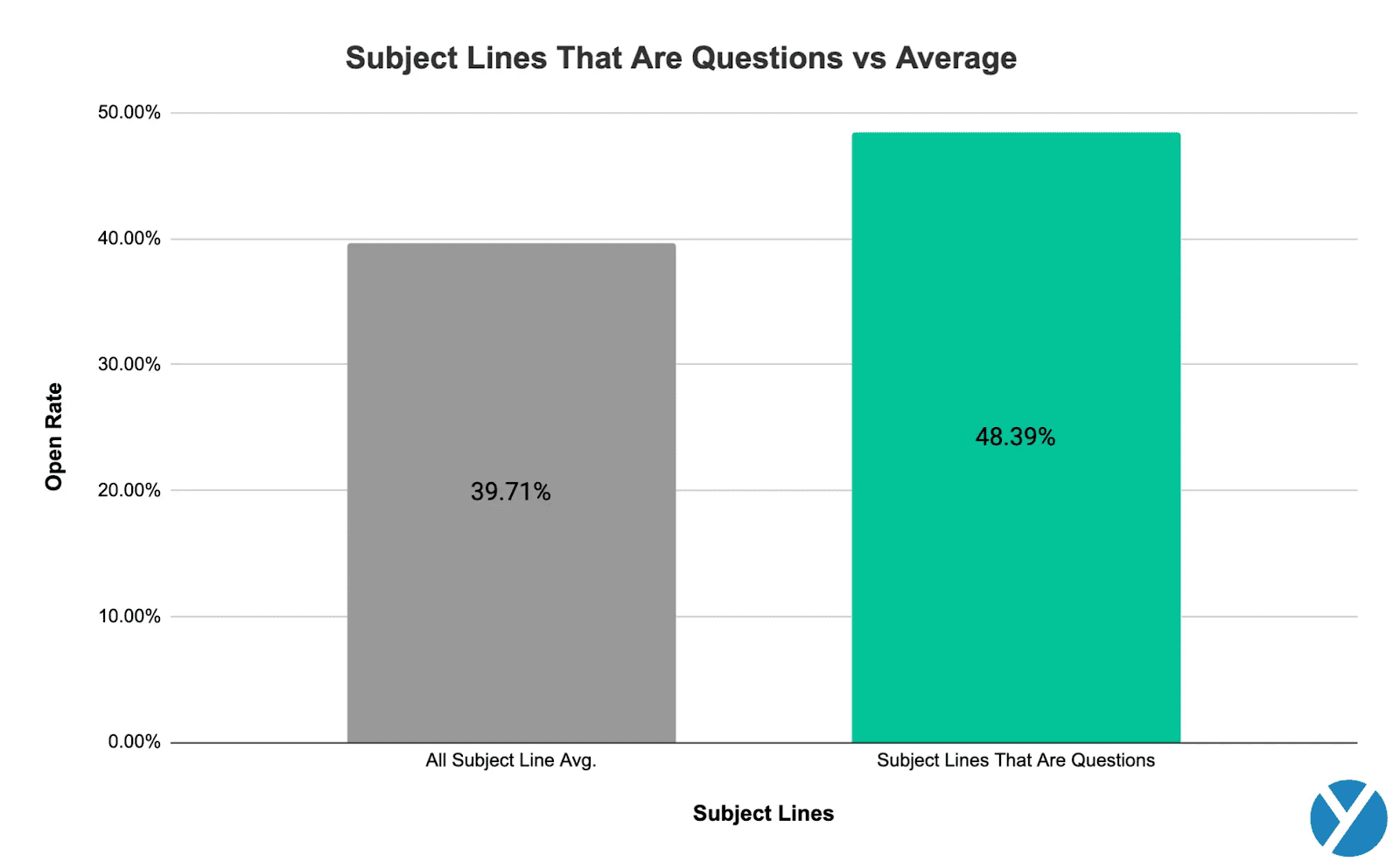
- Subject lines framed as questions may bring you a 10% higher open rate.
We can clearly see that questions spark more interest in recipients.
What about salutations in subject lines?
- Generic greetings, such as “Hello” or “Friend”, used in subject lines can lower open rates to 9%.
- As is stated in Belkin’s report, subject lines that are three, seven, or eight words long show the highest open rates (33%).
- Surprisingly, subject lines in uppercase have the highest open rates of 35%, while subject lines in Sentence case show an open rate of 24%.
🤔 How to find out which subject lines work best in YOUR campaigns?
Identify the most compelling subject lines using Snov.io’s A/B testing feature. You can include up to 15 variations to each step of your campaigns, so don’t limit yourself.
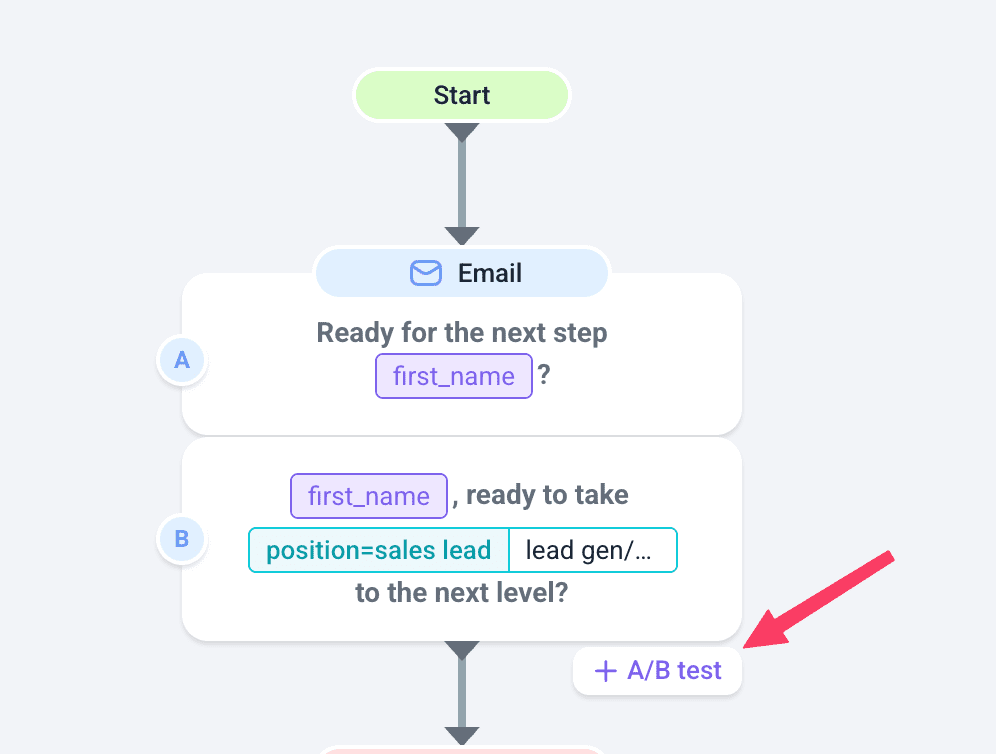
Experiment with subject line length, style, case, CTA, wording, or any other idea you have to see what drives opens in your niche.
Cold email response rate statistics in 2026
Cold email response rate statistics indicate whether recipients are interested in your message’s content. But what is a good reply rate for cold email? Let’s review relevant emailing statistics and industry benchmarks to figure it out.
The average reply rate for cold email
According to recent average cold email response rate statistics published by Belkins:
- The average response rate for cold emails is 5.1%.
- The average cold email response rate statistics for C-level professionals is 4.2%, while for non-C-level executives, it is 5.6%.
- Emails to HR specialists show the highest reply rate of 8.5%.
- Sequences sent to fewer than 100 recipients drive the highest reply rate, up to 5.5%.
Overall, reply rates vary by audience, but relevance and targeting remain key drivers of engagement. To reach the right people faster, use an email finder extension that locates email addresses on company websites as you browse.
We looked for a reliable tool to generate the contacts of decision-makers and pitch services to the found prospects in the most efficient and affordable way. Snov.io has all that and even more! With emails scraped using its finder tools, we consistently hit 40% open rates, which is our most important metric.
Director at Growth Hackers

But what is a good response rate for cold email in 2026?
Considering cold email benchmarks mentioned above:
- A truly good cold email reply rate in 2026 is 10%.
- Legal services companies have the highest response rate across industries, up to 10%.
- Businesses operating in the software sector show the lowest response rates (less than 1%).
Keep in mind that this is a general score, not tied to any specific industry. B2B cold email response rates depend on the niche and the target recipients, so don’t be discouraged if your results are slightly lower.
Take these benchmarks for various industries as a reference point and aim for higher cold email open rates:
However, if you’re seeing a response rate below 5%, it may indicate that your campaign needs optimization.
Cold email response rates can vary significantly depending on your targeting, messaging, and follow-up strategy. But the campaign structure itself also plays a major role in whether recipients engage with your emails.
Here’s what Snov.io internal campaign statistics tells us:
- Campaigns with follow up emails achieved a much lower bounce rate (0.25% vs 0.63%) and lower unsubscribe rate (0.02% vs 0.08%).
- Follow-up campaigns generated more total replies (9,678 vs 8,769).
- Auto-reply rates were also lower in campaigns with follow-ups (0.11% vs 0.19%).
This suggests that well-structured follow-up sequences are associated with lower bounce rates, fewer unsubscribes, and more total replies.
|
💡 Expert tip When it comes to cold outreach and sales, response rate is often considered a key metric for measuring cold email engagement. But what matters most is the quality of these responses. You can track it with Snov.io’s Sentiment analysis. This feature uses AI to analyze all replies and determine your recipients’ level of interest. Thus, you can identify prospects with the highest potential and focus your efforts on them rather than on less promising leads. |
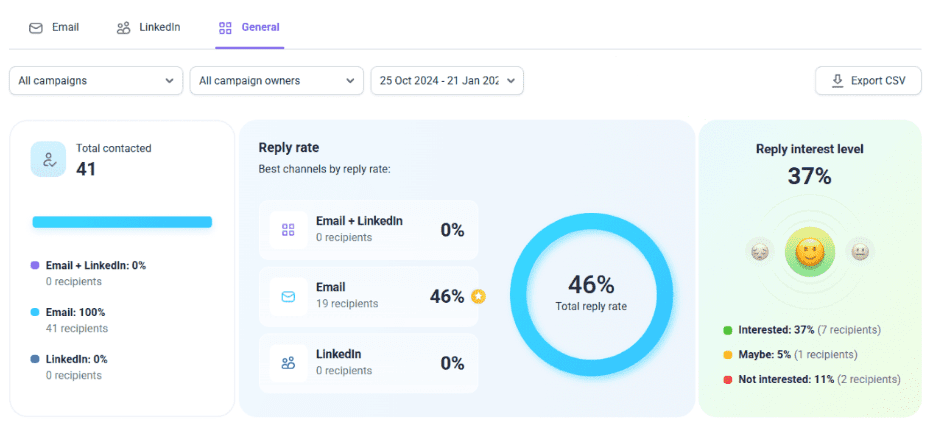
Now, let’s move on to the cold email conversion rate statistics.
✨ Want to get even more value from AI for your outreach? Learn how to build a cold email system with Claude Cowork and Snov.io:
Cold email conversion rate statistics in 2026
The ultimate sales goal isn’t high reply rates — it’s conversions. And not every reply equals a conversion. So, first, let’s define what can be considered a conversion in cold outreach, and then dive into key emailing statistics.
What is a conversion in cold emailing (reply, meeting booked, etc.)?
Typically, a conversion means that your recipient took a desired action. This can be a booked meeting, a positive reply (or any reply at all), a purchase, signing up for a trial, and so on.
Average cold email conversion rate
According to recent Focus Digital research:
- The average conversion rate for cold emails is 0.2153%.
- This conversion rate means that one deal is secured for every 464 emails sent.
- Personalization can improve this metric by 10%.
Again, to find your optima, refer to the average cold email conversion rate benchmarks, which differ from industry to industry:
*Based on a 2024 study by Focus Digital
Cold email timing, frequency, and delivery insights
Your cold outreach success largely depends on what you send, when you send it, and how often you reach out. Let’s get into some helpful insights and statistics on cold outreach regarding email length, scheduling, and volume.
Best days/times to send emails in 2026
Based on Beklins’ study:
- July boasts the highest response rate among all months (6.3%), while December shows the worst results (4.67%).
- Cold email open rates are the highest on Tuesday (28.2%) and Wednesday (27.5%).
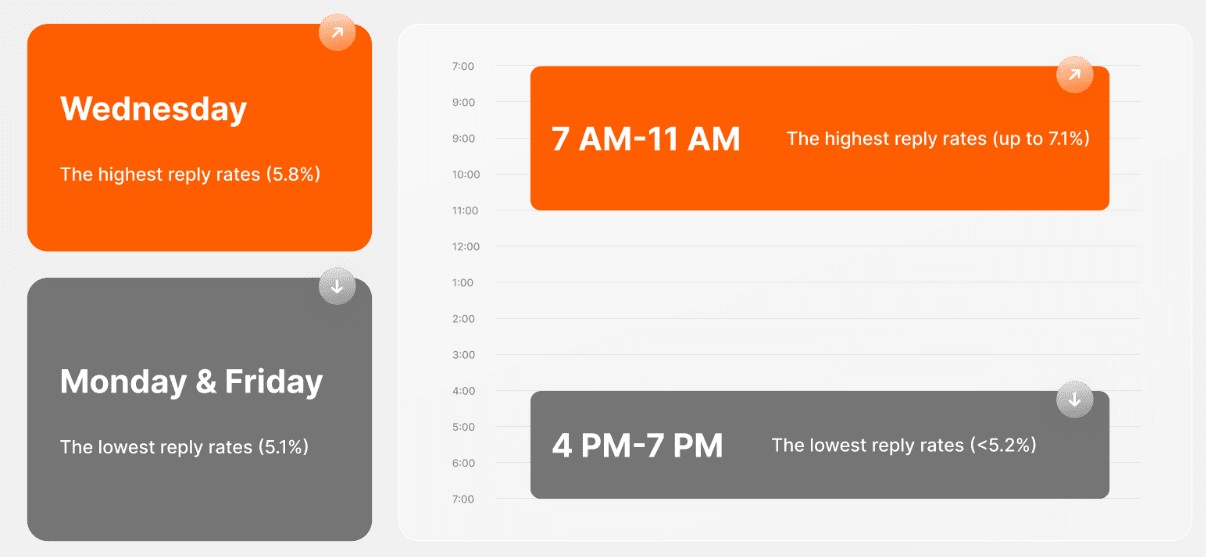
- People are most likely to respond between 7:00 and 11:00 a.m.
- Wednesday sees the highest cold email response rate at 5.8%.
- The worst days regarding response rates are Mondays and Fridays, at 5.1% each.
Time of day also matters, as evident here:
- According to Emailtotester’s report, for B2C campaigns, the optimal sending time is between 5 a.m. and 8 a.m. on Monday, with an average response rate of 2.3%.
For most targeted campaigns, timing matters almost as much as the message itself. The strongest results were generated when the initial email reached prospects during active working hours.
Average cold email stats: bounce rate and unsubscribe rate
When evaluating campaign performance, bounce and unsubscribe rates are metrics worth close attention. Here’s what Snov.io’s internal cold email data shows:
- Campaigns containing spam-trigger words generated a significantly higher bounce rate (3.43% vs 1.53%).
- Emails containing emojis had slightly higher bounce rates (2.03% vs 1.81%) and unsubscribe rates (0.11% vs 0.05%), but also higher click and reply rates.
- Emails with attachments underperformed on deliverability metrics, resulting in a higher bounce rate (2.98%).
Industry-wide studies provide additional benchmarks for comparison. According to cold email stats, provided by QuickMail:
- The average unsubscribe rate is 2.17%.
- The average unsubscribe rate is 2.17%.
- The average bounce rate is 7.5%.
- A good deliverability rate for cold outreach is 95% or higher.
- Cold email response rates can increase by nearly 49% after one follow-up.
Overall, bounce and unsubscribe rates are often early warning signs that something in your targeting, messaging, or sending practices needs attention.

How many cold emails do you need to get a reply or a client?
There is no universal rule for each campaign, industry, or business type. However, the best option is to send no more than 2-3 follow-ups to not overwhelm your prospect.
Here is what the follow-up stats say:
- Cold email response rates can increase by nearly 49% after one follow-up.
- Two follow-ups can bring 3.2% more responses.
- Three follow-up drops responses by 30%.
- Moreover, sending the fourth follow-up may result in a 1.6% spam rate and a 2% unsubscribe rate. This may be detrimental to your sender’s reputation, so don’t exceed three follow-ups per sequence.
- Belkin’s study revealed that a 2-email sequence with one follow-up shows the highest response rate at 6.9%.
- The best time to follow up is 3 days after sending your initial message.
Industry studies point to the value of 1-2 follow-ups, but our own campaign data adds a few interesting nuances:
- Campaigns with follow-ups maintained substantially lower bounce rates (0.25% vs 0.63%) and unsubscribe rates (0.02% vs 0.08%).
- Both campaign types generated the same average reply rate (0.41%), although follow-up campaigns produced more total replies.
These findings suggest that follow-ups remain an important part of cold outreach.
Cold email copy statistics
Different template choices can significantly impact cold email strategy performance, affecting everything from open and click rates to bounce, unsubscribe, and reply metrics.
Based on Snov.io internal campaign statistics, several clear patterns emerge across personalization, emojis, spam wording, attachments, link tracking, and email length.
How long should a cold email be?
While there is no perfect formula for every campaign, both industry research and Snov.io cold email data reveal several clear performance patterns for the optimal email length:
- According to Belkins, emails with fewer than 100 characters generate the highest response rates, reaching up to 5.4%.
- Messages without attachments or graphic materials tend to achieve almost 2x higher reply rates, while visual elements may slightly improve click-through rates from 0.51% to 0.84%.
- Emails between 100 and 200 characters reportedly show the lowest bounce rate at 1.9%.
- Emails written in 1–2 short paragraphs perform best overall, reaching response rates of approximately 3.8%.
- Messages containing shorter sentences with fewer than 10 words per sentence also tend to generate higher response rates.
Snov.io internal campaign statistics support many of these trends:
- Emails with fewer than 100 words generated a 0.54% reply rate across more than 4.6 million sends, making them one of the strongest-performing formats at scale.
- Emails between 200 and 500 words delivered the most balanced performance in terms of opens, clicks, and replies.
- Emails longer than 5,000 words had the highest reply rate (1.06%) but accounted for a much smaller share of total sends.
- Emails between 500 and 1,000 words consistently produced the weakest engagement metrics.
While email length alone doesn’t determine success, our data suggests that shorter emails consistently deliver the strongest results at scale.
Is cold email personalization worth it?
Yes, adding personalization pays off! Here’s what the data says:
- Personalized emails achieved a significantly higher open rate (20.79% vs 14.96%) than non-personalized emails.
- Personalized campaigns also generated stronger click rates (1.80% vs 0.82%) and reply rates (0.58% vs 0.42%).
- However, personalized emails also showed slightly higher bounce rates (2.55% vs 1.29%) and unsubscribe rates (0.07% vs 0.03%).
As you see, cold email personalization statistics suggest that customized emails generated more opens, clicks, and replies.
Do emojis help or hurt cold email performance?
Some teams swear by emojis, while others avoid them completely. We looked at how they affected performance.
- Emails containing emojis produced a slightly lower open rate (17.63% vs 18.13%).
- But emoji-based campaigns generated significantly stronger click rates (2.97% vs 1.22%) and improved reply rates (0.64% vs 0.48%).
- Emoji usage also slightly increased bounce (2.03% vs 1.81%) and unsubscribe rates (0.11% vs 0.05%).
Overall, emojis didn’t increase opens, but they were linked to higher click and reply rates.
What happens when you use spam-trigger words?
Let’s look at how spam-trigger wording affected campaign performance:
- Emails containing spam-trigger words generated a significantly higher bounce rate (3.43% vs 1.53%).
- Spam wording also increased unsubscribe rates (0.10% vs 0.06%).
- At the same time, these emails showed slightly higher engagement metrics, including 2.89% click rates and an 18.88% open rate.
While spam-trigger wording may generate slightly more engagement, the trade-off is higher bounce and unsubscribe rates.
What does the data say about link tracking?
Link tracking is useful for measuring engagement:
- Campaigns with link tracking enabled achieved substantially higher open rates (21.44% vs 13.95%) and click rates (2.42% vs 0%).
- Emails with tracked links also maintained one of the lowest bounce rates in the dataset (1.15%).
- However, campaigns without tracked links generated a higher reply rate (0.87% vs 0.21%).
Tracked links boosted opens and clicks, while emails without tracking generated more replies.
Do attachments help or hurt cold emails?
According to the latest data:
- Emails without attachments slightly outperformed emails with attachments in both cold email open rates (16.12% vs 15.19%) and click rates (1.32% vs 0.75%).
- Attachment-heavy emails also generated a higher bounce rate (2.98% vs 1.86%).
The results suggest that emails without attachments performed slightly better across most metrics.
How to improve your cold email metrics: tips and tools from Snov.io
Now that you know cold email stats and key benchmarks, let’s explore how to improve your results with the cold outreach automation software. Here are practical messaging tips to optimize your campaigns:
Improve deliverability
How can prospects reply if your campaigns never reach their inboxes? Focusing on inbox placement should be step number one. Before starting cold outreach, set up proper authentication (SPF, DKIM, DMARC) and utilize warm-up tools to establish a strong sender reputation.
Looking for an advanced yet user-friendly solution to improve inbox placement? With Snov.io Email Warm-up, you can find a ready-to-use warm-up strategy that fits your specific goals.
Whether you’re preparing a new domain for cold campaigns or want to fix your domain reputation, you’ll be able to grow deliverability automatically, sparing hours of your precious time.
Aim for hyper-personalization
Therefore, to make your cold outreach more impactful, go beyond using first names. Reference a prospect’s company, role, or recent activity. You can also mention shared connections to build instant relevance and trust.
With Snov.io’s Cold Email tool, for example, you can personalize your bulk messaging on autopilot. Its advanced Dynamic content variables will help personalize each message in your sequence on the go, so it feels relevant and warm.
Meanwhile, with Snov.io’s Personalized AI Email Builder, you can create targeted messages based on your ICP and unique selling points.
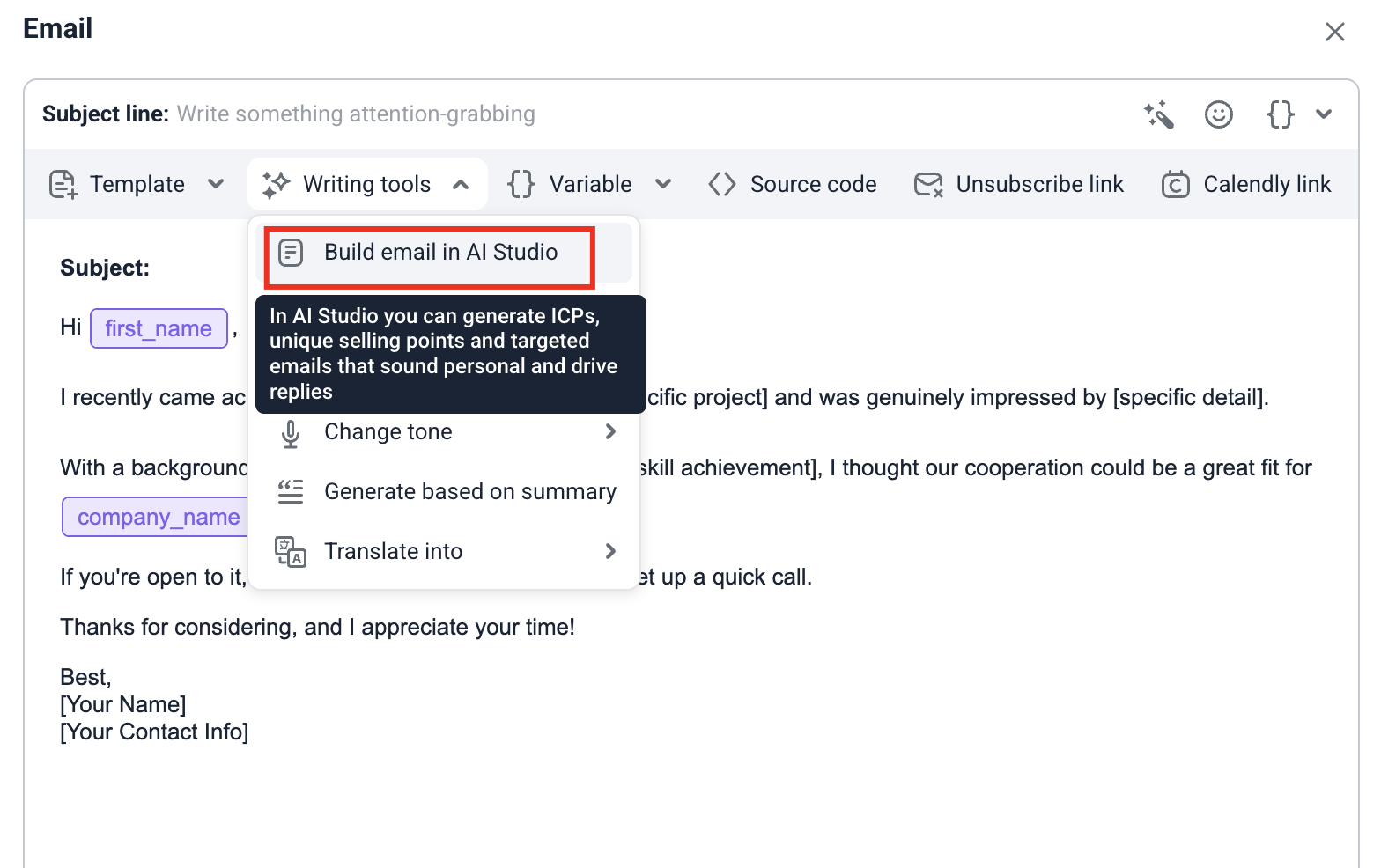
No matter how many prospects are on your list, Snov.io’s AI-powered features will make each email feel personal and relevant to your prospects.
Segment your lead list
How do you ensure your outreach is relevant to all your leads? Group them by shared characteristics and tailor your messaging at scale. By segmenting your leads based on industry, job role, location, or other criteria, you can create marketing emails that resonate with each group. More targeted cold outreach always brings better results.
Optimize your sending schedule
Timing can make or break your open and response rates. Never send campaigns randomly!
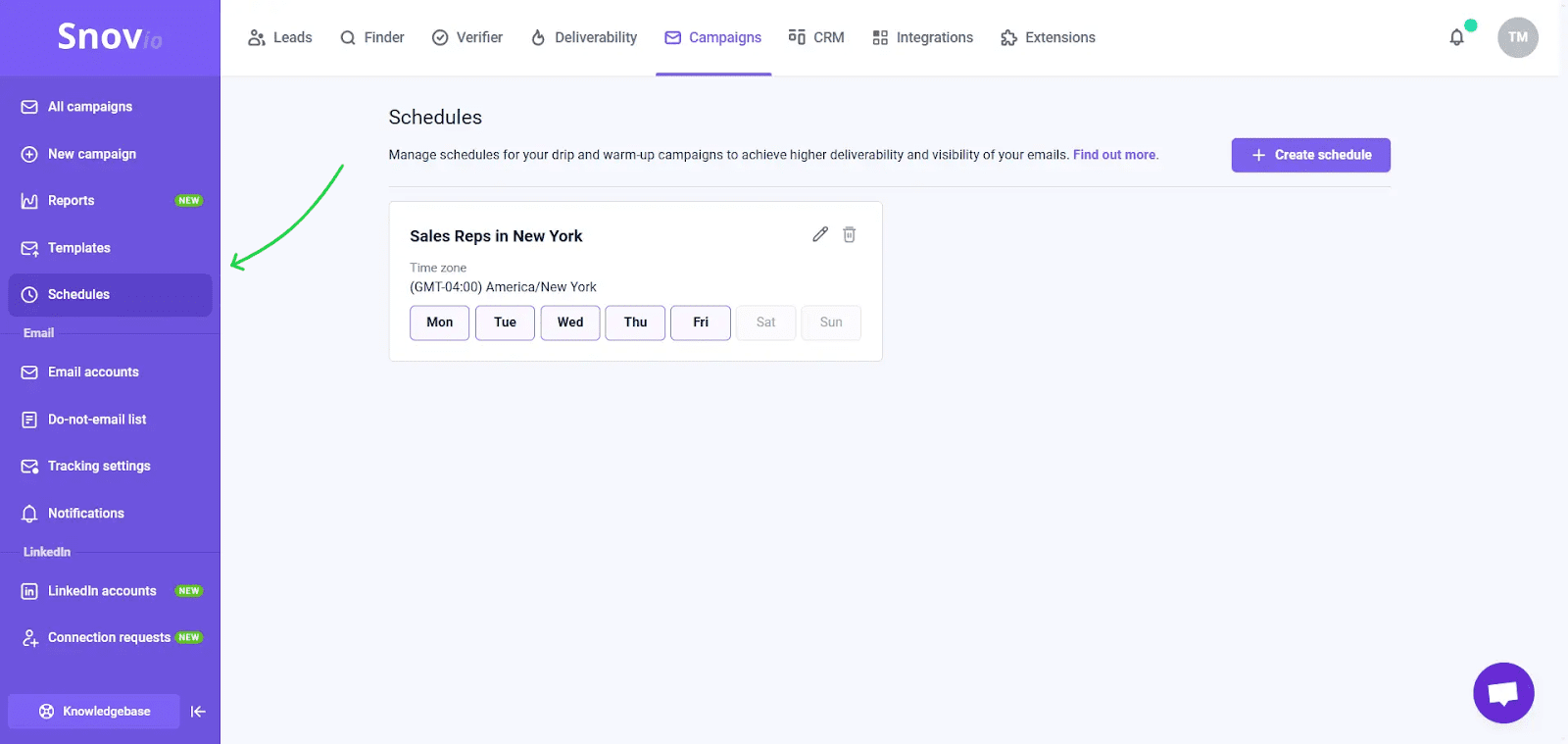
Instead, learn about your audience to align your schedule accordingly. The cold email statistics provided in this article will also be helpful.
Provide a catchy subject line and a clear CTA
Subject lines open the doors to your outreach, so make them:
- attention-grabbing
- Relevant
- clear
Meanwhile, CTA can significantly impact your reply rates. Ensure your recipient understands what you want them to do. Avoid vague phrases like “Let me know what you think.” Instead, consider adding action-oriented calls to action, such as “Would you be open to a 15-minute call?” to guide your prospect to the desired action.
Follow up strategically
Don’t give up after the first email. Most replies come after 2-3 follow-ups. Create a compelling follow-up sequence to move your prospect towards a response/action. Don’t repeat yourself in follow-ups – add fresh value to keep your cold campaigns effective.
|
💡 Expert tip Email is often combined with LinkedIn lead generation in modern outreach strategies to improve response rates. For example, start with a personalized message to introduce yourself and then follow up on LinkedIn with a connection request. With Snov.io, you can put your multichannel outreach on complete autopilot. Create automated multichannel sequences by adding LinkedIn actions to your email campaigns. You can include connection requests, profile views, post likes, following, messages, and even personalized InMails. |
A/B test to spot what’s working
Experiment with various approaches through A/B testing and analyze your results to identify the most effective options. Try out different subject lines, CTAs, texts, and other elements to see what works best. With valuable insights you gain, you’ll be able to adjust your next campaigns — a key strategy for boosting cold email open rates and other metrics.
The idea is simple: if we don’t keep our strategies fresh, we might miss out on connecting with potential clients. Our recent tweaks have upped our response rates to a steady 3-4%, but who knows how long that’ll last? So, we constantly optimize and test. Personalized content and smart timing are the main ingredients that grab the attention of busy execs.
VP of Sales at Salesforge.ai
Key takeaways
Cold emailing still works in 2026, but the data shows that campaign performance depends heavily on how your outreach is structured.
Here are the biggest patterns revealed by the Snov.io internal dataset and industry benchmarks:
- Personalized subject lines, questions, numbers, and concise wording consistently improve engagement.
- Personalized outreach significantly improves performance across nearly every key metric.
- Outreach template structure matters. Emails without attachments generally outperformed attachment-heavy campaigns in both engagement and deliverability metrics.
- Link tracking dramatically improved click rates and open rates, although simpler emails without tracked links often generated stronger reply rates.
- Spam-trigger wording slightly increased short-term engagement but also produced substantially higher bounce rates.
- Short emails performed best overall, driving more replies while maintaining lower bounce rates.
- Follow-ups improved overall reply volume and reduced unsubscribe rates.
The trends behind the strongest cold email success rate benchmarks are remarkably consistent: better targeting and stronger personalization. That’s exactly what Snov.io is built to help you achieve.