TL;DR:
An email sequence is a structured series of pre-written messages that help naturally build interest and move new leads or existing customers toward a conversion by sending relevant emails automatically. When done right, an automated sequence can streamline the sales process, re-engage inactive subscribers, and create a smoother customer journey.
Here are the best practices for building sequences that convert:
- Define one clear goal for every sequence before writing your emails.
- Segment your email subscribers by industry, role, behavior, readiness to convert, and other criteria to build more relevant and tailored sequences.
- Space emails naturally to stay visible without overwhelming recipients or looking spammy.
- Use customer data to create personalized messages and avoid sounding generic.
- Provide value before pitching with useful insights, helpful resources, or educational content.
- Make the next step clear to your recipient and try to keep one CTA per email.
- Track performance and optimize sequences based on the metrics that matter most for your goal.
Read further to explore more expert tips, practical examples, and email sequence templates, and build effective campaigns for your business needs.
When dealing with email marketing automation, you’ve most likely come across the term ‘email drip campaign’ more than once. However, some sources highlight another term, ‘email sequence,’ and never mention email drip campaigns.
If this has left you puzzled, this post is for you. In this article, I’ll explain the difference between these two notions, focusing more on email sequences, how to build them, their various types, and some illustrative examples.
Off we go!
Outline:
What is an email sequence?
An email sequence is a series of pre-written emails sent automatically in a specific order and at scheduled intervals to a select audience.
Email sequences are generally used for lead nurturing, onboarding new users, promoting products, or delivering other types of content. The aim of sending automated email sequences is to seamlessly guide recipients through the sales funnel toward conversion (typically a purchase decision).
Difference between email drip campaign and email sequence
The terms ‘email drip campaign‘ and ‘email sequence’ are often used interchangeably, as both involve sending a series of emails to a target audience to increase engagement and move prospects closer to conversion.
Yet there are subtle differences between the two: the term ‘drip campaign’ is broader and focuses on various automated email strategies.
Some email marketing experts also draw the line between the notions based on their main purpose. Email sequences are commonly used for more personalized and targeted communication that adapts to user interactions. In contrast, email drips are static emails that rely more on predetermined rules than on the user’s interactions.
Personalized email sequences require thorough segmentation. For email drips, you just need to set up trigger actions (conditions) and write emails.
|
Situation 1 Let’s take a welcome email you automatically send using your marketing automation tool after gaining new subscribers through the opt-in form on your landing page. This email is part of an email drip campaign because it doesn’t require audience segmentation. You just configure the settings so that every new user receives the same message based on a predetermined rule: signing up for your newsletter by entering their email address. But if your campaign involves a series of welcome emails, you could say you have a welcome email sequence in your drip campaign. Situation 2 Now, imagine a campaign that depends on how your leads interact with your brand. You can’t send the same sequence or email copy to every lead, as they are at different stages of the funnel. For instance, some may be active readers of your blog, so you’ll send them regular email digests, while others might need just a slight push to make a purchase—a perfect opportunity to surprise them with a special offer email. In this scenario, you need to segment your leads and send customized messages based on user behavior, purchase intent, or sales pipeline stage. These emails will form your lead nurturing sequence. |
As you can see, the distinction between these two concepts is somewhat theoretical. For us, the senders, it’s more important to understand which email sequences are effective and how to create an automated email sequence that magnetizes prospects to convert, just like the smell of morning coffee in a popular TV ad.
💡 Expert tip:
To optimize your workflow and drive even more results with your sequences, I recommend implementing an automation tool. For example, Snov.io’s cold email software can help you streamline the process by automating most outreach tasks and freeing up time for strategic planning or actual closing deals.
Collect high-quality leads anywhere on the web, check your list with Email Verifier, and create personalized sequences at scale within a single platform. Then, track performance with customizable reports and AI-powered analytics to improve results through data-driven decisions.
Email sequence examples and types
Email marketing specialists distinguish the following types of sequences:
- Welcome email sequence
- Onboarding email sequence
- Abandon cart email sequence
- Re-engagement email sequence
- Event email sequence
- Repeat customer/post-purchase email sequence
In many ways, these email sequences coincide with the respective email drip campaign types, which I’ve already discussed in one of my previous articles.
In this article, we’ll shift the focus to the more sales-oriented scenarios and explore practical sales email sequence examples:
- Cold email outreach sequence
- Lead nurturing email sequence
- Engagement email sequence
- Follow-up email sequence
- Conversion email sequence
- Improved sales email sequence
- Reminder email sequence
Each of these sequences plays a specific role in nurturing leads and converting them into new customers, so let’s take a closer look at these types.
Cold email sequence example
A cold email sequence is a series of outreach emails designed to engage and warm up prospects unfamiliar with your brand. By covering several touchpoints, you can showcase your offer better than in a single message.
With a specific purpose per email, the sequential strategy lets you gradually move your prospects through the sales funnel.
Here’s a cold email sequence example:
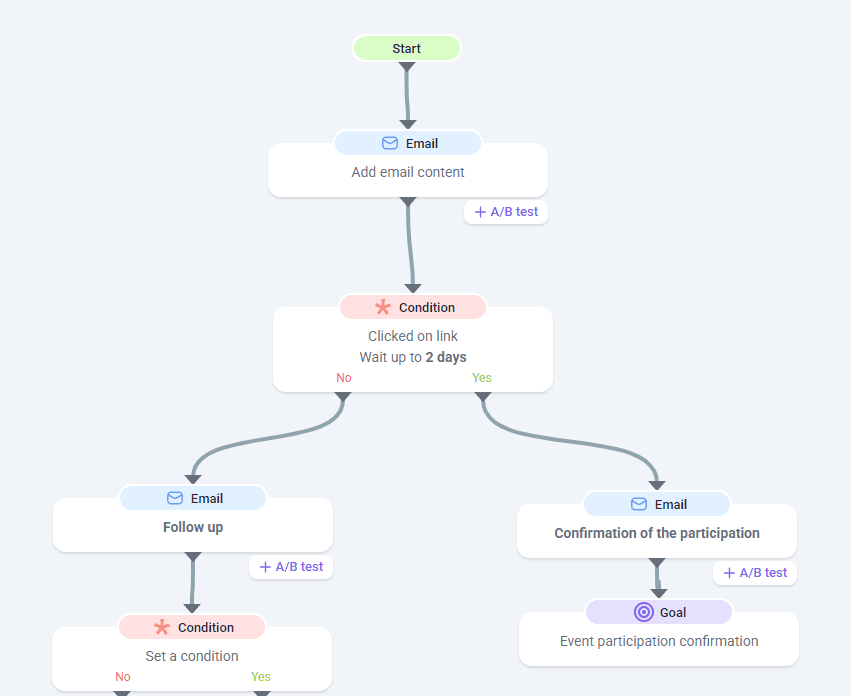
Cold email sequences are essential for sales growth because they enable a more targeted and persistent approach to outreach.
Messages sent at proper time intervals allow you to remind recipients of your offer without overwhelming them, giving them enough time to consider your value proposition. A well-planned cold outreach email sequence can ultimately convert prospects into warm leads.
Lead nurturing email sequence
Of course, you can create a lead nurturing email drip campaign that will include various sequences (welcome, educational, event, you name it). But in this paragraph, I’ll talk about a lead nurturing email sequence for companies with fast-paced sales cycles. The goal? To give your prospects a warm welcome and swiftly move them closer to conversion.
Imagine kicking your nurturing sequence off with a welcome email that does more than just say “Hi.” Thank your leads for subscription and give them a lead magnet they can’t resist, coupled with first-hand instructions on how to use your service.
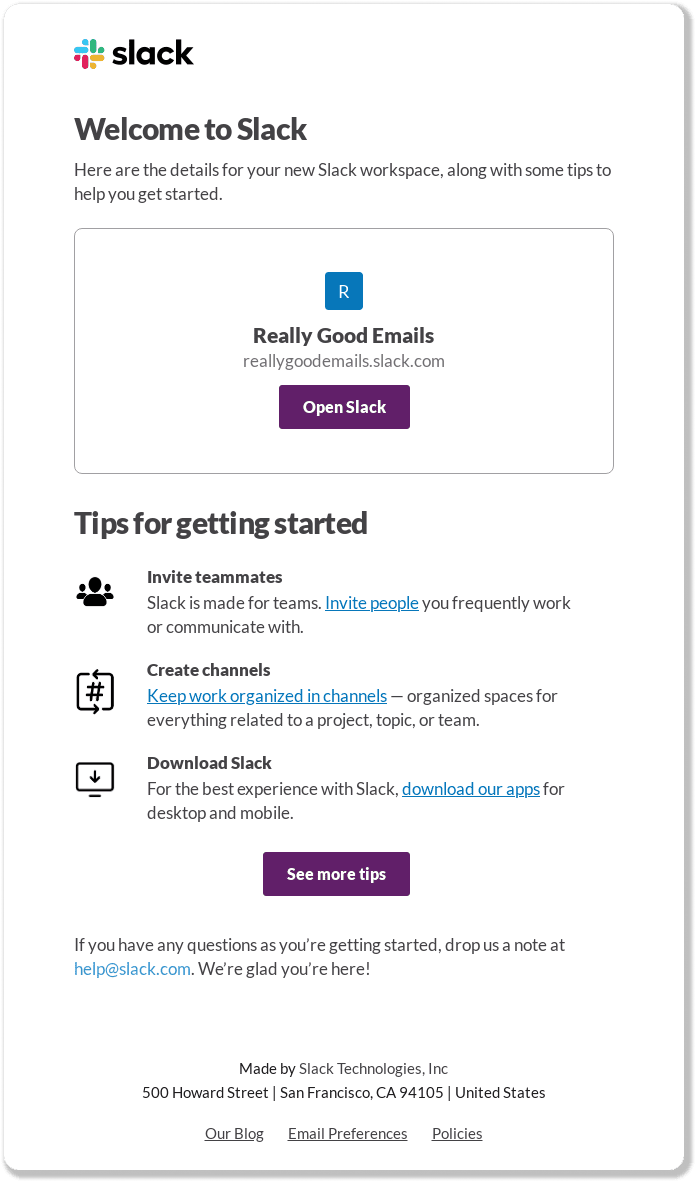
As your leads are not sales-ready yet, you should focus your sequence on moving them to the purchase decision. You can achieve this by highlighting the value of your product or service, adding social proof, and handling sales objections.
Let’s take a look at the email within a lead nurturing sequence that highlights the social proof:
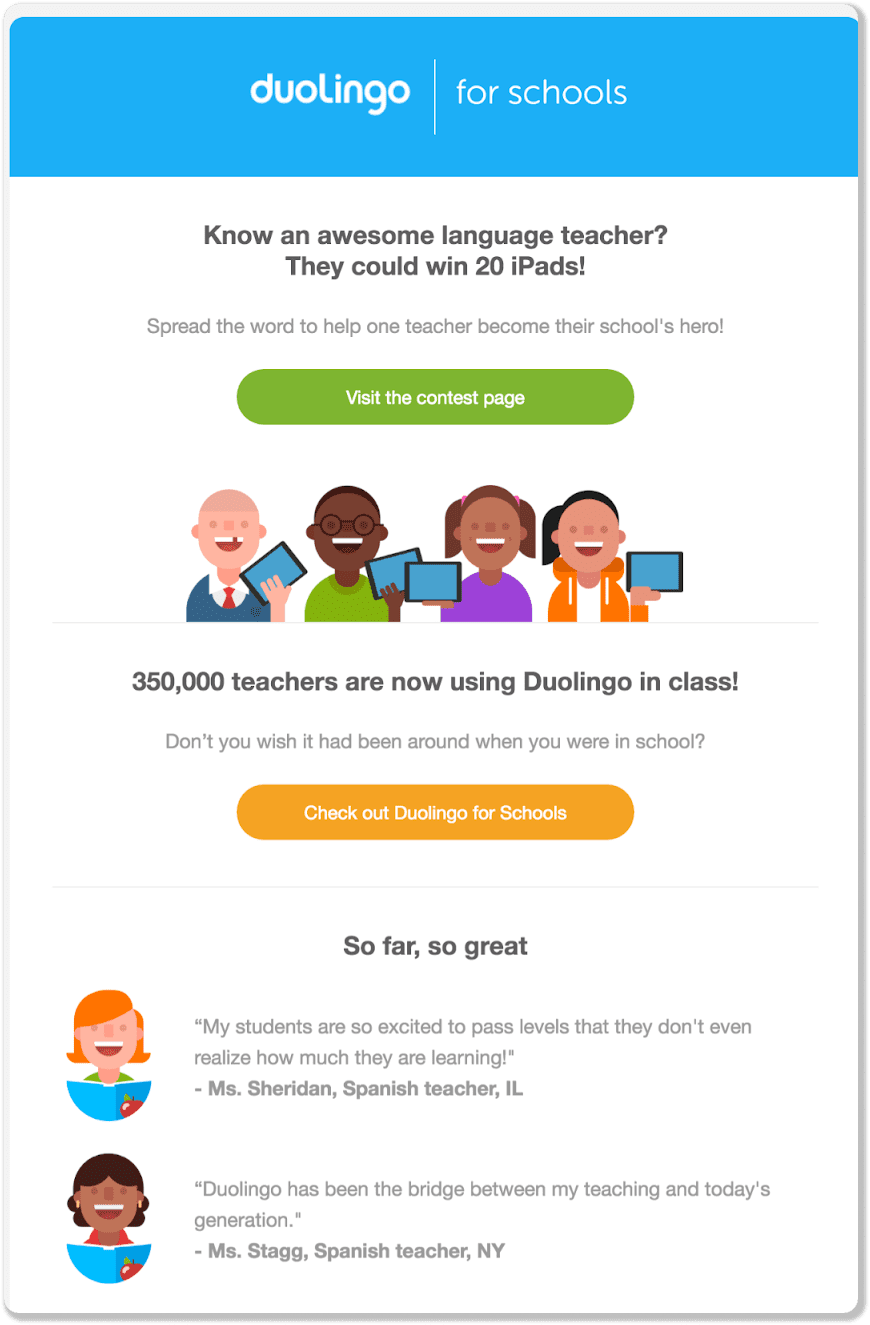
Notice that this email doesn’t push for an immediate purchase. Instead, it builds trust with proof by adding real numbers and customer quotes.
Engagement email sequence
At the heart of every memorable email campaign is the art of engagement. And this isn’t just about sending emails; it’s about sparking a conversation and kindling a relationship.
This type of sequence helps you understand how your recipients engage with your emails and which messages to send them to build rapport, improve loyalty, or re-engage inactive subscribers.
|
What does building rapport mean? In sales and marketing, building rapport means creating a sense of trust and confidence that makes prospects more eager to share their needs and pain points. → You can find more information about building rapport here. |
The purpose of the engagement sequence is not to convert right away but rather to play the long game, pique interest, and stir curiosity. If your company can boast of frequent industry events or insightful content, don’t hesitate to try this sequence for your campaigns.
The engagement sequence can also start with a welcoming email, where you thank your new email subscribers:
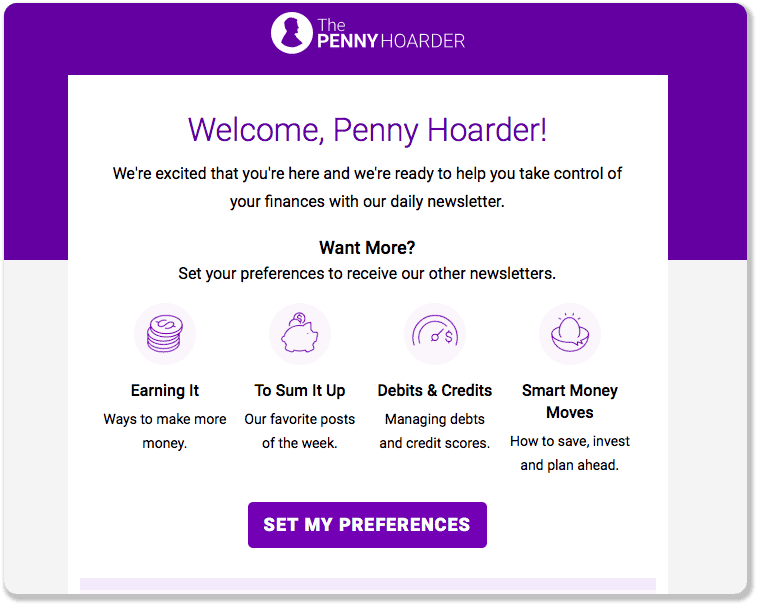
In that first message, do more than say thanks. Ask your leads to set their preferences so you can segment them further and send more relevant and effective content for future lead nurturing.
Following that, you can send emails that promise useful content or events based on their preferences. Then, you observe. You learn from their interactions, fine-tuning your approach with every click and open.
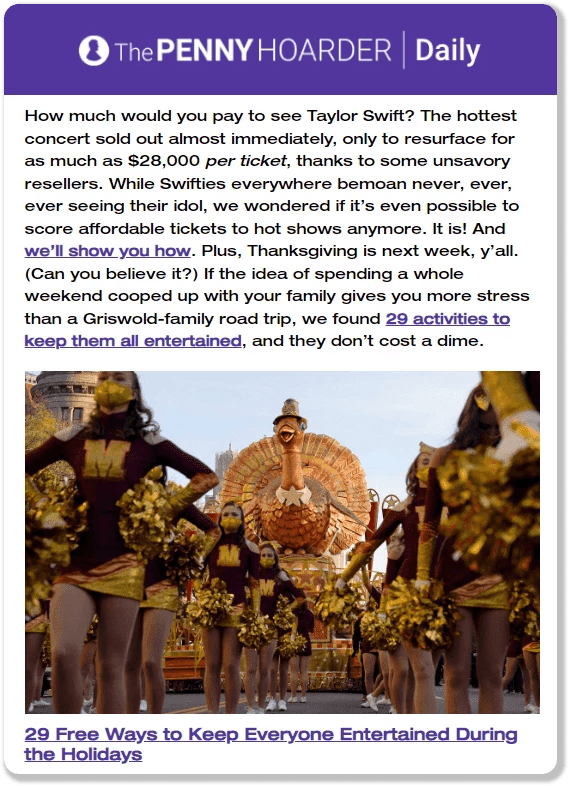
When an engagement email sequence is wielded with skill, it seamlessly transitions your prospects to the next act—the one where your product or service takes center stage.
Conversion email sequence
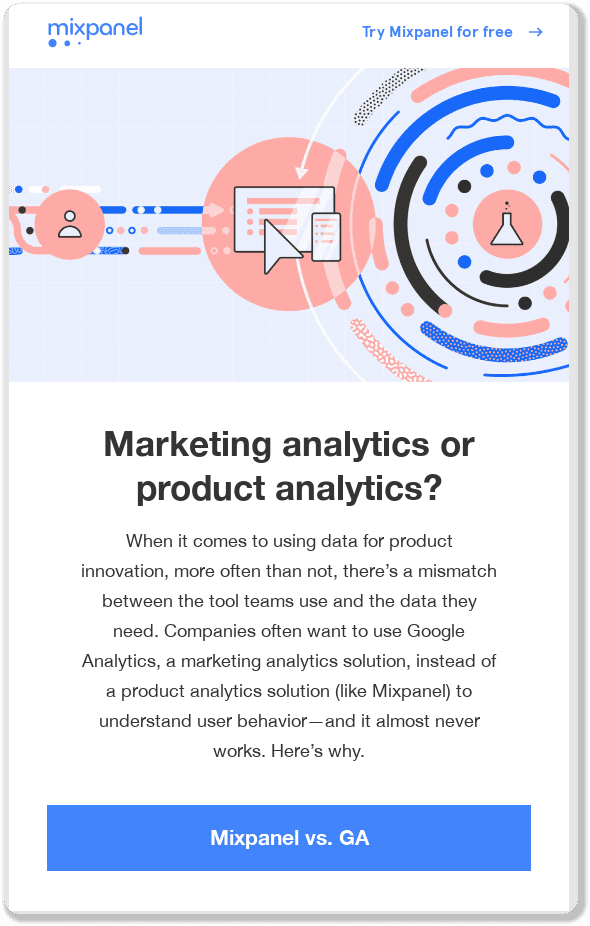
The conversion email sequence is a must-have tool in the marketer’s toolkit. SaaS companies especially love it because it is laser-focused on encouraging prospects to take a certain action, such as scheduling a meeting, booking a demo, or starting a free trial.
Very often, conversion sequences start with a series of educational emails, whereby you are sending users an email/several emails with helpful information:
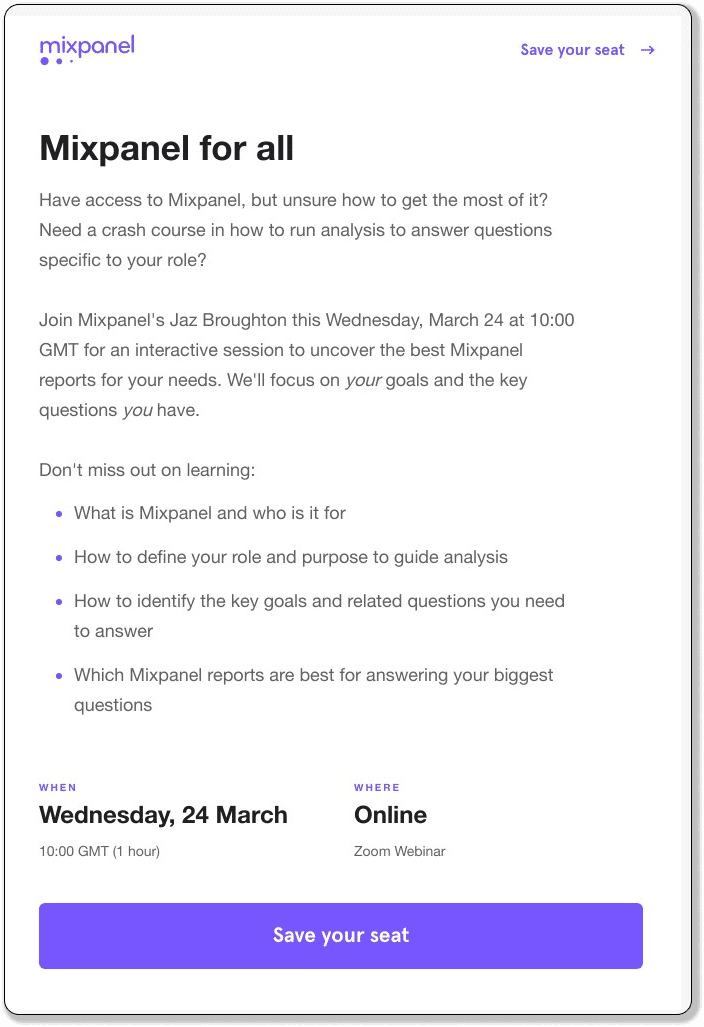
As the sequence progresses and you sense a ripening in the prospect’s journey, you encourage them to act, such as joining a user session, like in the example below:
If prospects stay cold to your conversion email sequence, you can proceed with a follow-up sequence.
Follow-up email sequence
Following up is probably one of the key rules of any successful sales team. So, for those of you who focus on sales email outreach, email follow-up sales sequencing is a total must.
A follow-up sequence is a set of messages you program your automation software to send either after a cold email or after a conversion sequence when a prospect remains silent.
|
How many emails should a follow-up email sequence comprise? The ideal number depends on several factors: the nature of your product or service, your target audience’s preferences, and the context. Remember to balance persistence with respect for the prospect’s time and preferences. Typically, a series of 1-3 well-timed and thoughtful follow-up emails would be appropriate. For example, in cold outreach, a sequence with one follow-up email achieves the highest response rate, at 6.9%, according to Belkin’s study. → Discover more cold email stats to see how many follow-ups deliver the best results for your industry and context. |
The ultimate aim of your follow-up sequence is to gently coax the reader into action. Whether it’s securing a slot on your sales call calendar, scheduling a product demo, or starting a free trial, each email should be a persuasive, personalized call to action.
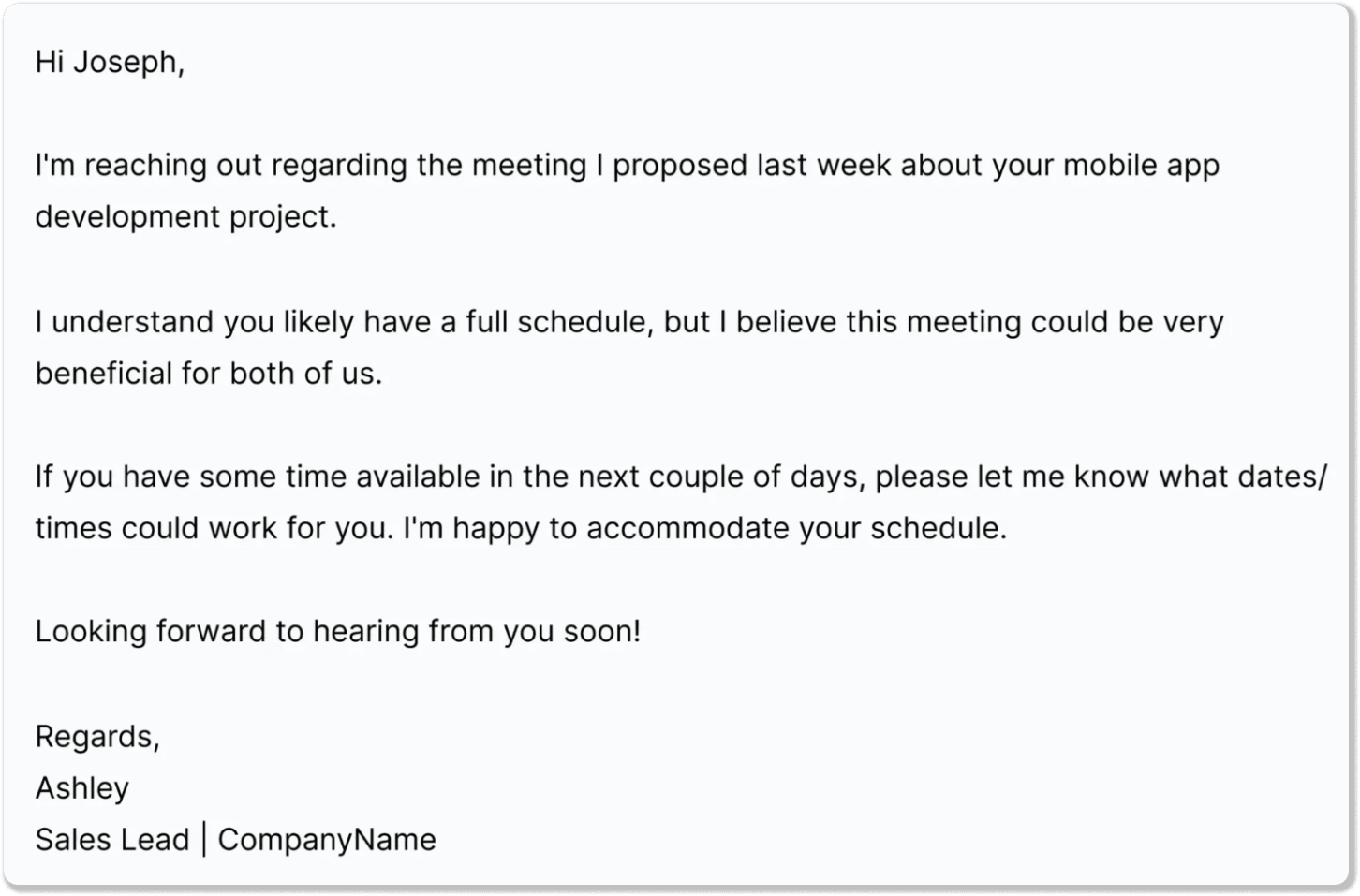
And if you’ve ever heard the statement “Personalization is king!”, be sure it applies exactly to follow-up email sequences. The specificity with which you address the recipient’s needs and the personal touch you weave into your message—these are the threads that can bind a prospect to your brand.
When it comes to cold email sequences, I recommend sending one initial email and one follow-up after that. In my experience, this is enough to stay on a prospect’s radar without coming across as pushy. To increase your chances of getting a response, you can also use multichannel outreach and add one to two additional touchpoints via email or LinkedIn after your initial message.
Outbound Outreach Expert at Snov.io

In short, a good follow-up sequence should feel helpful, not aggressive. Keep your messages relevant and make every touchpoint easy to respond. Consider also combining email with other channels to reach target customers where they are most likely to engage.

Improved sales email sequence
This email sequence can be part of an after-sales email campaign when you aim to encourage your customer to repeat the purchase. It generally boils down to upselling or cross-selling, a tactic well known to e-commerce companies but also familiar to the B2B SaaS landscape.
|
Upselling means offering your customers upgraded, more expensive products or services instead of what they initially wanted to buy or have already purchased. Cross-selling means offering customers additional goods or services relevant to their purchase. |
You can start your improved sales sequence with a series of onboarding or educational emails (one of them is in the example below).
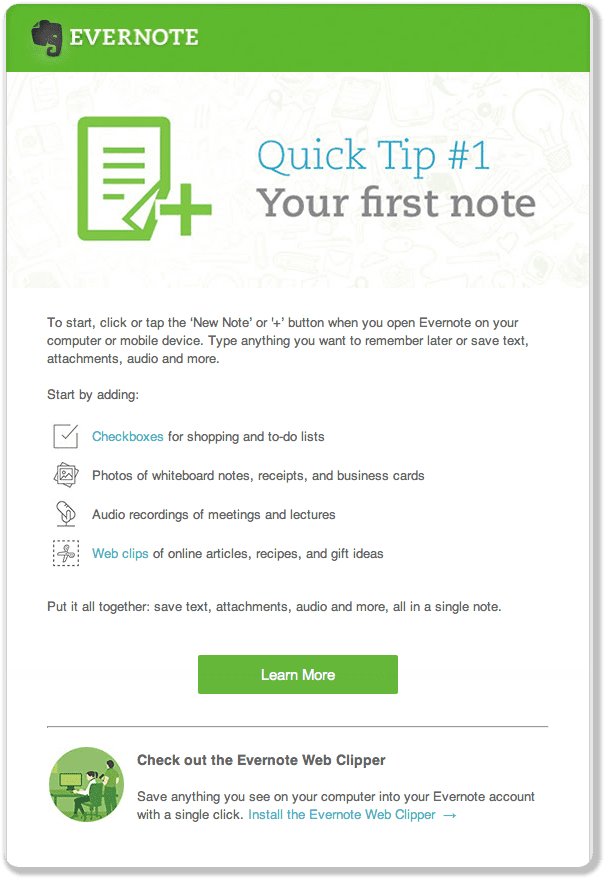
Send an email congratulating your new customer on their initial purchase. Then follow with a sequence that gradually educates them on the advantages of the product’s key features, culminating in a tailored upsell offer that feels like the natural next step.
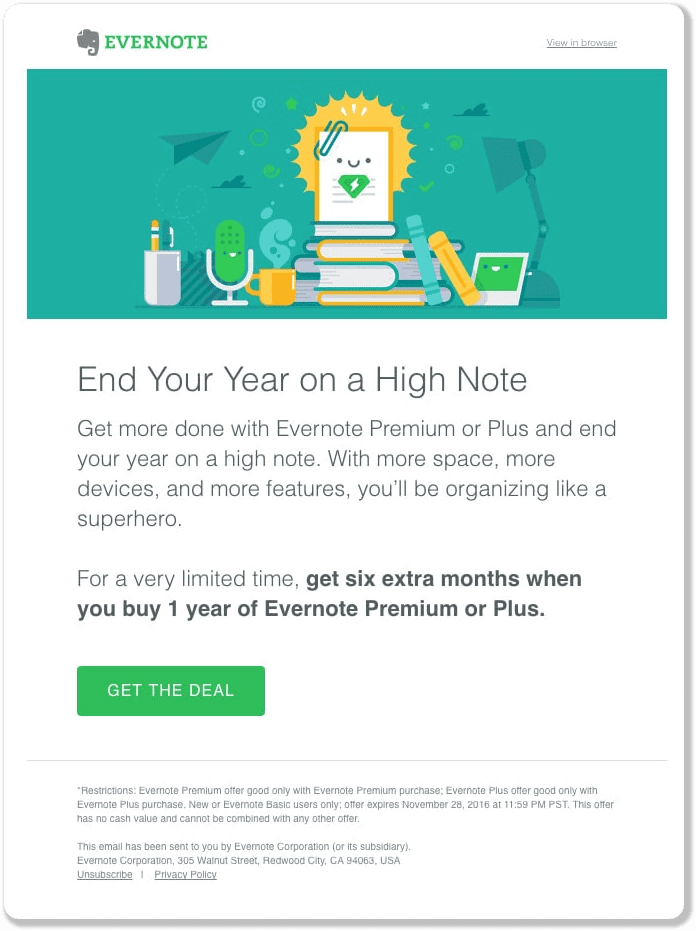
The improved sales sequence is just one aspect of a post-purchase campaign designed to boost customer retention. Other effective sequences include asking for feedback, requesting reviews, or encouraging testimonials.
💎 The latter is the sequence we use at Snov.io for getting testimonials. I’ll show you how it worked in the last chapter of this post.
Best Sales Email Templates For Your Next Great Deal
November 7 2025
Reminder email sequence
Reminder email sequences are typical of event campaigns where you invite a lead to participate in your webinar or special sale and send them regular reminders so they don’t forget to show up.
Alternatively, you can use these sequences to remind your prospects about the demo or meeting they’ve already booked. Do not mix them with follow-up sequences; remember that the reminder email sequences aim to get a prospect to the event/meeting/call they’ve already agreed to participate in.
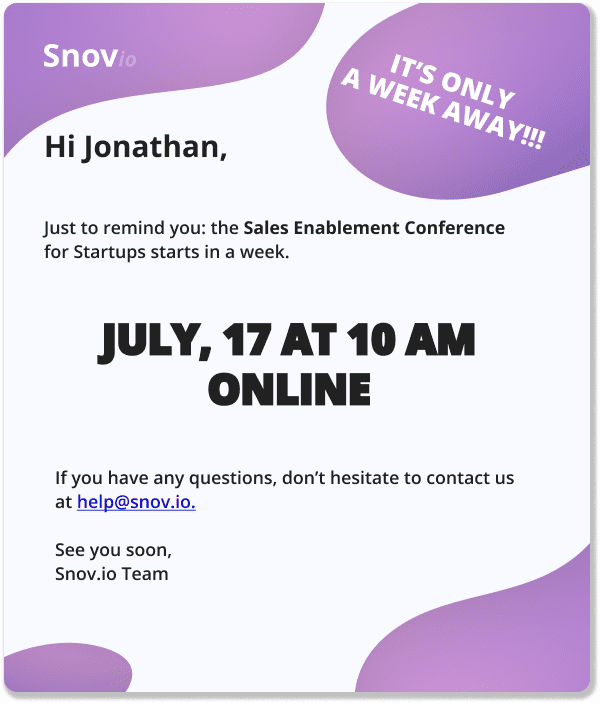
After the first reminder email, send another message within this sequence closer to the event date:
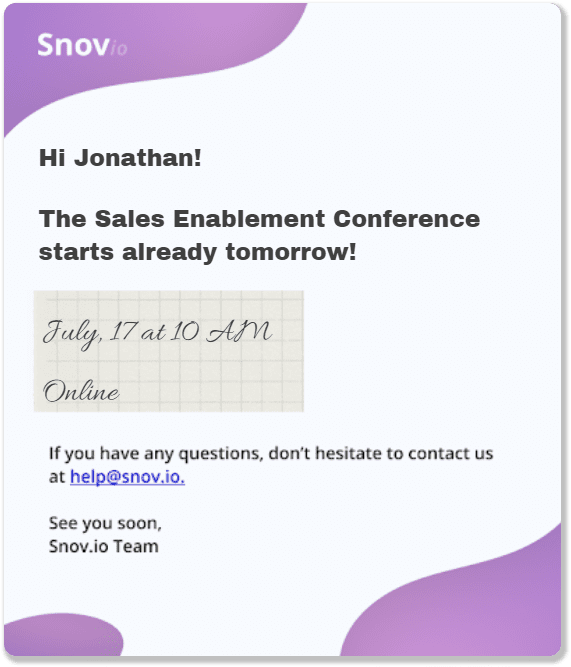
You can also include key details again, such as the date, time, agenda, or anything your recipient should prepare in advance. This way, you reduce friction and increase the chances that the prospect will actually attend.
Best practices to optimize email sequences
Now that you have a step-by-step guide to creating an email sequence and a cold email tool that may assist you, I can’t help but offer some practical recommendations you can use as a personal checklist. 🙂
Clearly define the goals
Whether you’re nurturing leads, onboarding products, or converting sales, having a specific objective will guide your content. Each goal requires a different structure, tone, and writing style.
For example, nurture campaigns focus on educating prospects on pain points and guiding them toward a solution. At the same time, a post-purchase sequence serves to increase customer lifetime value by asking for reviews, sending helpful tips, or cross-selling related products.
Segment your audience
Not all prospects are the same, so your emails shouldn’t be either. Group recipients by shared criteria to ensure more relevant communication.
You can segment your target customers by industry, job role, behavior, sales pipeline stage, intent level, and other specific characteristics. The more precise the segmentation is, the easier it is to send personalized messages that resonate with recipients and drive higher engagement and conversions.
Provide valuable and relevant content
Create emails that solve problems, answer questions, or address your audience’s pain points. Include valuable insights from your recipient’s industry, provide educational content, or share relevant blog posts or other helpful resources. It’s also good practice to send testimonials: real customer stories add credibility and showcase how your solution works in practice better than marketing claims.
Optimize email timing
Recent email marketing stats show that sending on Thursdays delivers the highest conversion rate, at 6.87%. However, the most effective approach is to adjust timing based on your audience’s behavior.
Experiment with different schedules to find the best times to send emails, considering factors like time zones and the nature of the content. Besides, remember to balance persistence with respect for the prospect’s time and preferences.
Write converting email subject lines
To deliver the desired outcome, you first need your emails to get opened. Did you know that 64% of recipients decide to open an email based on the subject line? It is the first thing your potential customers see, so try to make it irresistible.
Test different approaches, lengths, and formatting to find what works best for your audience. The goal is to create engaging email subject lines that stand out in prospects’ crowded inboxes and tempt them to open your message.
Personalize every touchpoint
Personalization helps build trust and increase engagement. Use prospect data to tailor your messaging. Go beyond basic name fields and adjust your emails to each recipient’s context to create more genuine conversations. This approach not only increases the likelihood of a response but also helps build trust and foster long-term customer relationships.
Remember about a call to action
No matter which type of sequence you’re sending, clearly define the action you want recipients to take in every email. Whether it’s clicking a link, downloading content, booking a meeting, or making a purchase, your call to action should be easy to understand and act on. I also recommend keeping one CTA per email to avoid confusion and improve conversion rates.
Do A/B testing
Testing is essential for improving performance. Test various elements of your email, such as subject lines, content, and calls to action. Use the insights gained to refine and optimize your email sequences.
The idea is simple: if we don’t keep our email strategies fresh, we might miss out on connecting with potential clients. Our recent tweaks have upped our response rates to a steady 3-4%, but who knows how long that’ll last? That’s why A/B testing is crucial for optimizing email sequences. Even a tiny thing, like a period or an exclamation mark in a subject line, can impact reply rates.
VP GTM at Salesforge
Maintain consistency
Keep a uniform tone, branding, and messaging throughout your sequence to build trust and brand recognition. When every email feels like part of the same conversation, recipients better understand your value proposition and remember your company. Besides, consistency improves the overall customer journey, especially in longer nurturing or onboarding sequences.
Optimize for mobile
More and more users prefer checking their mailboxes on their phones; today, only 36% of recipients use desktops to check their email. So, make sure your email design and content are easy to scan and optimized for smaller screens.
Monitor analytics
Regularly track key performance metrics, such as open rates, click-through rates, and conversion rates. By analyzing this data, you can understand what’s working and what needs improvement and refine your approach accordingly to improve results. Plus, regular monitoring lets you identify sequence issues early and react quickly.
How to create an email sequence with Snov.io
Now that you understand the basics, let’s talk about how you can easily create your own email sequence and how the Snov.io outreach automation platform can help you.
Let’s break down the process into easy-to-follow steps.
Step 1. Determine the goal and email sequence type
Be strategic about the primary purpose of your cold email sequences. Do you want to bring a prospect to the sales demo? Or maybe they have already agreed to it, and you want to ensure they’ll actually participate? By determining the goal, you will understand which type of email sequence you need.
In the first case, this will be a follow-up email sequence, while in the second, you should build a reminder email sequence.
Step 2. Think of the number of emails for your sequence
You need to plan your email sequence by evaluating your sales cycle and the number of emails it will comprise.
|
How many emails should be in a sequence? Every email marketing guru will tell you the same thing: there is no single optimal number of emails in a sequence. It all depends on your goals, industry, audience, sales cycle length, etc. From my experience, the standard email sequence consists of 3 to 7 emails. It is considered enough to provide a prospect with valuable information, engage with them, and smoothly lead them to the desired action. |
With the Snov.io drag-and-drop editor, you can easily add as many emails as you need for your sequence:
As different sequences require different lengths, this flexibility can be helpful. For example, while a reminder campaign can include 1–2 messages, onboarding sequences may need more touchpoints to ensure a smoother customer journey.
Step 3. Define conditions that trigger automation
When configuring your email sequence, identify the triggers that will activate the automation. Modern email marketing tools and automation platforms let you tailor communication based on user behavior.
In Snov.io, you can create separate flows for interested and unengaged recipients by setting specific conditions. They include opening an email, clicking a link, booking a meeting via Calendly, and other actions that show engagement.
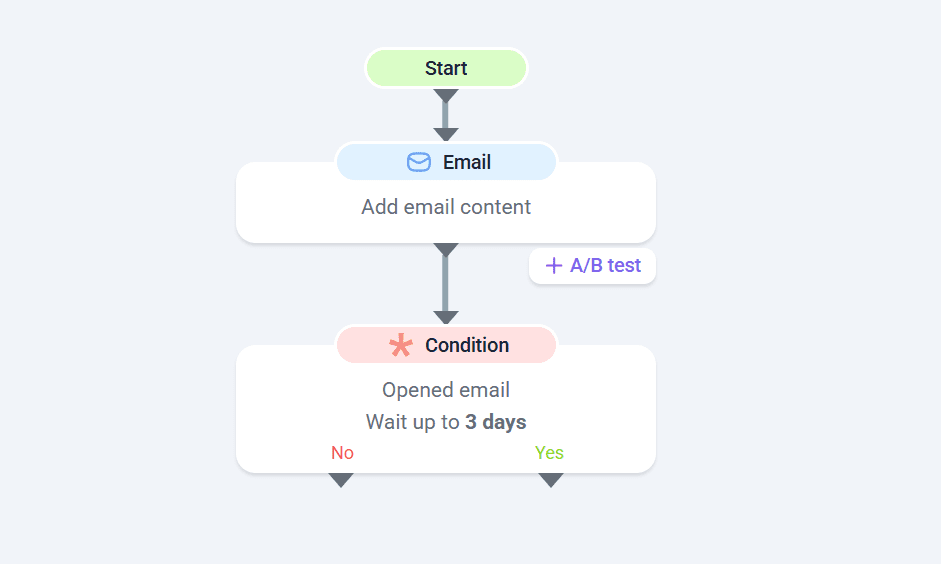
You can also set the waiting time before the condition takes effect. Thus, you give your recipient enough time to react while still keeping your sequences relevant.
For example, if you’re creating a follow-up email sequence to secure a meeting, you can choose the “Booked a meeting via Calendly” condition to stop the campaign once the action is completed and move the recipient to a reminder cadence if needed.

Step 4. Compose emails for the sequence
Now, it’s time to write the content for each email within your sequence.
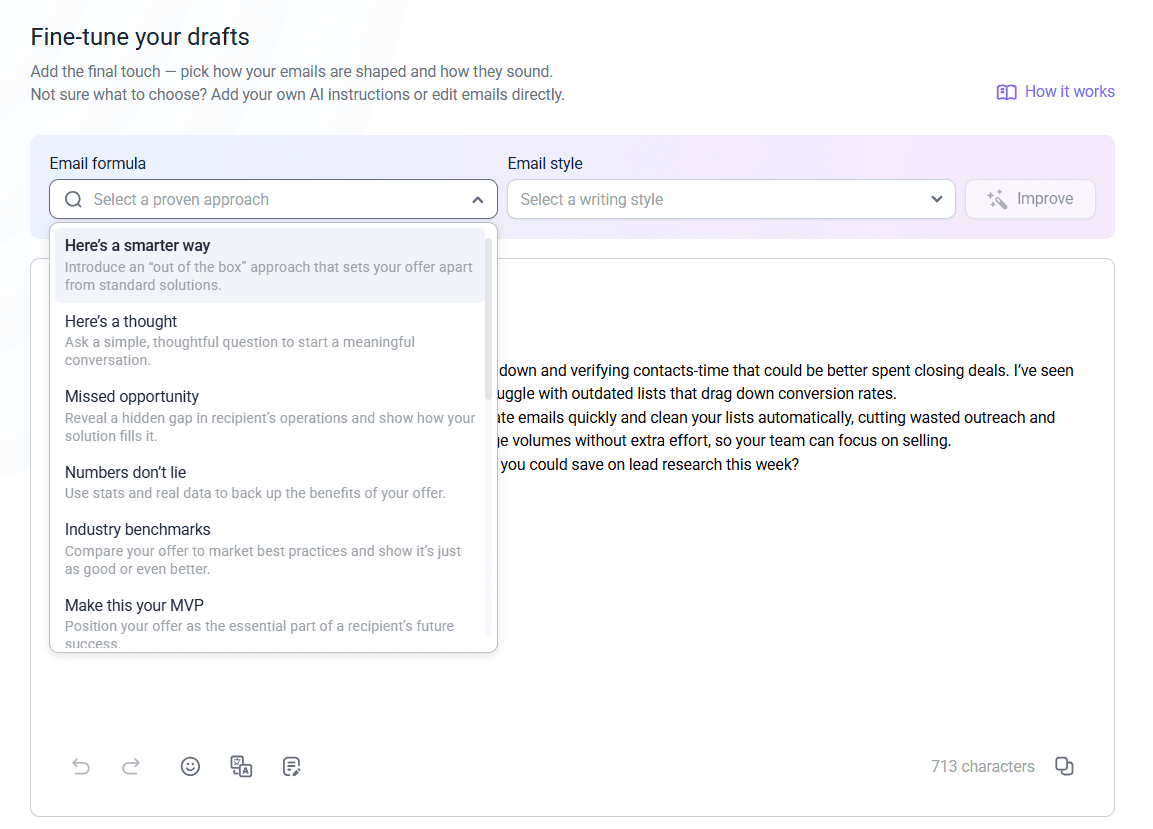
You can craft emails yourself or use the Snov.io AI Persona-driven Email Builder. This tool automatically generates content based on your prompt or ICP information. Edit the generated email manually, or select a style and formula to automatically adjust your copy to your sequence goals and brand voice.
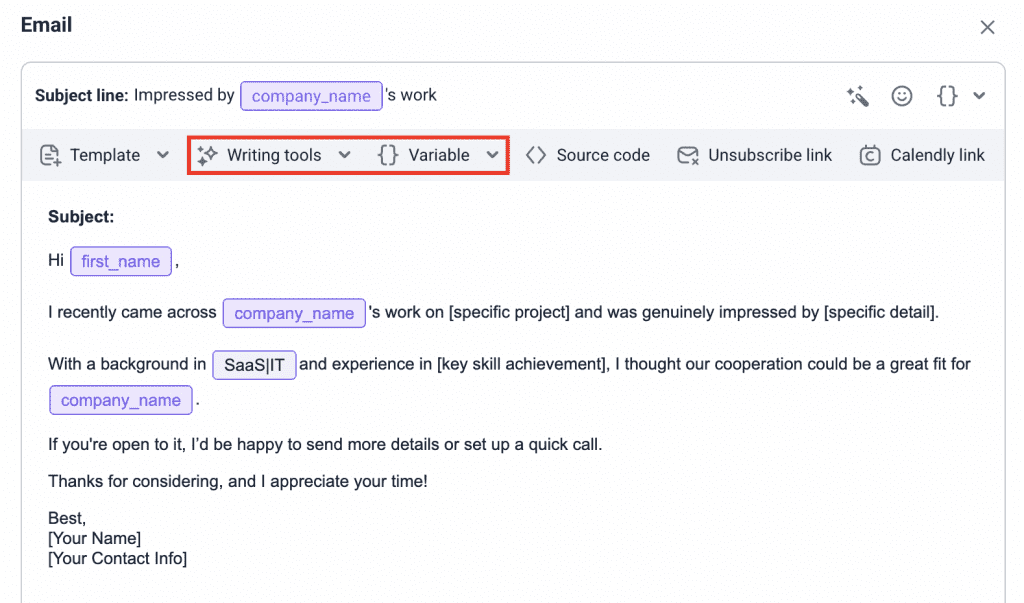
You can also use a built-in AI email assistant to refine your copy right in the editor. Add variables to personalize messages with customer data or include dynamic fields to automatically tailor your email templates to specific conditions.
To create multiple unique messages from a single version, you can experiment with Snov.io’s Spintax feature. Randomizing email content helps reduce the risk of being flagged as spam, especially when sending to many recipients at once.
Step 5. Choose the prospects
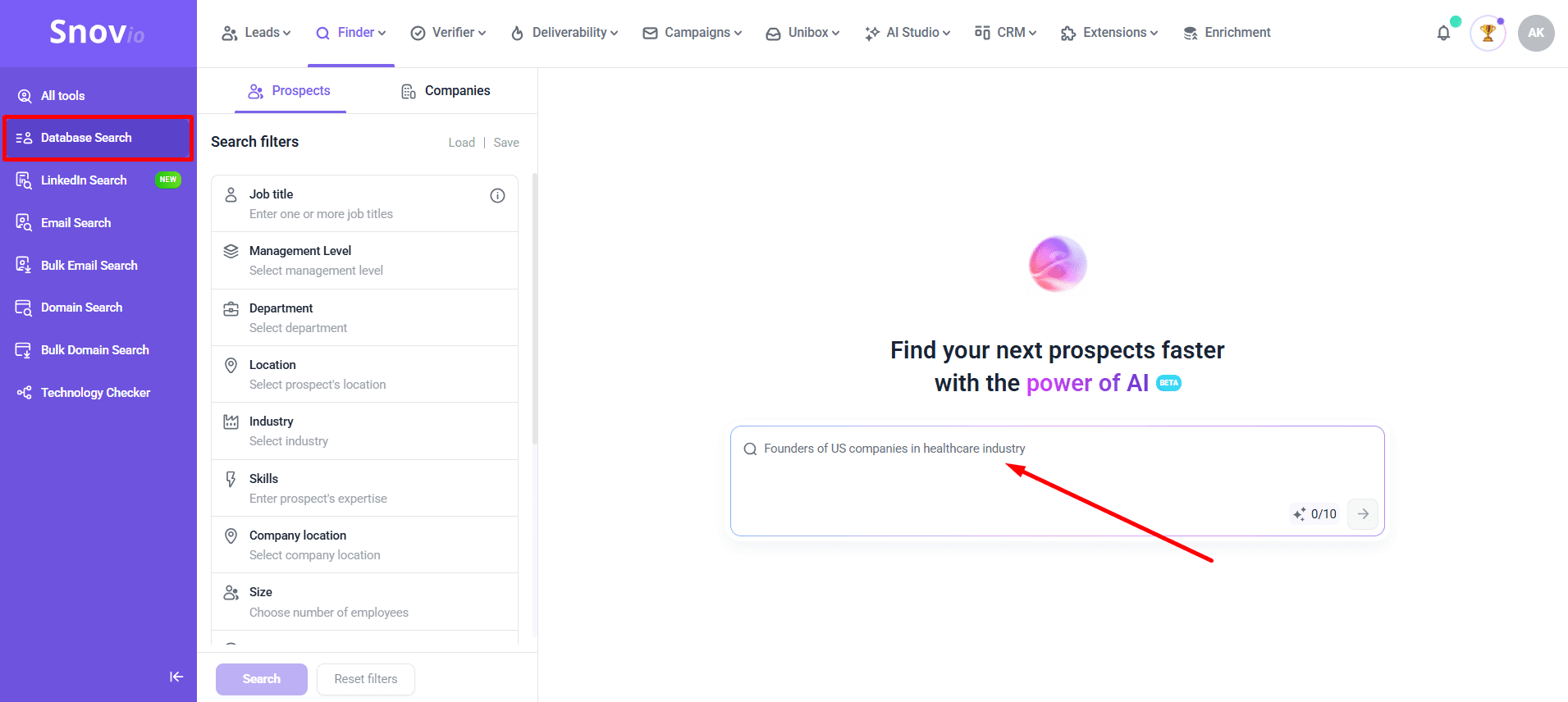
After drafting your emails, you’ll need to select the prospect list to which your email sequence will be sent. Upload your recipient list to Snov.io and segment it with built-in filters for precision targeting.
No prospect list yet? No problem! Use Snov.io’s built-in database with 500M+ prospects and 50M+ company profiles. Set the filters to narrow your search or specify who you’re looking for in a prompt to let the AI build a targeted list for you:
You can also gather leads’ contact data from web sources and LinkedIn pages using one of the Snov.io Chrome extensions.
Step 6. Set sending options
At this point, you’ll configure how your sequence will be sent and how the email automation tool will track it. Choose the email account you will send from, set the sending schedule, and define the campaign duration.
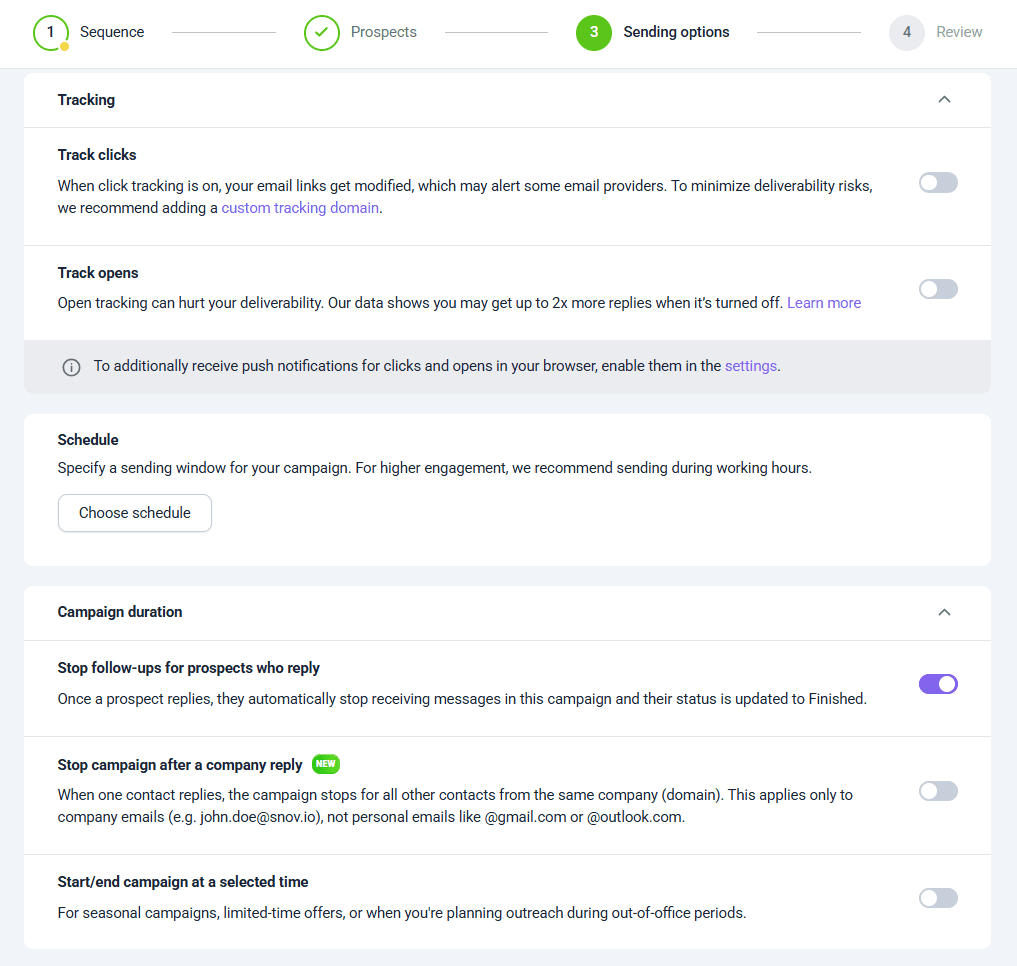
You can also decide which actions to track, such as opens, clicks, and replies. This will help you control the sending process and monitor how recipients interact with your sequence to see whether any improvements are needed.
💡 Expert note:
Our recent research, based on 44 million emails, revealed that turning off open tracking can significantly boost reply rates. In fact, this simple tweak more than doubled the performance, increasing replies from 1.08% to 2.36%.
Step 7. Review and test
Finally, review your email sequence settings and preview each email to see how it will appear to recipients. You can also send test emails to ensure they display correctly on various devices and verify that the personalization variables are working properly.
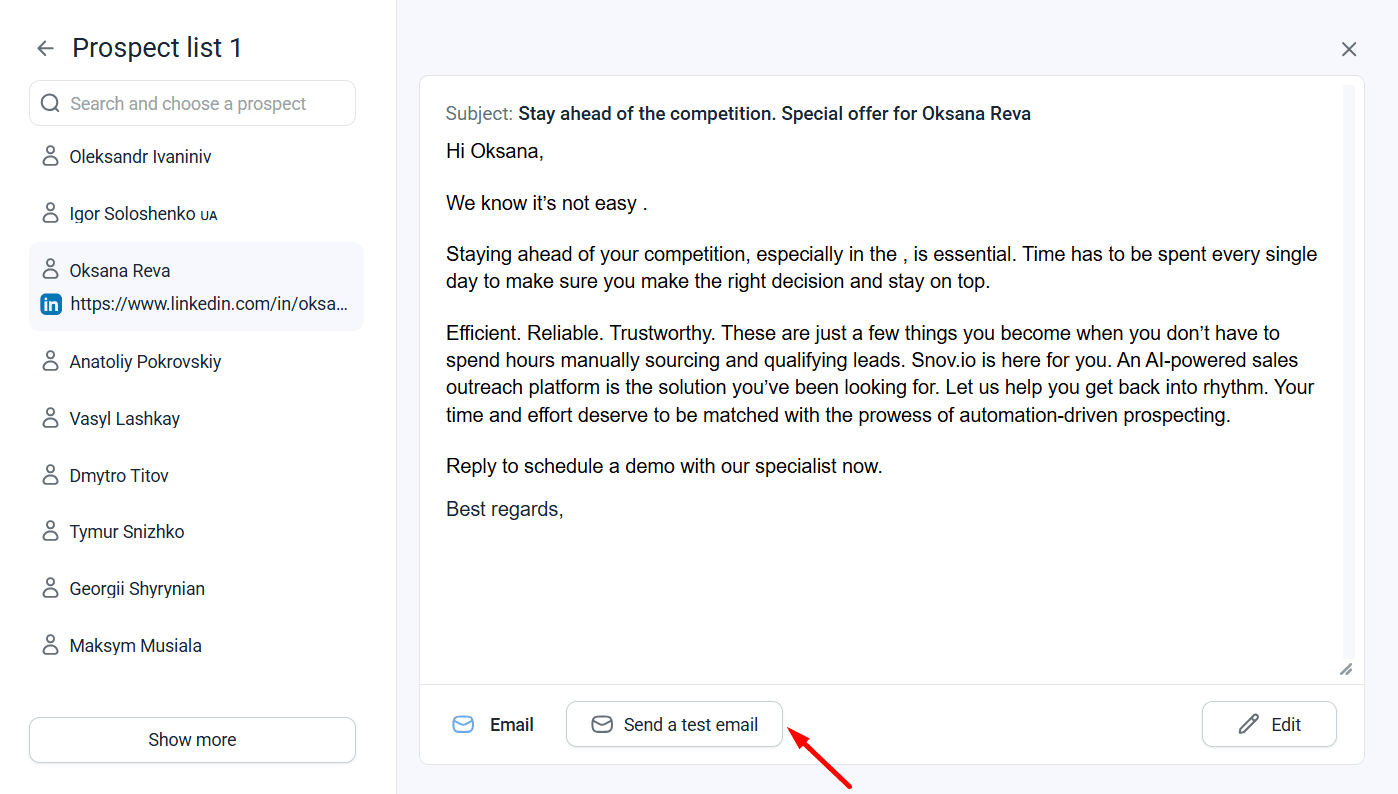
Enjoy! Your email sequence is now successfully built with minimal effort — Snov.io has automated nearly everything for you.
Snov.io is easy to use, very functional, and allows us to send tailored emails en masse. With properly prepared sequences, the response rate is incredible, usually at 75-80%.
CTO at Neadoo

How we used a winning email sequence to get testimonials from our customers: a case study from Snov.io
Now I’d like to infuse a dose of inspiration into your email marketing endeavors by showing how we at Snov.io successfully used an email sequence to ask for testimonials from our loyal customers.
The objective was to get positive responses from users willing to leave a testimonial (thereby making email replies our key metric).
Here’s what we did:
Step 1. Segmented our users
We have segmented all our paid customers by how long they’ve been with Snov.io to pick those users who regularly use credits and have been with Snov.io for more than a year.
Step 2. Created an email sequence
Within the Snov.io cold email tool, we built a sequence consisting of an initial email followed by three follow-ups. Each message was spaced out with different time delays.
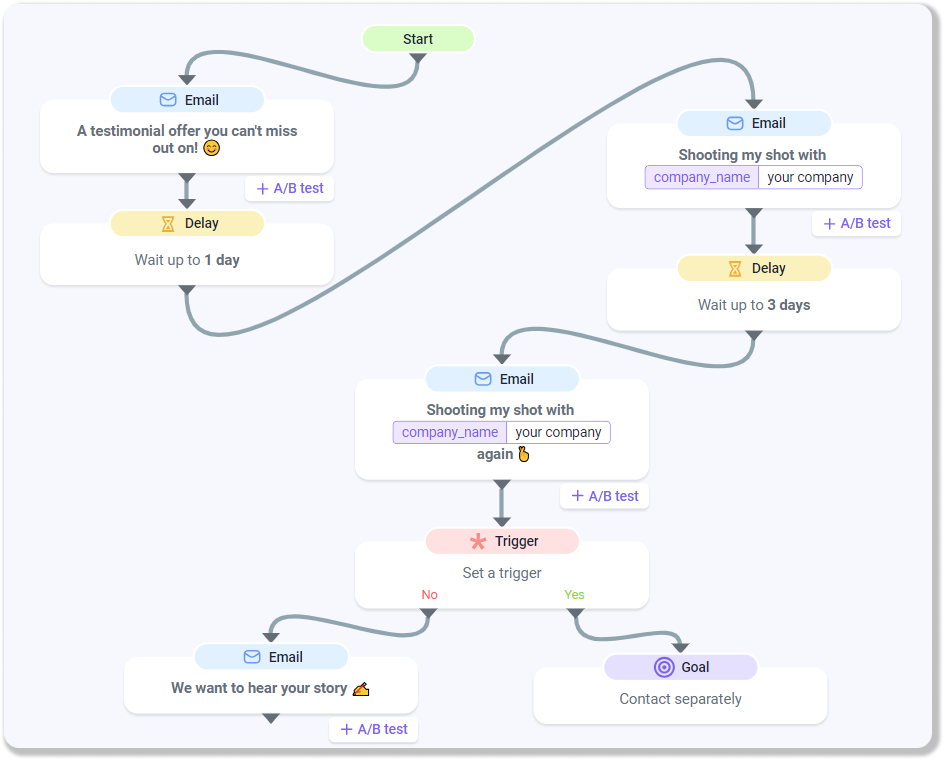
We also set a condition to activate after the second follow-up; this condition was based on whether a user opened an email.
Step 3. Elaborated on every email
We worked on each email in our sequence to ensure it was personalized and logically followed the previous message.
Email 1
|
Hello [first_name], My name is Victoria, and I’m a Marketing Specialist here at Snov.io. I’m working on a series of share-all user testimonials. While reviewing a list of our most experienced customers, I came across [company_name] and thought you’d be the perfect fit: you’ve been using Snov.io for a while, and your feedback would be greatly appreciated. I would like to showcase your story and accomplishments (and the role Snov.io played in your results). Here’s what we offer:
Here are our questions:
Share any data you can on the results you’ve achieved. Please, include numbers like % growth in efficiency or revenue, number of leads collected, meetings scheduled, campaigns launched, etc. The more juicier the number, the more exposure your testimonial gets! We can get this testimonial published at the end of next month. Can I count you in?🙏 Looking forward to your reply, Viktoria Marketing Specialist from Snov.io |
Email 2
|
Hey [first_name], how are you doing? Have you had the chance to take a look at my offer? This testimonial can help you get extra exposure and help us deliver a real experience review to other potential Snov.io users. I’d love for you to be a part of this, so shoot me a quick reply if you’re in/out. Have a good day, Viktoria Marketing Specialist from Snov.io |
Email 3-4
|
Hey [first_name], Hope you’ve had a chance to check out my Snov.io testimonial offer. I understand that you may be too busy, but if you are interested and just haven’t had the time to decide, let me know so I can tell you more about it. Here’s a quick overview of what I’m offering:
Your experience is extremely valuable both to us and to any potential Snov.io users. So, are you in?😉 Looking forward to your reply, Viktoria Marketing Specialist from Snov.io |
The last follow-up reinforced the messages that came before it.
Step 4. Measured the performance of our email sequence
Upon sending emails, we tracked the email sequence performance to see how many replies we received. Each reply was carefully analyzed to determine whether the user accepted our request for a testimonial.
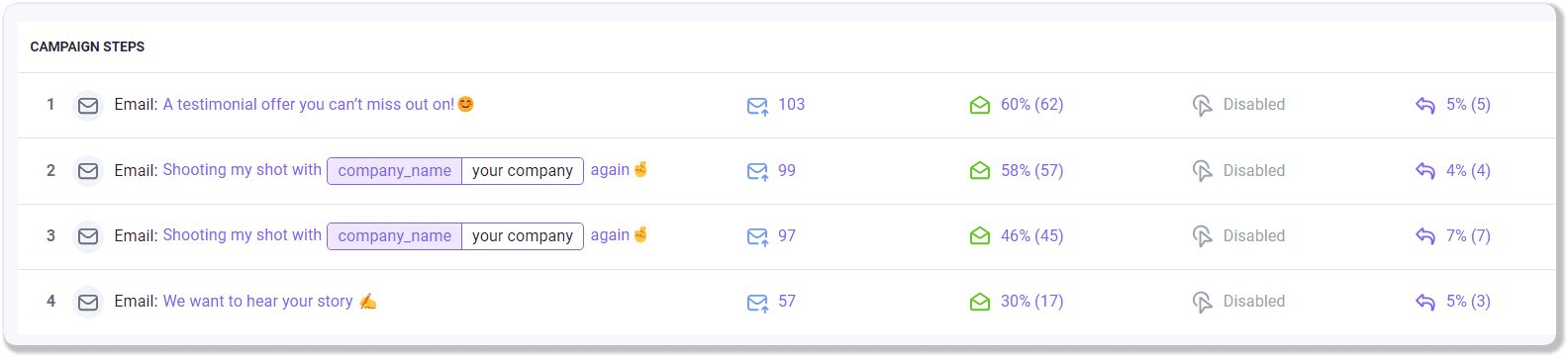
As a result, we got 17 replies, and to our delight, all were positive:)
Step 5. Contacted all converted users separately
Finally, we contacted the users who agreed to share their experiences with Snov.io individually to collect their testimonials. You can now view some of them on our testimonials page.
Key takeaways
Email sequences help nurture relationships, improve engagement, and drive consistent conversions by naturally guiding recipients toward the desired action.
By combining clear goals, strong segmentation, thoughtful timing, and relevant content, you can turn cold contacts into engaged leads and, eventually, loyal clients. The key is balance: persistence without pressure, value without overpromotion, and automation without losing the personal touch.
As you can see, building your own automated email sequence isn’t as complicated as it may seem, provided you’ve got a plan, working examples, and reliable support from Snov.io’s cold email sequence software. Now it’s your turn to try how it works and share your impeccable results with us.
Happy email sending!