TL;DR: What affects cold email deliverability?
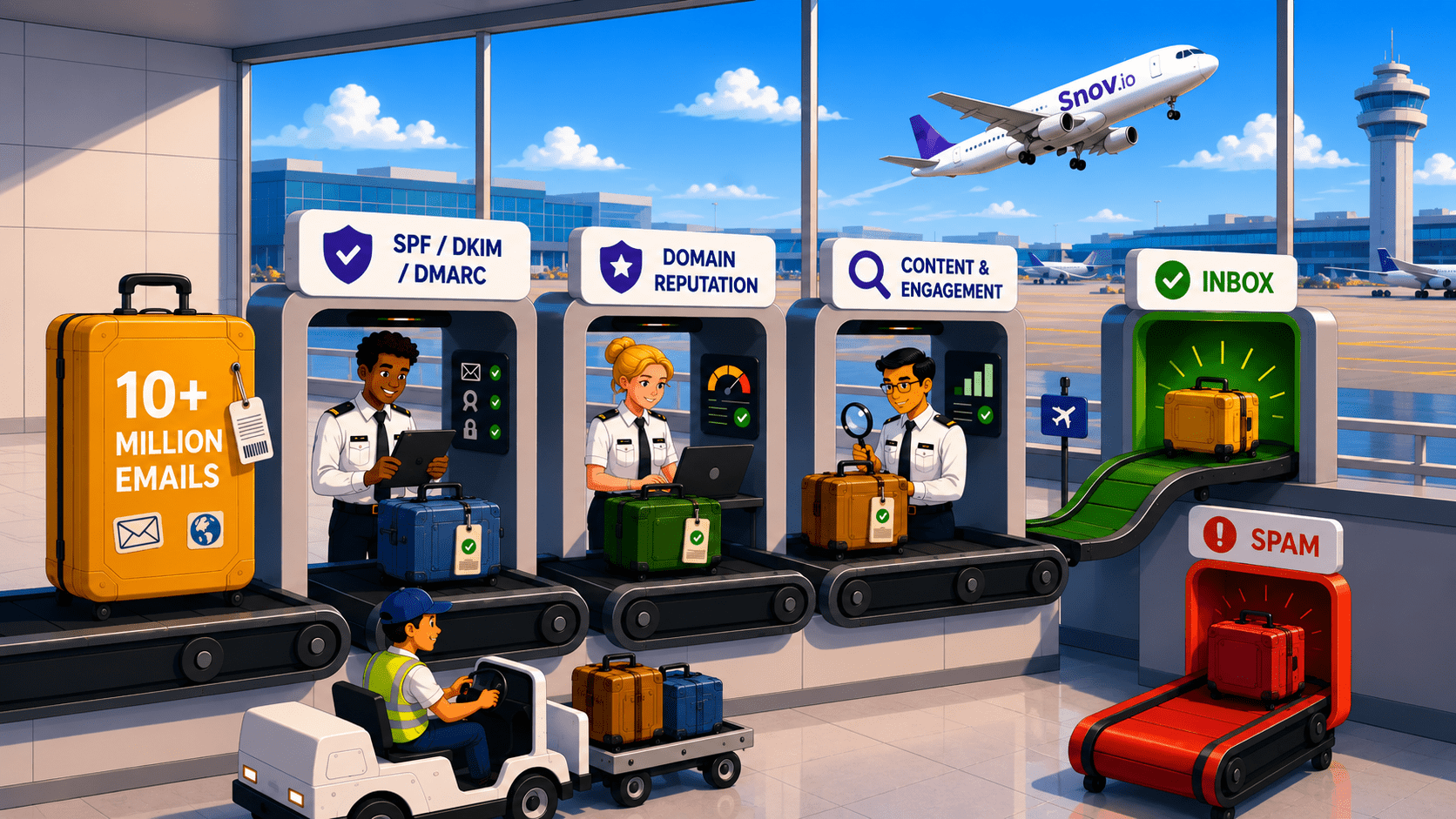
Based on our analysis of more than 10 million emails from cold outreach campaigns sent via Snov.io in May 2026, here’s what affects email deliverability (both directly and via impact on engagement).*
- Valid email authentication protocols (SPF, DKIM, DMARC) result in more opens, clicks, and replies.
- Custom and paid domains generate significantly fewer bounces than free or non-custom domains.
- Personalized emails outperform non-personalized outreach across key engagement metrics.
- Spam trigger words and attachments are associated with higher bounce rates and lower performance.
- Domain warm-up requires active monitoring, especially during the 20–50-day period, when bounce rates tend to spike.
*All aggregated data is anonymized to protect user privacy.
Let’s be honest — every cold outreach specialist is keen on improving email deliverability. But what most measure are the spam folder and inbox placement rates as the basic metrics, and overlook indirect, proxy signals, which often become serious pitfalls that throw the deliverability rate off its positive track.
For this analysis, we took over 10M emails — 10,105,581 messages to be exact — sent via the Snov.io platform during May 2026.
We didn’t run a seed-list test to measure direct deliverability metrics, such as spam, blacklisting, and inbox placement rates, which determine the overall deliverability rate.
Instead, our study focused on indirect campaign-level signals: engagement metrics (open, click, reply, and unsubscribe rates), along with the bounce rate, as the key indicator of email delivery.
We wanted to demonstrate that these data are important cold email deliverability factors that can’t be ignored.
As a result, we prepared this report to help you discover actionable ways to improve your email deliverability.
Note: We still recommend that you regularly monitor inbox placement rate, check whether your domain or IP is blacklisted, and track other metrics to ensure your reputation as a sender isn’t at risk.
How email engagement metrics affect cold email deliverability
Let’s look at the average healthy open, click, reply, unsubscribe, and bounce rates in 2026 and see how they actually correlate with email deliverability.
Overall, bounce rate and reply rate are the strongest proxy signals associated with deliverability, whether in cold outreach or email marketing. That’s why they are the most meaningful to track and compare.
So, let’s dive into our firsthand data, focusing on bounces, responses, and other engagement metrics and factors driving them.
Email delivery and engagement insights by email service provider
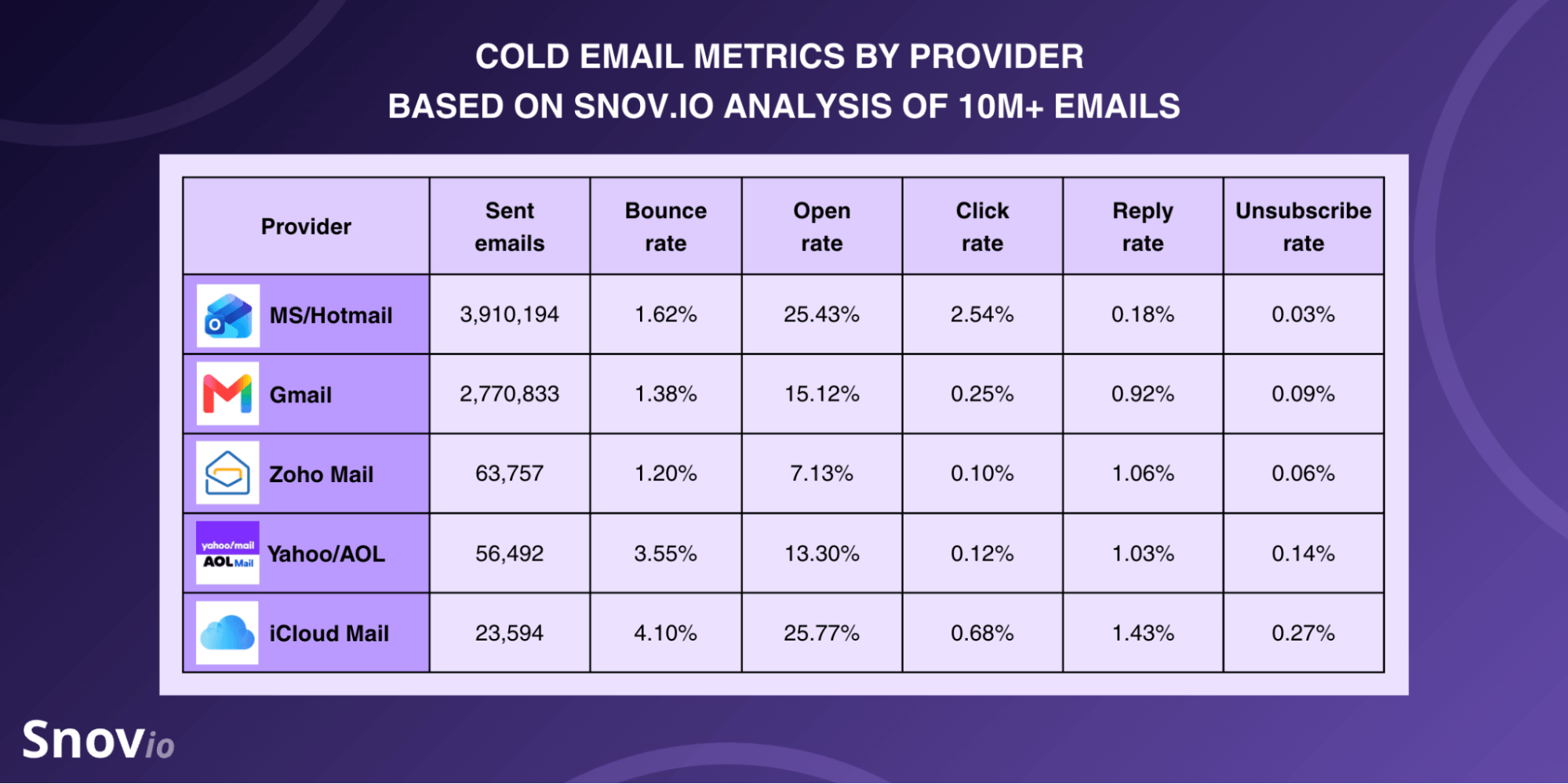
The same message from the same sending domain yields different outcomes across inbox providers. We examined email metrics from 5 email providers that represent the largest datasets in our analysis: Microsoft/Hotmail, Gmail, Zoho Mail, Yahoo/AOL, and iCloud Mail.
Let’s take a closer look at the results.
Microsoft/Hotmail
In our study, MS/Hotmail provides the largest dataset for analysis — over 3.9 million emails sent its way.
Compared with other email providers, it shows the second-highest open rate, at 25.43%, after iCloud Mail.
However, it surpasses others with the highest click rate — 2.54%. On the other hand, our data demonstrate the lowest reply rate, sitting at merely 0.18%, and the lowest unsubscribe rate across all mailbox providers (0.03%).
Gmail
Gmail addresses make up the second-largest dataset of over 2.7 million emails.
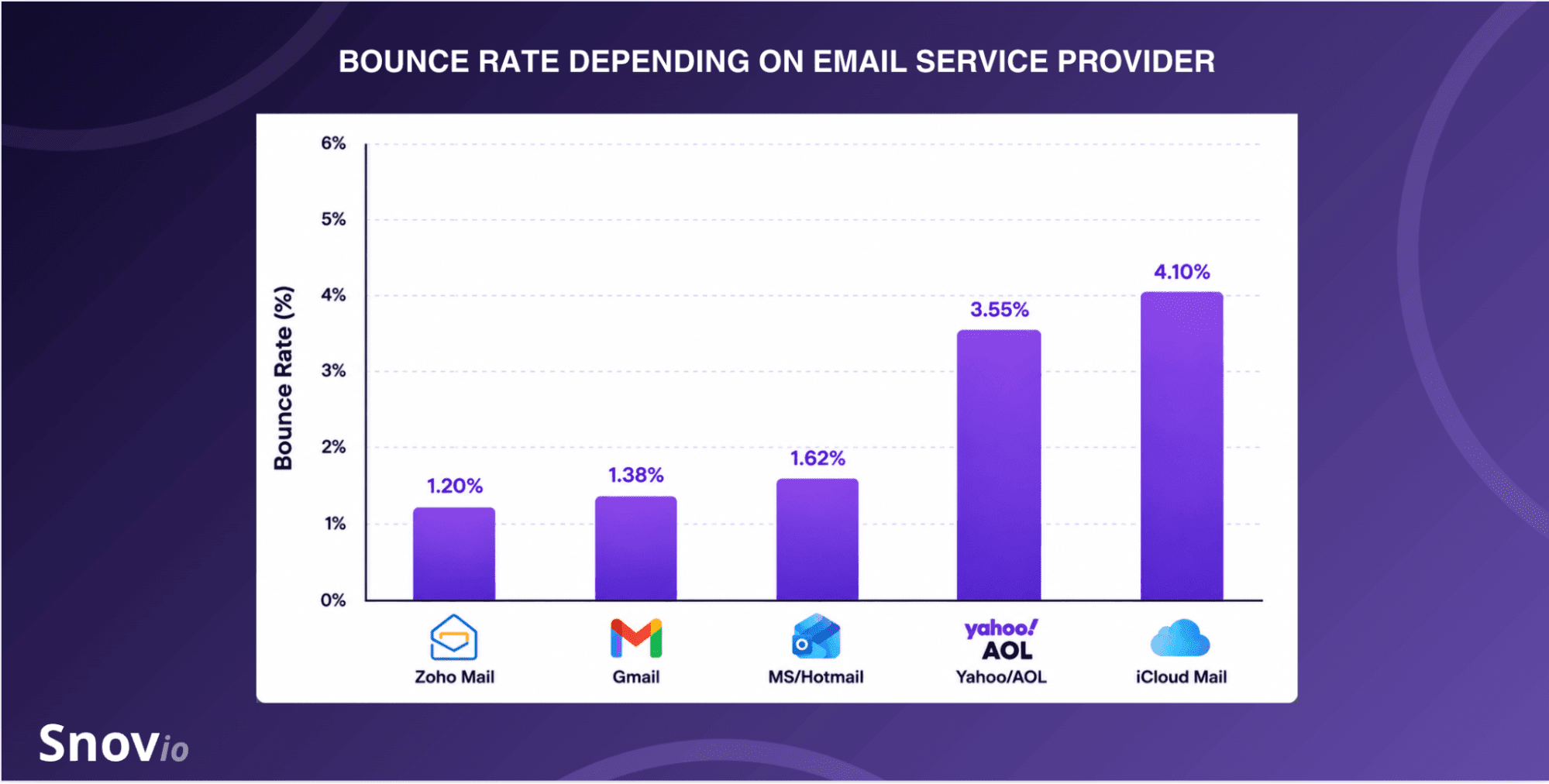
Remarkably, its 1.38% bounce rate is among the lowest of all ESPs.
However, the open rate (15.12%) is much lower than Microsoft’s.
🗒️ Note:
If you suddenly stop getting replies when sending to a Gmail recipient, this is one of the clearest signs that they might have blocked you or that you’ve triggered Gmail’s spam filters. In either case, your emails end up in their spam folder instead of their primary inbox. Naturally, your email deliverability rate declines.


Zoho Mail
Comprising nearly 64,000 emails, our Zoho Mail data shows the lowest bounce rate of all — 1.20%, contributing to deliverability success, albeit indirectly.
That said, Zoho Mail’s open rate drops sharply to just 7.13%, lower than in any other email service provider.
This may reflect users’ content preferences. However, another reason could lie in the open tracking limitations enabled by Zoho Mail clients.
Yahoo/AOL
With a 3.55% bounce rate in our dataset, Yahoo/AOL emails clearly raise concerns about email delivery. It’s one of the highest, particularly 2.5x higher than Gmail’s bounce rate, as you can see in the following graph.
The unsubscribe rate of 0.14% is also one of the highest among inbox providers.
Despite that, Yahoo/AOL’s open and reply rates are reasonably strong when set against others.
iCloud Mail
Representing the smallest sample in our dataset (only 23,594 emails), iCloud Mail demonstrates surprisingly extreme numbers — the highest across all email providers:
- Open rate: 25.77%
- Reply rate: 1.43%
- Unsubscribe rate: 0.27%
- Bounce rate: 4.10%
Here, it’s worth noting that an open rate this high can be inflated by Apple’s Mail Privacy Protection. It auto-loads images, including tracking pixels, even if the recipient didn’t open the message, resulting in false-positive opens.
Key takeaways:
Gmail and Zoho Mail demonstrated the strongest delivery signals through the lowest bounce rates. Because open rates can be distorted by privacy features, bounce rate remains the most dependable metric for evaluating deliverability across providers.
Most impactful cold email deliverability factors
The following factors significantly influence the metrics we measured:
- Authentication protocols (SPF, DKIM, and DMARC)
- Email domain age and type (free/non-free or custom/non-custom)
- Domain warm-up duration
- Email copy elements (personalization, link tracking, attachments, spam words, emojis)
- Email length
And since mailbox providers heavily lean on those to evaluate your domain/IP reputation and sender score, anything that moves them in the wrong direction likewise affects your email deliverability rate.
Do DKIM, SPF, and DMARC improve deliverability?
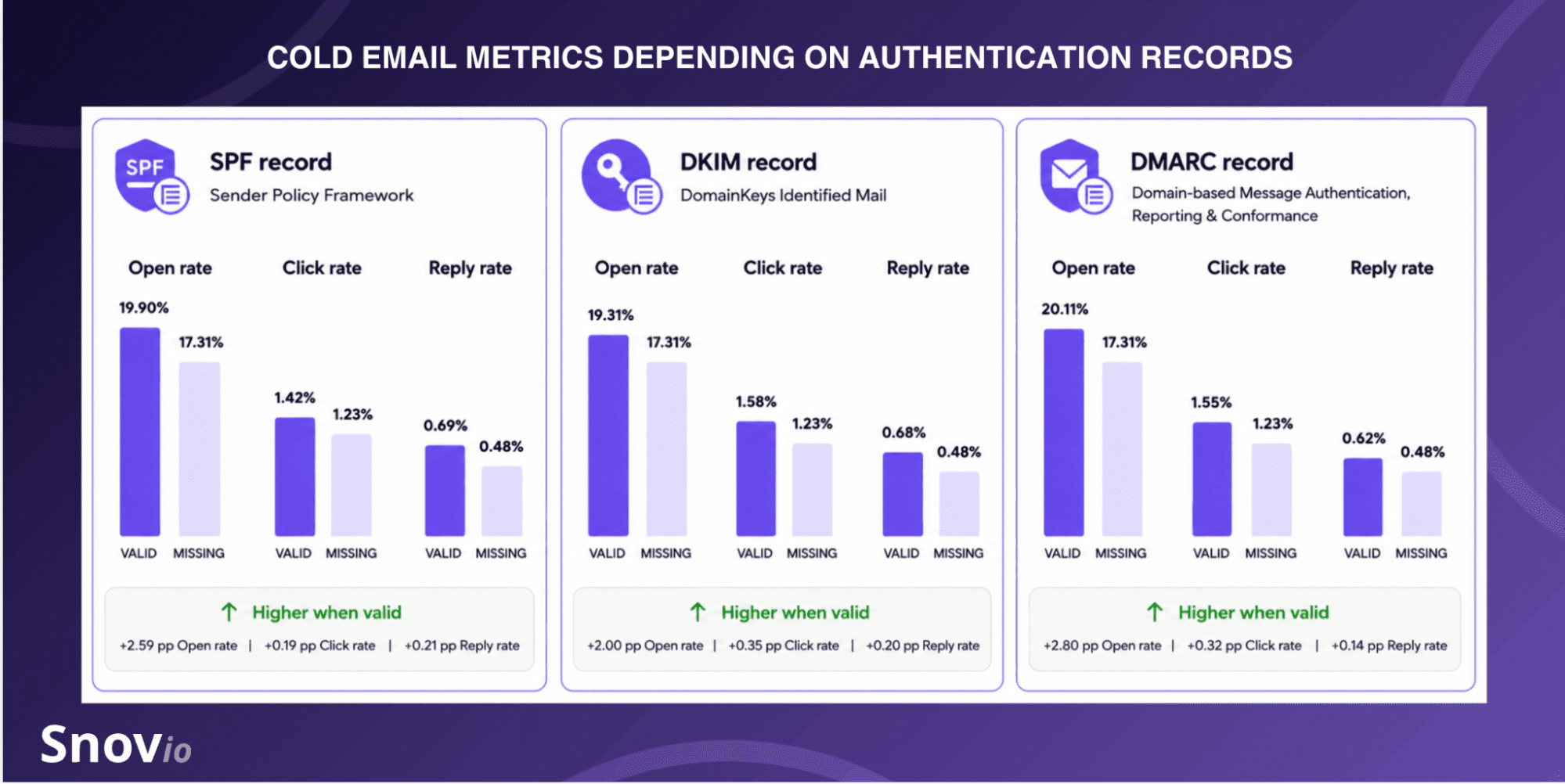
Yes — and we see it most obviously through the engagement metrics we tracked. Our data gives a comprehensive view of email metric changes when each of the three email authentication protocols is valid vs missing.
Here’s how authentication influences open, click, and reply rates specifically:
- DMARC-valid campaigns produce a 20.11% open rate compared to 17.31% for those without DMARC setup. That’s roughly a 3% difference across millions of emails taken for this analysis.
- DKIM-valid campaigns show a higher click rate of 1.58% vs 1.23% for those missing this record.
- SPF-valid campaigns demonstrate identical patterns with more opens, clicks, and replies.
Key takeaways:
Valid SPF, DKIM, and DMARC records are essential elements for achieving higher recipient engagement (open, click, and reply rates), maintaining a positive sender reputation with email providers, and boosting your inbox placement rates.

Does the sending domain type matter for deliverability?
Our research proves it does – domain type influences the bounce rate.
See the correlation in the bar chart showing the bounce rates of free/paid and custom/non-custom sending domains.
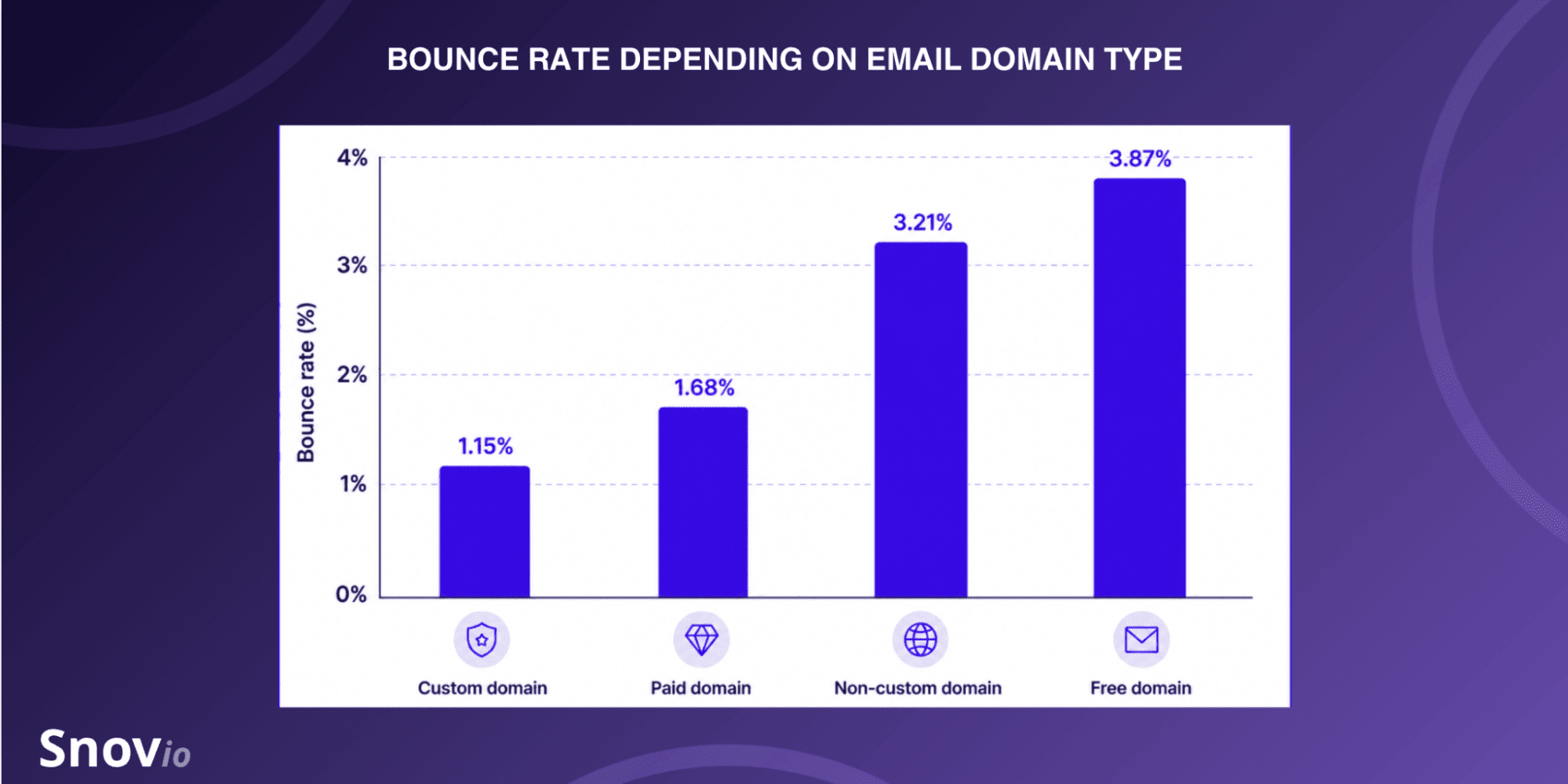
Free domains have the highest percentage of bounced emails — 3.87% — more than twice the 1.68% for paid domains. This is quite predictable because millions of people use them and, therefore, they carry a weaker domain reputation.
Custom email domains achieve the lowest bounce rate in comparison with paid non-custom domains: 1.15% vs 3.21%.
Key takeaways:
The sending domain type affects cold email delivery and, as a result, deliverability. Compared to paid custom domains, their free, non-custom alternatives are associated with a measurably higher number of bounced emails. As a result, a custom email infrastructure with paid domains becomes the strongest delivery-focused option for cold outreach.
How does domain age affect email deliverability?
Here, the answer will be more nuanced and surprising than we anticipated, assuming that older domains may be more trustworthy with a more solid sender reputation earned over the years.
Let’s look closer at the numbers demonstrating the impact of domain age on our tracked metrics.
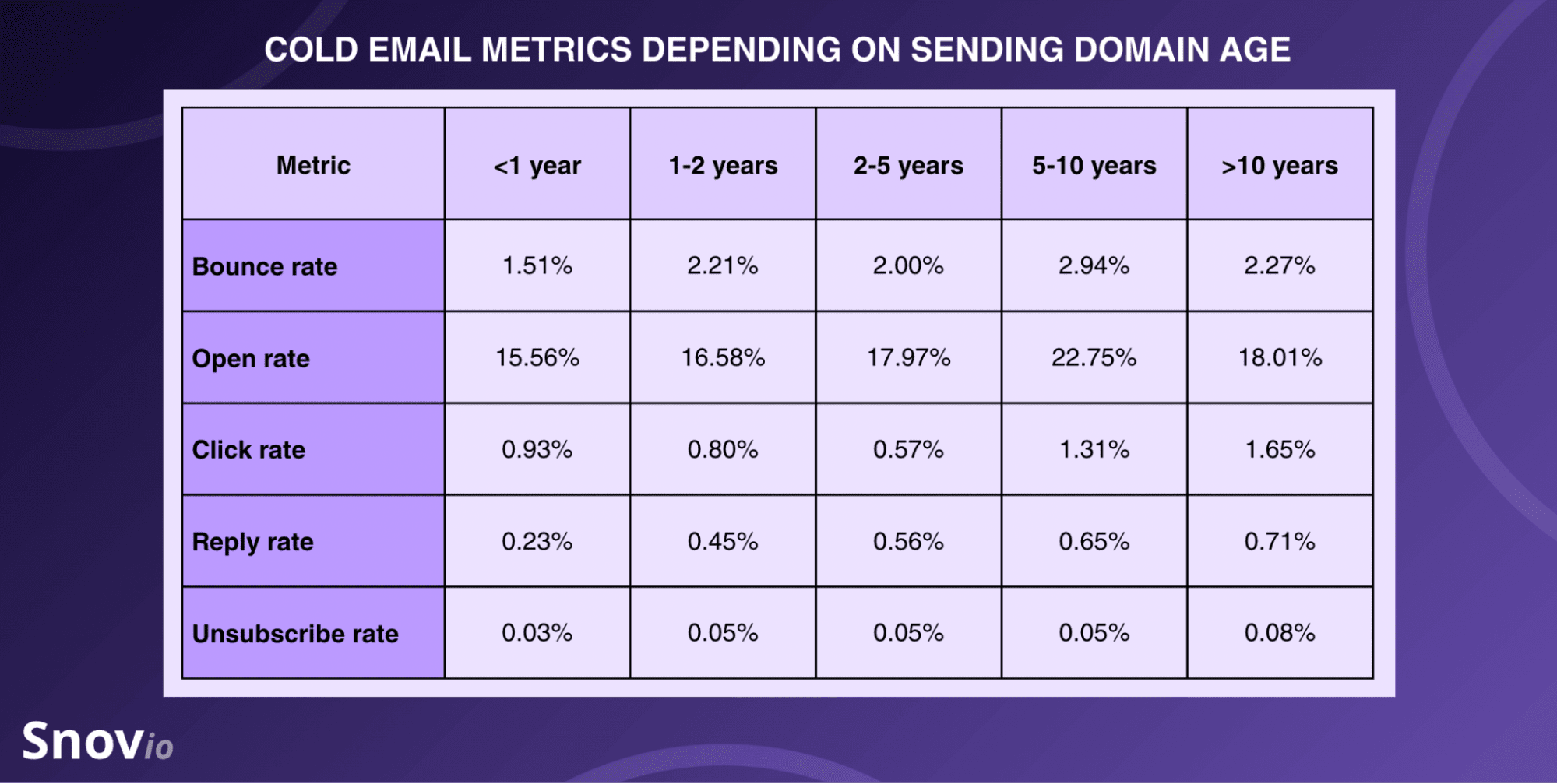
Among all groups, domains under 1 year boast the lowest bounce rate at 1.51%, while those between 5 and 10 years have the highest at 2.94%.
Meanwhile, opens, clicks, and replies do increase with aging domains. They hit their highest with those older than 5 years:
- Open rate: 22.75%
- Click rate: 1.65%
- Reply rate: 0.71%
The unsubscribe rate, however, is lower for younger domains.
One possible explanation for the higher bounce and unsubscribe rates among older domains is database aging. As contact lists grow over the years, they naturally accumulate inactive, outdated, or invalid email addresses.
Key takeaways:
Domain aging influences email performance. Engagement rates generally increase. However, older domains don’t automatically guarantee better email delivery and, consequently, high inbox placement rates, as bounces spike with domain age.
To keep bounce rates low and engagement high, verify new contacts before outreach and regularly clean your email lists by removing invalid, inactive, and unresponsive addresses.
How long does it take to warm up an email domain for high deliverability?
The general rule of thumb says: the longer the warm-up, the better the inbox placement. Our analysis, on the other hand, suggests that the connection between the two is not always directly proportionate.
Take a look at how the bounce rate, the most impacted metric, changes with warm-up length.
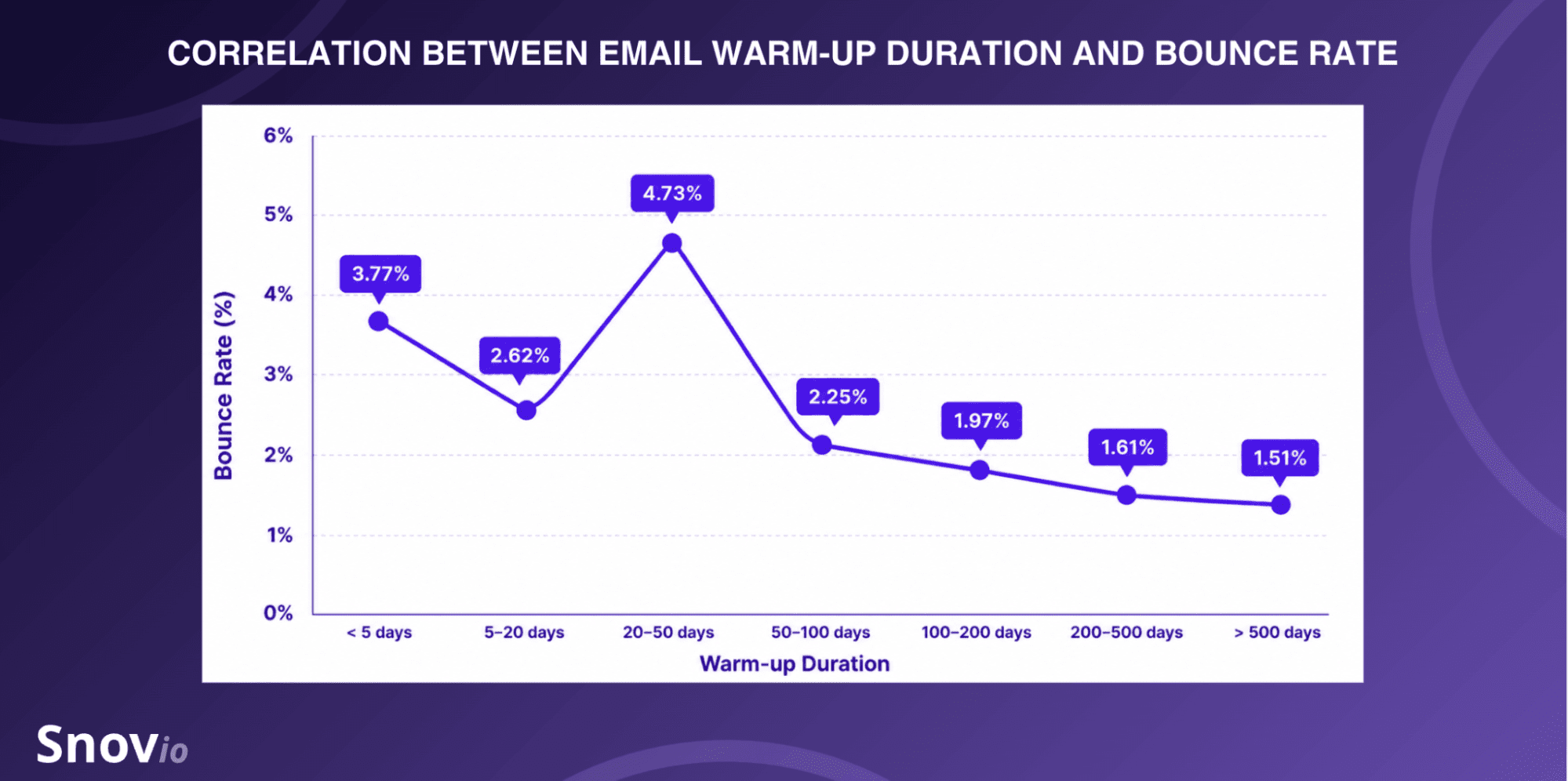
Our research shows the following bounce rates during the shortest and longest warm-ups:
- <5 days: 3.77%
- 20–50 days: 4.73%
- >500 days: 1.51%
Interestingly, the 20–50 day warm-up window shows a considerable spike to a whopping 4.73% bounce rate — the highest in the entire dataset. Meanwhile, once the warm-up period extends beyond 50 days, bounce rates begin to decline, suggesting a positive impact on deliverability.
As for engagement metrics, the differences aren’t significant enough to mention.
Key takeaways:
As expected, warm-up periods longer than 2 months generally reduce bounce rates and help establish a stronger sender reputation. However, the trend isn’t always smooth. So, we recommend regularly monitoring deliverability rates during your warm-up process.

What are copy-related cold email deliverability factors?
While researching what affects email deliverability, we also analyzed how email metrics vary depending on whether cold email campaigns include personalization, link tracking, spam words, attachments, and emojis.
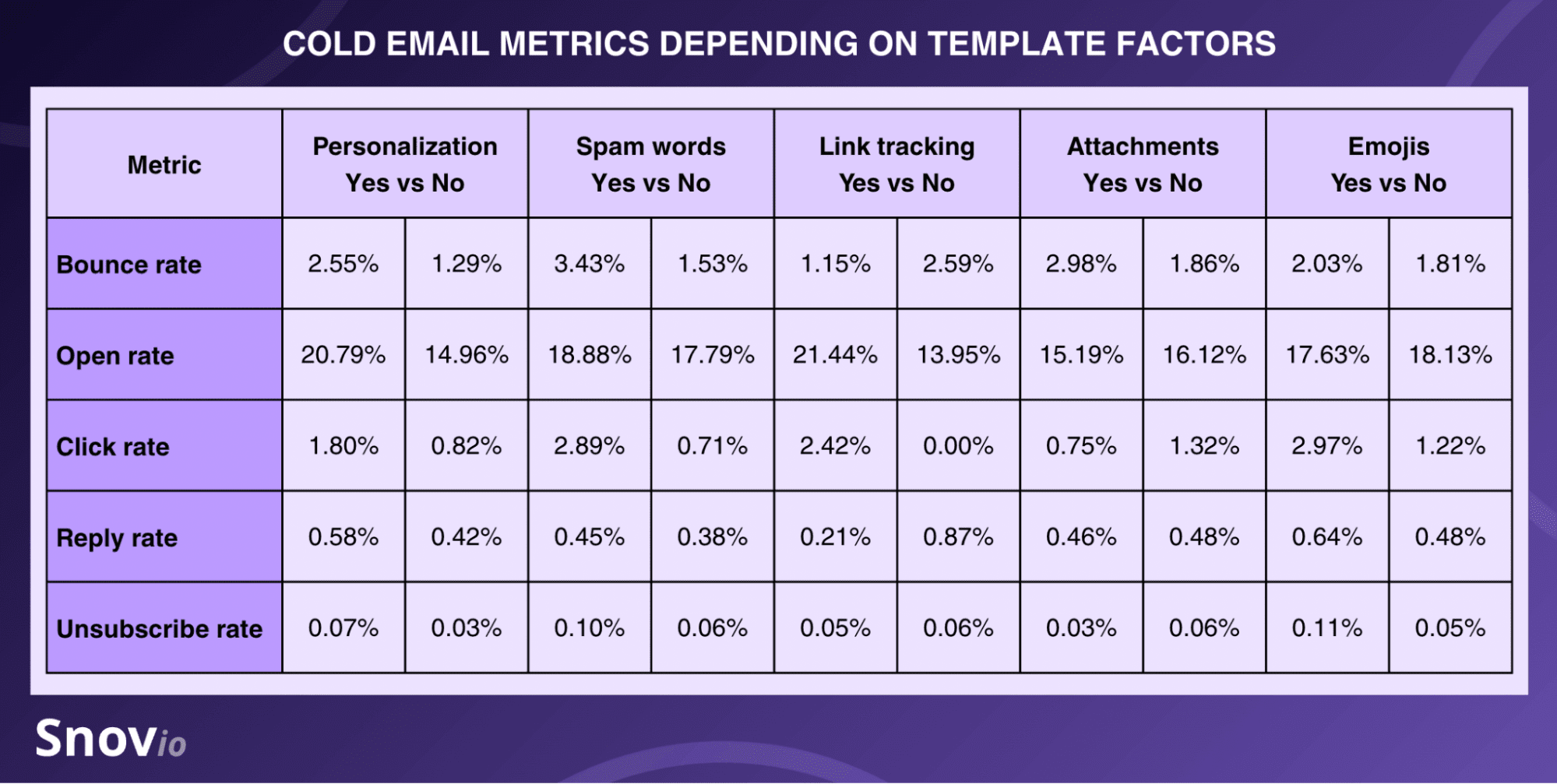
Here are our key findings:
Personalization
Personalized email campaigns are associated with substantially higher recipient engagement.
The open rate (20.79%) illustrates this tendency best in the graph below.
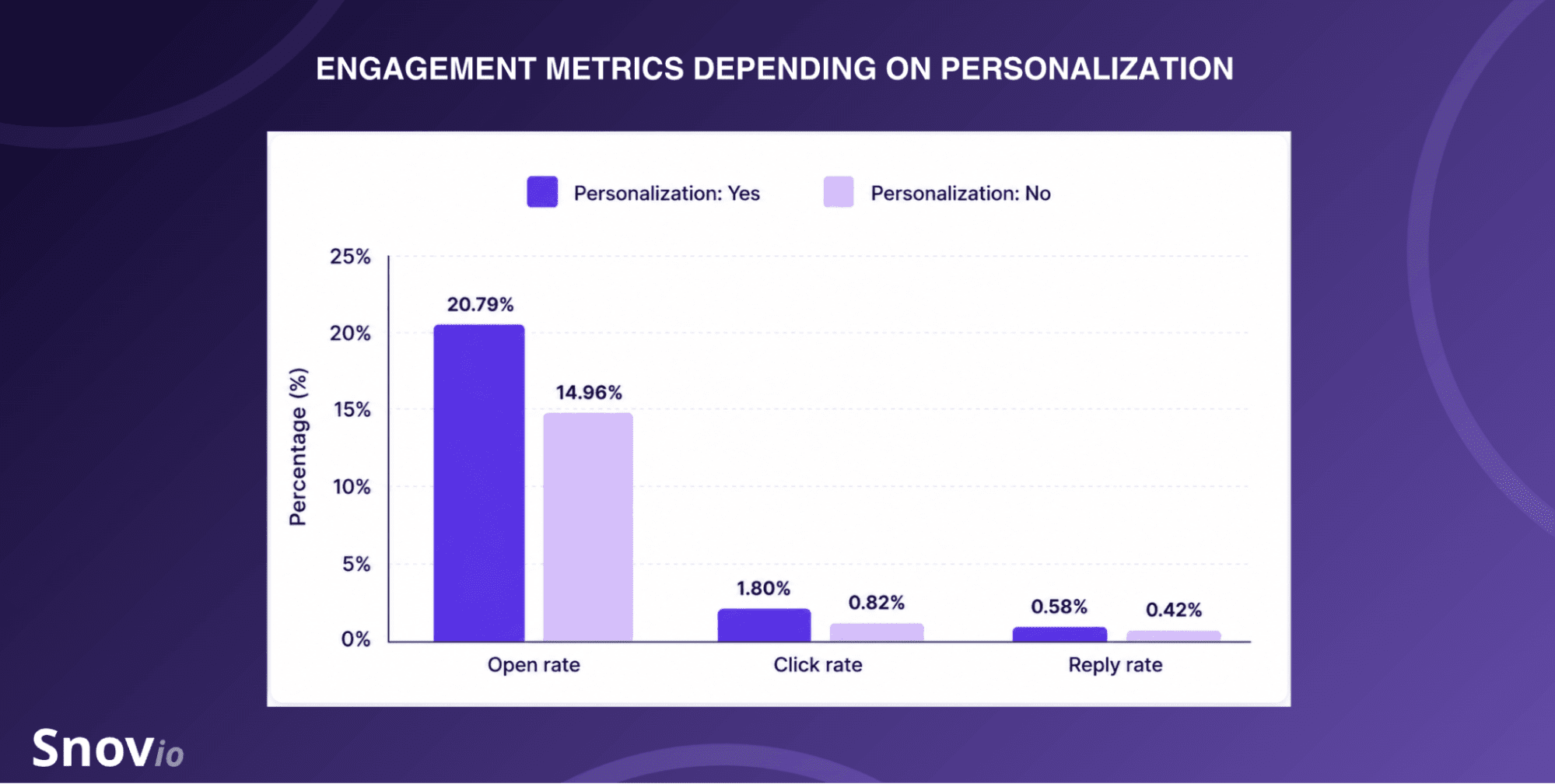
The higher bounce rate (2.55% vs 1.29%) may suggest that personalized email campaigns were sent to more targeted, manually collected (but not verified) lead lists with more invalid addresses.
Link tracking
Messages with tracked links have a lower bounce rate (1.15% vs 2.59%) and a higher open rate (21.44% vs 13.95%).
The 0.00% click rate is expected — clicks aren’t calculated when tracking is disabled.
Spam trigger words and attachments
The presence of spam trigger words is associated with significantly higher bounce rates: 3.43% versus 1.53% for emails free of spam-like vocabulary.
Along with spam words, attached files also increase the bounce rate: 2.98% against 1.86% for emails without attachments.
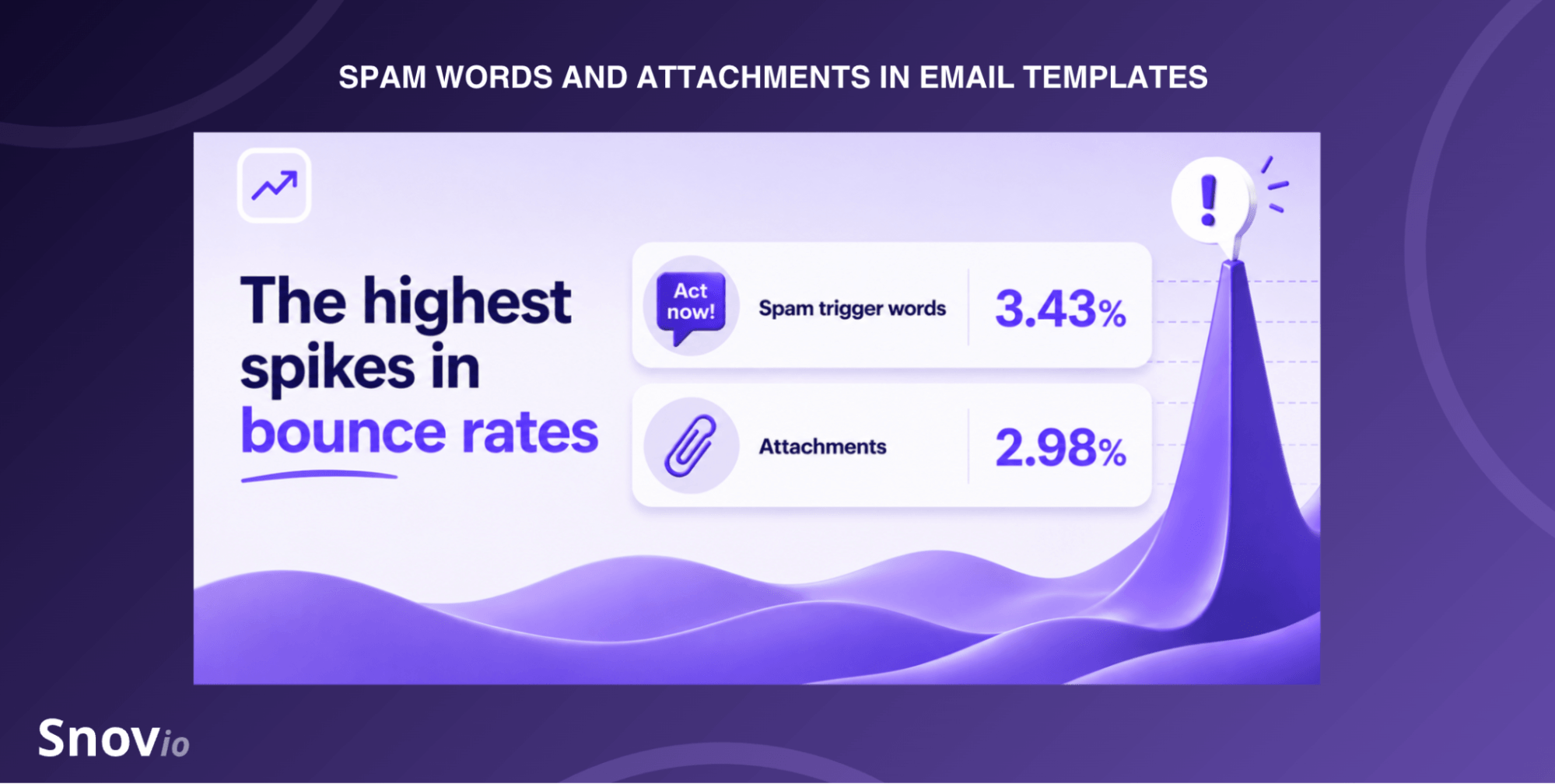
In addition, attachments also reduce all positive engagement metrics: open, click, and response rates.
Emojis
Click and reply rates are higher with emojis (2.97% vs 1.22% and 0.64% vs 0.48%).
At the same time, the bounce rate is also higher, and the unsubscribe rate more than doubles (0.11% vs 0.05%).
Key takeaways:
Personalization is the strongest engagement-booster among all template-related cold email deliverability factors. Meanwhile, adding attachments and spam words is the biggest red flag. As for emojis, be careful, especially if your email deliverability is not perfect at the moment.
Should cold emails be long or short for successful inbox placement?
According to our research, it’s better to keep cold emails on the shorter-to-medium side to reduce bounce and unsubscribe rates, although recipient engagement is more length-driven.
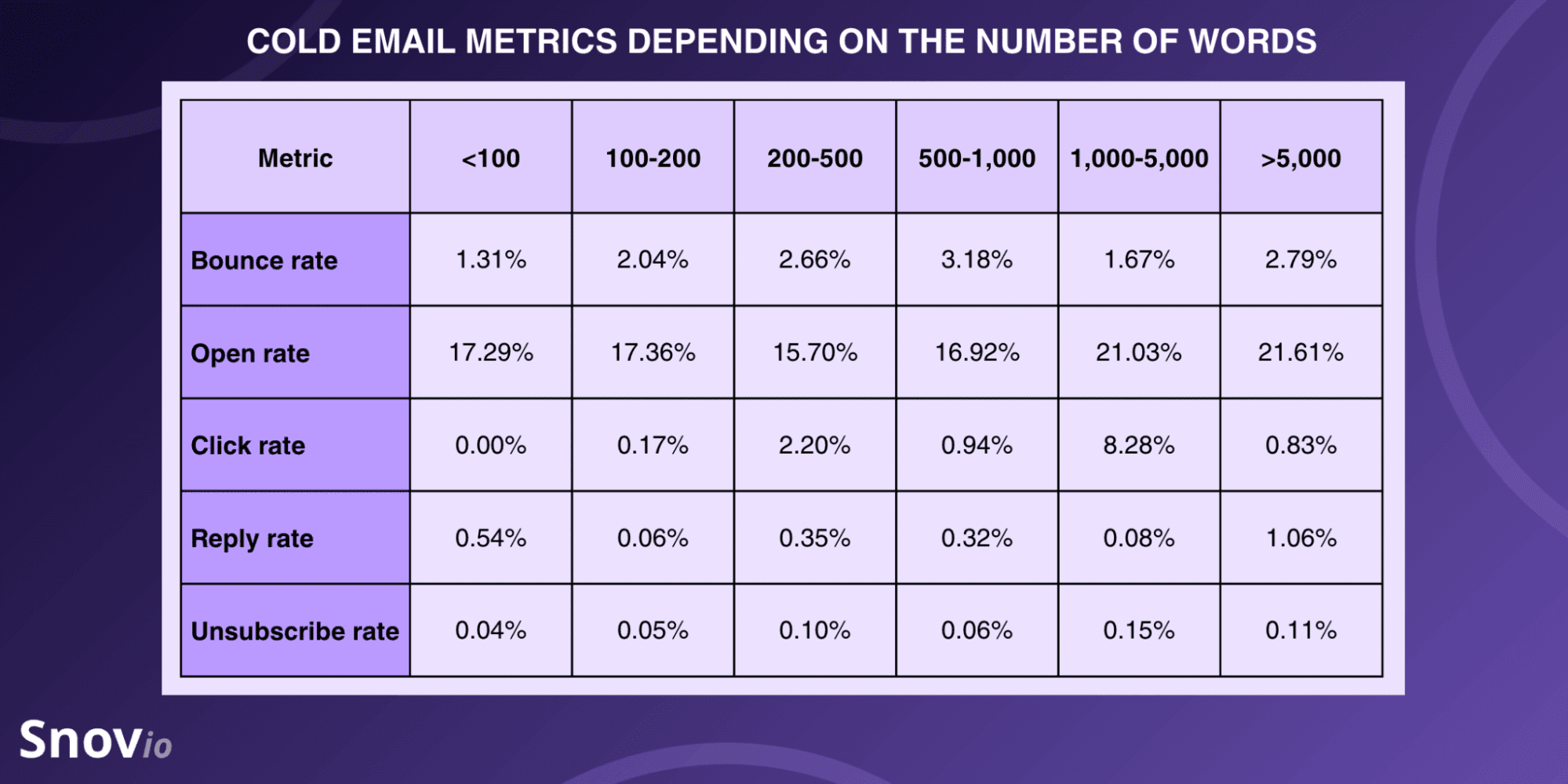
Here are our key findings:
- Bounce rate goes up with email length, peaking at 3.18% (500–1,000 words)
- Open rate peaks at 21.61% for the longest emails (yet, they comprise the smallest sample)
- Click rate is 0.00% for <100 words (most likely, no links in short emails = zero clicks); spikes to 8.28% for longer messages
- Reply rate is the highest for >5,000 words (again, a small sample)
- Unsubscribe rate climbs to 0.15% for longer emails
Key takeaways:
Messages under 100 words are the safest solution for cold email deliverability. If you want to experiment with long reads, it’s better to A/B test your campaigns first to find the optimal email length based on your audience.
How to improve email deliverability for successful cold outreach
Follow expert advice supported by the key discoveries and conclusions from our 2026 cold email report.
Set up and monitor your email authentication protocols
Literally all cold outreach experts’ tips on deliverability optimization begin with or include this trio. Here’s one of them.
I thought great copy was the secret to cold email. Then I realized 80% of my emails were landing in spam. Here’s what we found. […] Authentication is non-negotiable. SPF, DKIM, and DMARC are the foundation ESPs check before letting anything through.
Co-Founder of ColdIQ

Our findings also confirm that engagement metrics — opens, clicks, and replies — drop significantly when these email authentication records are missing. Not to mention that it’s a must to have them authenticated if you’re reaching out to Gmail email clients in particular. It’s a mandatory requirement in Gmail’s sender guidelines:
- SPF or DKIM for all senders
- SPF, DKIM, and DMARC for bulk senders (> 5,000 emails daily)
You can run a DKIM, SPF, or DMARC check separately with tools like Dmarcian or EasyDMARC, or launch an all-encompassing Email Deliverability Test via the Snov.io platform to determine whether all three are functioning properly.
You’ll also get actionable expert recommendations on how to fix cold email deliverability problems, if any are detected.
Organize contact list cleanups before launching email campaigns
The peaking bounce rate, as you’ve seen in numerous datasets across our report, may become the primary underminer of your sender reputation and inbox placement. To prevent it from sabotaging your efforts, clean your contact lists whenever you’re about to launch another campaign.
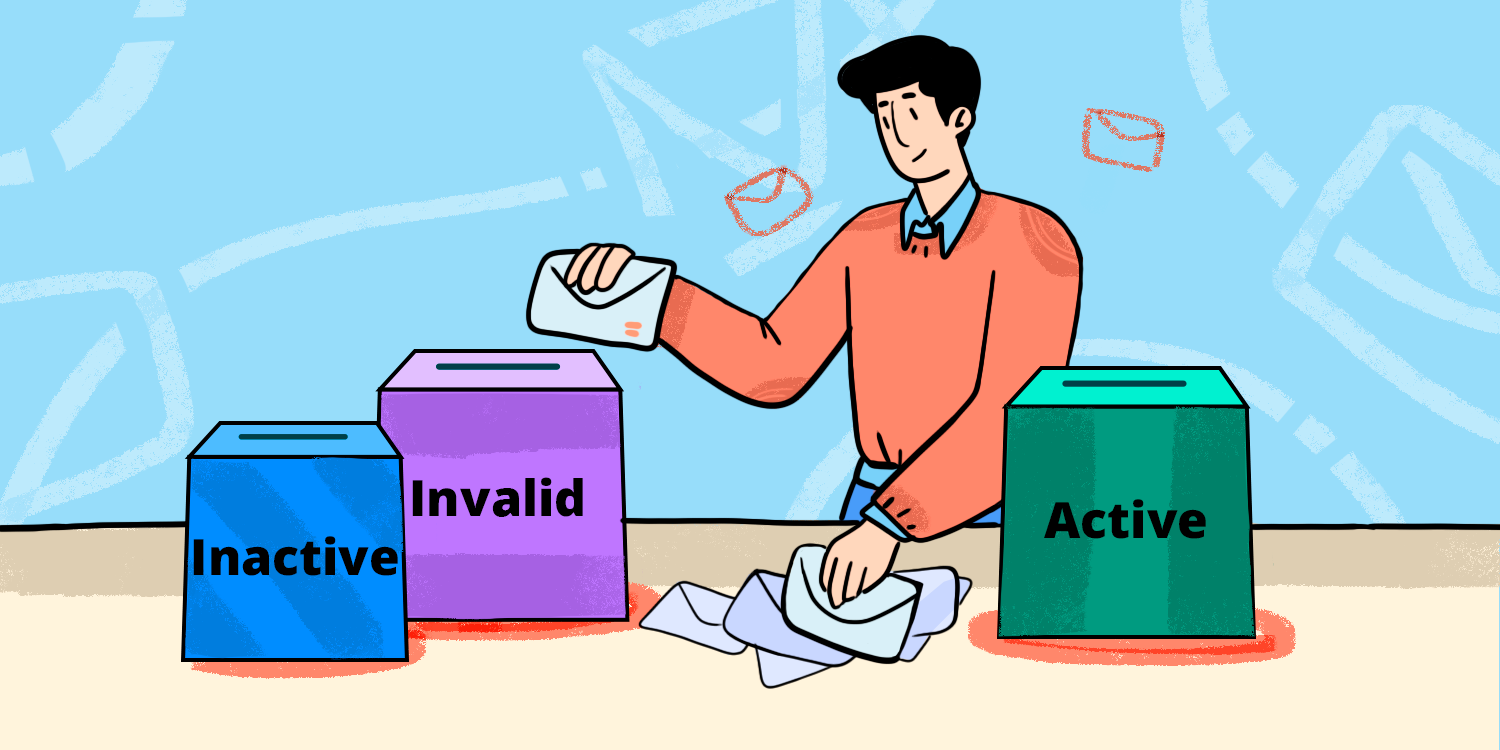
Inactive or invalid addresses or risky ones, such as catch-all, disposable, and so on, can account for up to 60% of the entire email list. That’s why verifying emails and cleaning up your list before each campaign is the groundwork. The foundation, without which your cold outreach will fall into the digital abyss after the first 100 emails sent, domains will go to spam for 3-5 weeks, and your email campaigns will simply stop.
Outbound Outreach Expert at Snov.io

When performing a contact list cleanup, get rid of the following:
- Inactive addresses
- Non-existent or invalid addresses
- Incorrect addresses with typos
- Catch-all addresses
- Spam trap addresses
- Disposable (temporary) addresses
Case study:
Arquitetura de Vendas ran bulk validation and list cleaning with Snov.io Email Verifier and found out that only 446 out of 2,100 contacts were valid for their cold email campaigns. That’s roughly one in five! With the cleaned-up email list, their messages reached the right people and landed in inboxes instead of bouncing back and undermining their sender reputation.

Warm up your sending domains more carefully
As our report demonstrated, 20–50 warm-up days are associated with the largest number of bounced emails. This is typically the phase where many senders scale email volume before their domain reputation stabilizes, and the bounce rate pays the cost of that decision. But then, what’s the best practice and sending volume for warming up your email domain?
Here’s the practical warm-up implication from our expert.
This risky window requires thorough monitoring, not just a phase to push through more messages. Your quick reaction to bounces, spam complaints, and other live signals matters more than a raw warm-up duration factor. Once the bounce rate climbs above 2% at any point, slow down and let your sender reputation stabilize before increasing email volume again.
Email Deliverability Expert at Snov.io

Speaking about volume, you should pay sharper attention to the precise daily sending limits of email providers.
For example:
If you compare Microsoft Outlook and Gmail, the former allows 10x more daily recipients for free accounts: 5,000 compared to only 500. However, both may penalize those who suddenly start sending messages in bulk without properly warming them up first.
So, start warming up your account with 2 emails/day and gradually increase your email volume to build your domain and IP reputation bit by bit. Avoid sending emails in spikes and stick to the recommended safe limit of 30 emails/day for cold outreach.

Revisit your templates and refine your email content
Our analysis of over 10 million messages made it clear that several template factors put both recipient engagement and deliverability at risk. So, we’ve rounded up a comprehensive list of template-related tips for improving cold email deliverability and engaging recipients more effectively.
They are represented in the following table.
Note: If you do want to experiment with the emoji language in your cold email campaigns, be mindful of your target audience, as there’s still an ongoing “emoji debate” in professional communications.
Match your audience. If your recipient uses emojis, mirroring their style can build rapport. Use emojis thoughtfully. They can help, but can they also backfire? — especially across generations.
Outbound Sales Consultant

Case-study:
Theo Seel Kent, Co-Founder of Clayworks, faced 3 deliverability issues impacting his open rate. One of them was the subject lines triggering spam filters and sending his messages to the Spam folder. Once he removed spam trigger words like “Dear,” better known as the “D-word” in email marketing, opens increased by 8% instantly.
Overall, he raised his open rate from as low as 12% to an impressive 47% after handling the other two problems: fixing the broken email authentication records (SPF, DKIM, and DMARC) and switching to a dedicated IP address to avoid the one shared with spammers.
What affects email deliverability: Key takeaways
Here’s a brief rundown of our key report insights after analyzing over 10 million cold emails and follow-ups:
- Cold email campaigns get delivered more reliably to Zoho Mail and Gmail users, showing the lowest bounce rates.
- Email authentication protocols are the core technical setup. Campaigns with valid SPF, DKIM, and DMARC records drive opens, clicks, and responses.
- Free and non-custom domains have significantly higher bounce rates. So, paid and custom domains are more beneficial for cold outreach.
- Warm-up for 20–50 days requires more careful monitoring. The bounce rate is the highest during this timeframe.
- Shorter emails are the safest choice for cold outreach. Messages under 100 words achieve the lowest bounce rate in the body-length dataset.
- Template choices are crucial for both recipient engagement and delivery. While personalization boosts open rates, spam words and attachments double the bounce rate.
The effect of negative signals may be cumulative, turning into an unstoppable avalanche of consequences to your reputation. And let’s be real — a poor sender reputation is much harder to recover and rebuild than deleting one spam word from your template or fixing a one-time technical issue. Let Snov.io help you with all the necessary fixes right away.