TL;DR
In this guide, you’ll find proven drip campaign examples across the entire customer lifecycle. You’ll learn the basic structure for each campaign, possible variations, and sample messages that you can copy and paste.
And if you’re new to Snov.io, don’t worry. You’ll find step-by-step instructions for building all of the campaigns described at the end of the guide.
If you ask me what email marketing can’t do without, I will point to drip campaigns without hesitation. In 2026, one in three clicks on an automated email resulted in a purchase, making it one of the strongest sales methods.
In this post, I’ll provide you with more than ten top-performing email drip campaign examples to help you build your campaigns that will show incredible results in sales and beyond.
Outline:
- What is an email drip campaign?
- Types of email drip campaigns
- 15+ top email drip campaign examples and templates for your business growth
- Onboarding email drip campaign example
- Sales cold email drip campaign example
- Post-purchase email drip campaign example
- Abandoned cart email drip campaign example
- How to build an email drip campaign step by step
- Common email drip campaign mistakes
- Benefits of email drip campaigns
What is an email drip campaign?
An email drip campaign is a sequence of automated, triggered messages sent at specific times and dates. Each follow-up in this campaign is based on the recipient’s action. The sequence as a whole guides the recipient toward a particular outcome.
Regardless of your industry, I bet you see email drip campaign examples every day. Registered for a product trial, got a welcome email explaining what to set up, and then, a couple of days later, you receive a use-case email showing how similar teams solve a key problem? That’s a drip campaign. Put some items in an online shopping cart, closed the tab, and then got a reminder in your inbox? That’s also a drip campaign.
Signed up for some blogger’s updates and now get a digest of their articles every month or so? Not a drip campaign. You see, not all automated email sequences are drip campaigns. A drip campaign has very distinct characteristics in terms of goal, sending logic, and personalization level.
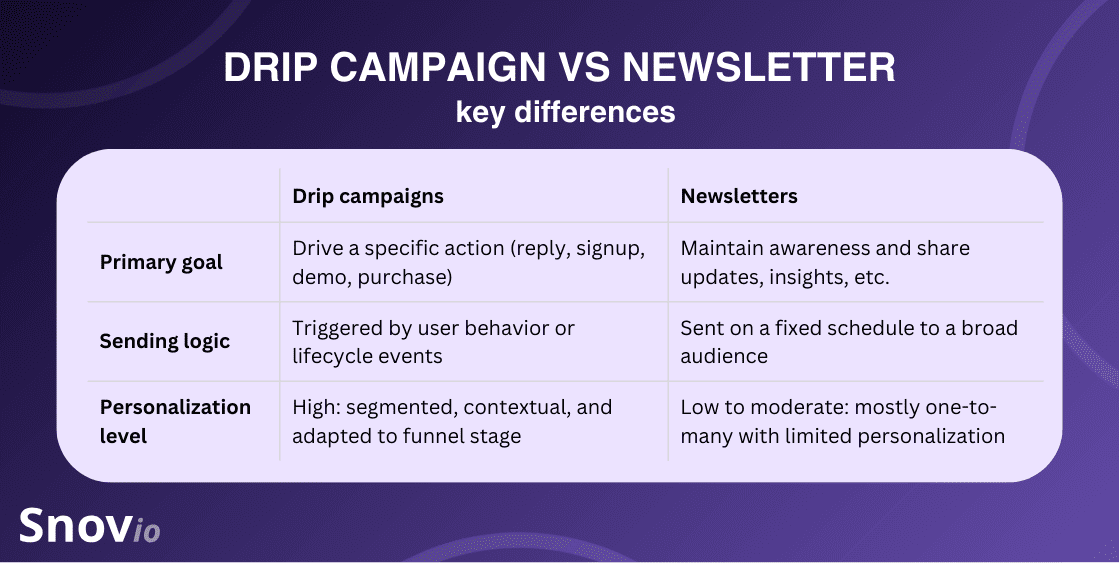
According to Klaviyo’s research, drip campaigns (behavior-triggered) perform a lot better than simple email campaigns (like newsletters) in terms of open and click rate. The average bulk sending campaigns’ click rate is 1.29%, while behavior-based campaigns have a 4.67% click rate across all industries.
❗️Note: I don’t recommend relying on open rate as a primary success metric. It can often be misleading. Click rate is a more reliable metric for optimizing your campaigns.
Learn more from this video:
Why do email drip campaigns work?
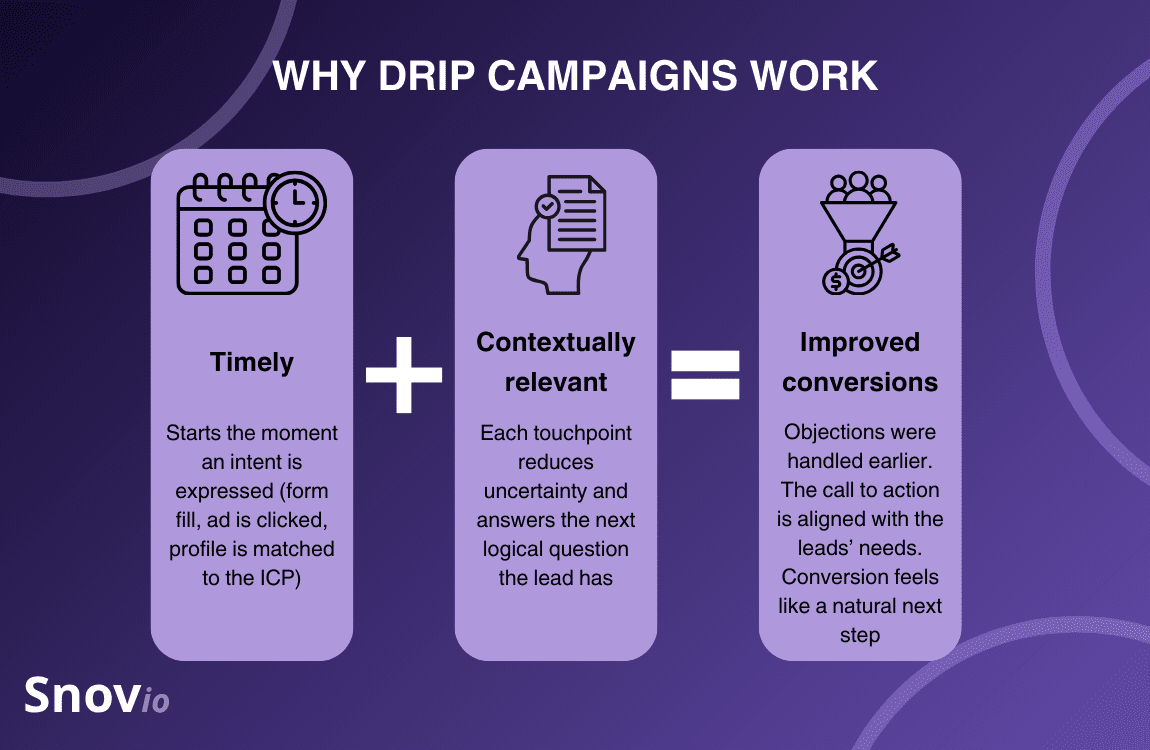
In a nutshell, drip campaigns work because they align with the lead’s interest at different stages of the funnel. They start at the point of curiosity, and then follow a recipient’s thought process right until the conversion.
Such information delivery is highly valuable to potential customers today, as 65% expect companies to adapt to their changing needs and preferences. They don’t want to feel like “just a number” to the company, so the closer brand’s communication aligns with the leads’ context – the better.
Of course, a drip campaign is only effective if it’s well configured, personalized, and targeted to a list of relevant recipients. Thus, before crafting the perfect copy for your campaign, ensure you have properly set up the basics:
- A clearly defined goal for the sequence
- A verified and clean email list (use a reliable Email Verifier for this)
- Accurately segmented audience
- Properly warmed-up email account (easy with Snov.io Warmup Tools)
- Deliverability safeguards (authentication and sending limits)
Once you’ve got these under your belt, you can start building your campaign.

Types of email drip campaigns
Email drip campaigns can be differentiated by purpose, target, or industry.
For example, if you speak about purpose, you can come across the following email drip campaigns that sales teams use:
- Welcome campaign
- Onboarding campaign
- Re-engagement campaign
- Lead nurturing campaign
- Educational campaign and more.
Based on targeting, there are three distinguished types of email drip campaigns:
- Cold email drip campaign
- Subscriber email drip campaign
- User email drip campaign
You can also find dozens of email drip campaigns based on the industry:
- Email drip campaign for B2B
- Email drip campaign for SaaS
- Email drip campaign for e-commerce
- Email drip campaign for retail
- Email drip campaign for real estate
- Email drip campaign for bloggers
- Email drip campaign for the fashion industry
- Email drip campaign for the automotive industry
And that’s not all, of course! However, when you find the example of a drip campaign that suits your industry, target audience, and goal, don’t forget to adjust it to your unique circumstances.
15+ top email drip campaign examples and templates for your business growth
To help you get started, I’ve analyzed top-performing marketing campaigns and prepared email drip examples in the form of templates you can start using today. For your convenience, I will also add their text versions, so get ready to enrich your template list with well-knit examples.
Welcome email drip campaign example
Welcome messages have the highest (52.98%) click-to-conversion rate among all automated emails. Which is interesting because the primary goal of a welcome campaign is trust-building, not selling. A welcome drip should confirm the user’s decision, set expectations, and guide them toward the first meaningful action that demonstrates value.
In a welcome automated email sequence, the first message is sent immediately or within the first 5 to 15 minutes after signup. That’s when the recipient’s intent and attention are at their peak. Follow-ups are usually spaced 1-3 days apart, depending on product complexity and sales cycle length.
Your CTAs throughout should be low-friction and action-oriented. For example, completing initial setup, exploring a key feature, confirming preferences, or taking a short guided step that leads to a “first win.” Avoid hard sales CTAs.
Here’s what your sequence might look like.
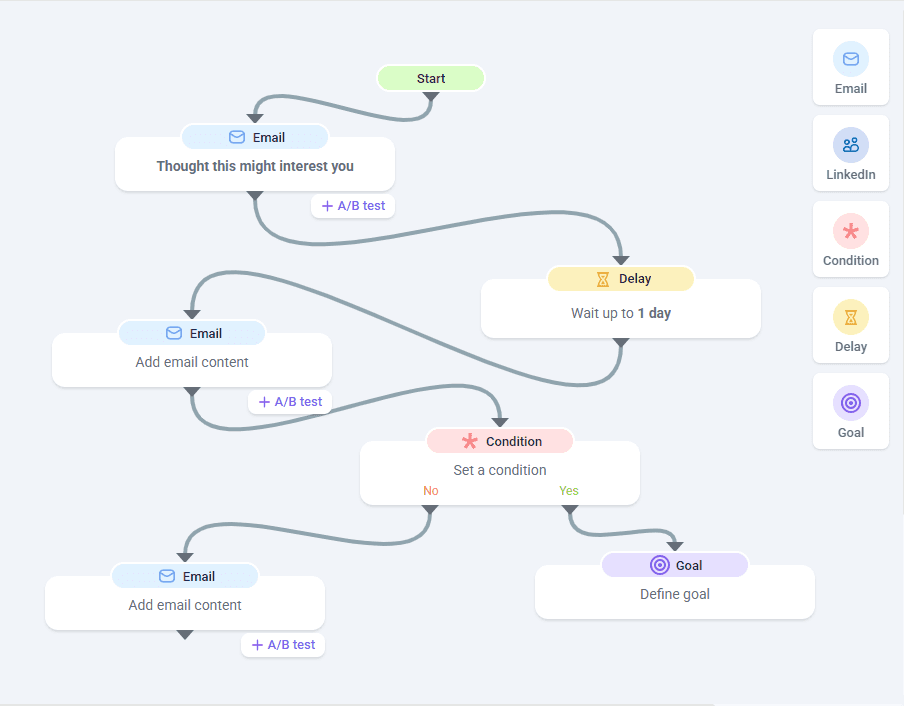
Start with a similar sequence, and then modify, depending on your goals and audience.
For the copy itself, you can utilize Snov.io AI email generator, or grab one of the templates listed below.
-
Greetings to a new user
As soon as you have a new subscriber, send them your first welcome email, thanking them for the subscription and underlining that you’re always available. Here’s a simple template you can use:
Hi [Name],
Thank you for subscribing to [Company]!
[Mention your mission and the customer’s pain point].
Visit our website page [Link] to learn more about the range of our tools and features.
Don’t hesitate to contact our support team at [Email address] if you have any questions. They’ll be happy to help.
Regards,
[Your name]
-
Asking a subscriber to set preferences
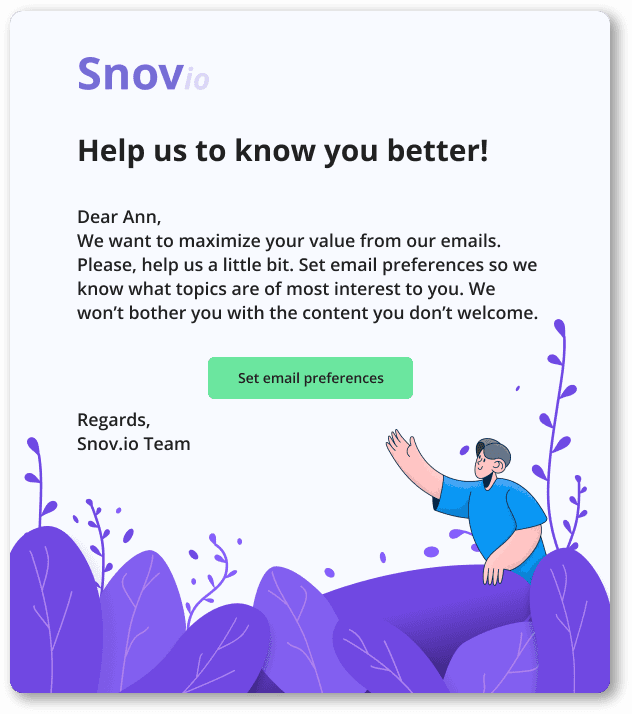
In the following email in your welcome series, you should emphasize that you aim to bring value to your clients. For instance, you can ask the user to set their email preferences so your following messages best suit their needs.
Here’s a text template for you:
Dear [Name],
We want to maximize your value from our emails. Please, help us a little bit. Set your preferences so we know what topics are of most interest to you. We won’t bother you with the content you don’t welcome.
[Call to action]
Regards,
[Company name] Team
-
Offering valuable content
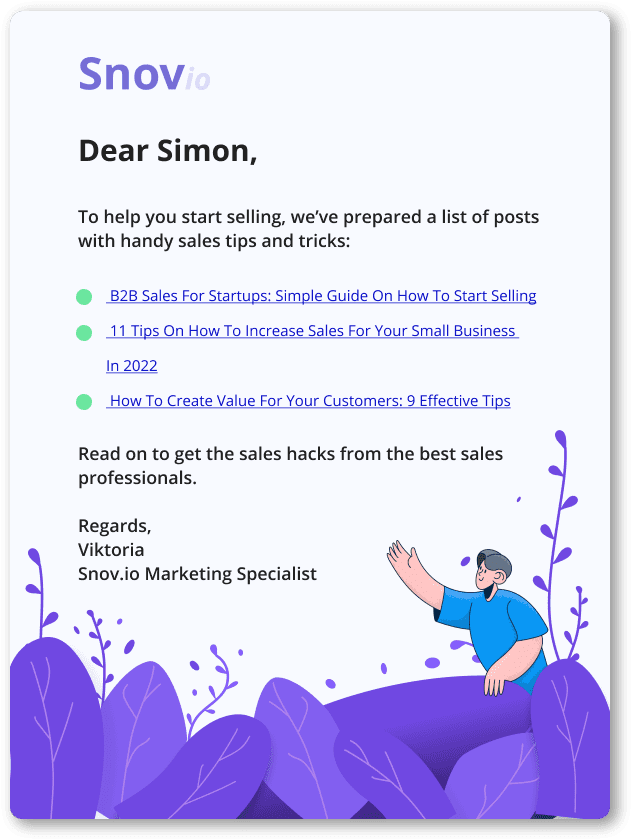
Once your subscriber has chosen the topics/products of interest, you have a chance to prove that you stick to your word by sending them an email with the relevant content. This can be a list of blog post topics or a collection of products (in case your company is an e-commerce business). This will be the third email in your drip campaign.
Consider adjusting this template to your needs:
Dear [Name],
To help you start selling, we’ve prepared a list of posts with handy sales tips and tricks:
– Blog post 1 [Link]
– Blog post 2 [Link]
– Blog post 3 [Link]
Read on to get the sales hacks from the best sales professionals.
Regards,
[Your name]
Onboarding email drip campaign example
If you’re a SaaS company, you know how important it is to successfully onboard your new users as soon as they start a trial.
A part of the lead nurturing email campaign, onboarding helps demonstrate to prospective customers how your product or service can make their lives easier. It guides them through its features to ensure they’ve made the right choice.
Therefore, a sequence of steps would be similar to the welcoming campaign, but the timing is different. The onboarding automated email sequences usually have only 1 day breaks between messages, so the user gets all of the relevant information early. Plus, the sequence starts branching out after the second message, depending on the recipient’s activity.
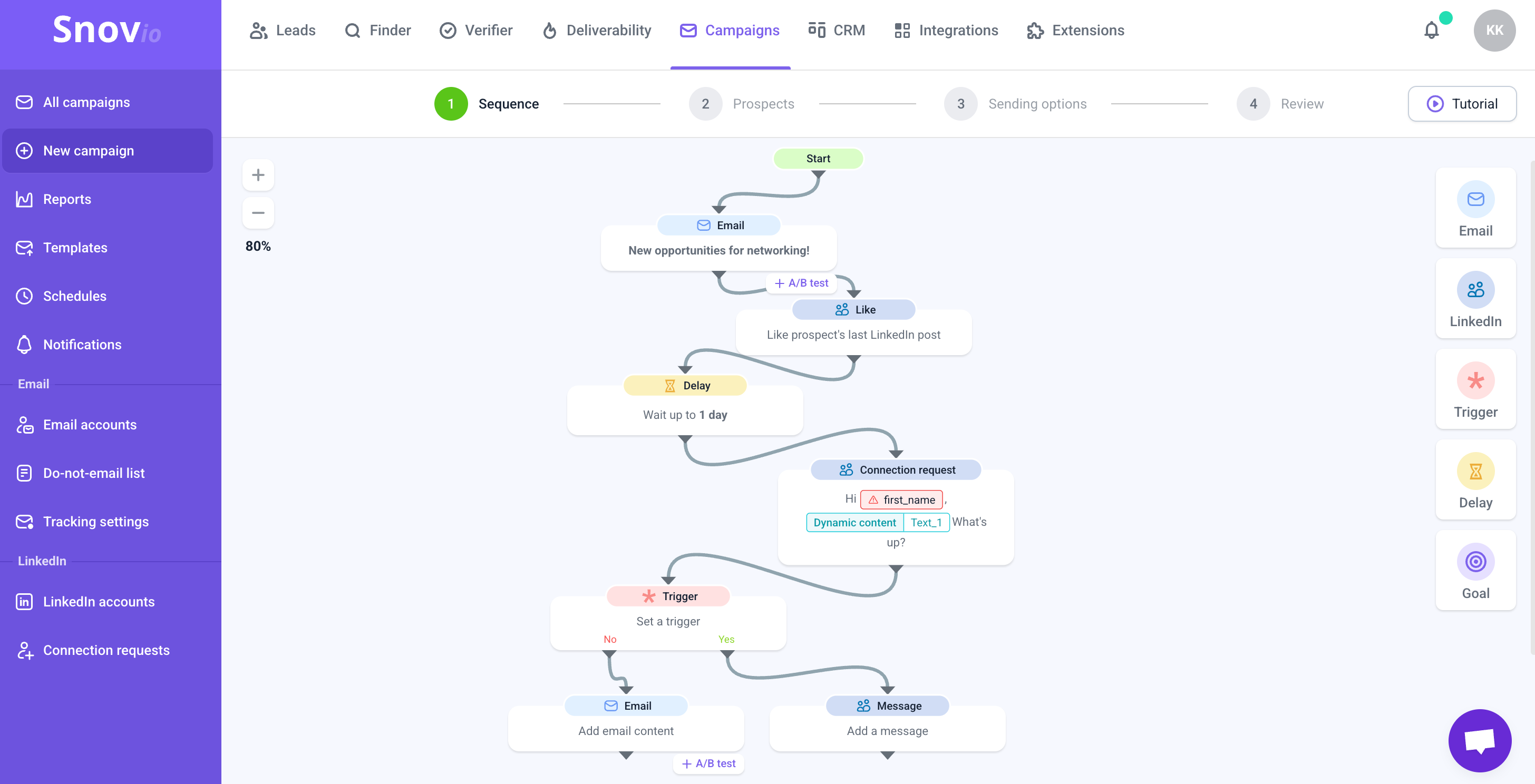
There’s no need to include each step from the email drip campaign example above into your own sequence. Pick and choose which messages would be relevant to your audience from the options below.
-
Welcoming a new user
Let’s look at an example of an onboarding email drip campaign that you can use as inspiration. It starts with sending your first welcome email to users who have just started a trial.
Feel free to use the text of this template for your onboarding goals:
Welcome to [Company name], [Name]
Your free trial starts today.
Over the next month, you’ll be receiving a few more emails to get maximum value from our [Product/service]. We’ll share some guidance and tips to keep you on board.
Regards,
[Your name]
-
Offering guidance
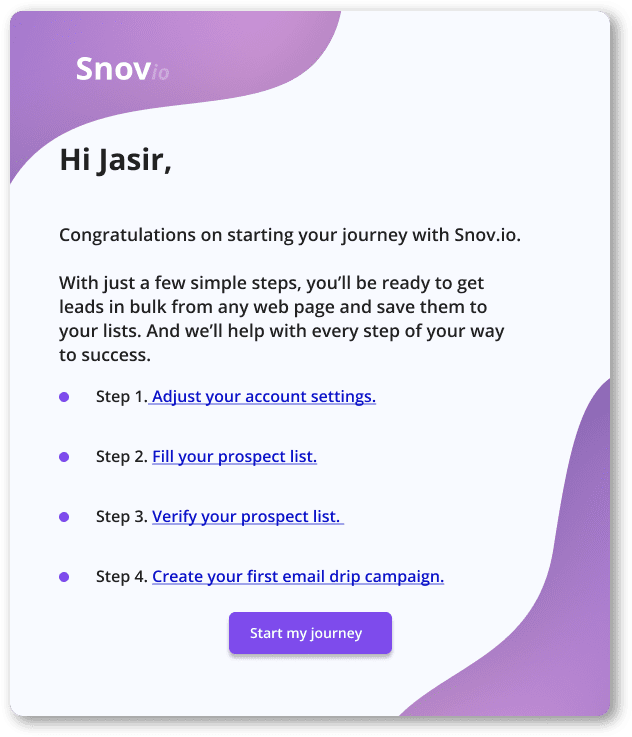
In your follow-up, let your users know all the steps you need them to take and ensure you’ll always help them through the onboarding process. This email should focus on offering help and support.
Don’t hesitate to add the template to your list:
Hi [Name],
Congratulations on starting your journey with [Company name].
With just a few simple steps, you’ll be ready to [Describe what the user will be able to do with your product or service]. And we’ll help with every step of your way to success.
Step 1 [Describe user’s actions]
Step 2 [Describe user’s actions]
Step 3 [Describe user’s actions]
Step 4 [Describe user’s actions]
[Call to action]
Regards,
[Your name]
At this point, your users’ behavior might differ. While some will enthusiastically start passing each step, others will remain inactive. You need to account for this and create different email sequences for active and inactive users.
-
Promoting and upselling
With active users, you can try to upsell premium features right after you demonstrate their value. To do this, create an email educating users about the value of additional features or tips on using your product more effectively. Then, create another one with a clear CTA that promotes purchase.
Here’s an example of the educational letter you can use:
Hi [Name],
You’ve already achieved so much with the basic [Product name] features – great job.
How about unlocking additional features that help you [describe a higher-level outcome: scale, automate more, improve results, save time, etc.]?
Here’s how most successful users move forward:
- Step 1
Enable [Additional feature #1] to [describe what it improves or automates].
- Step 2
Use [Additional feature #2] to [describe optimization, visibility, or control gained].
- Step 3
Combine [Feature #1] + [Feature #2] to [describe compounding effect or efficiency gain].
These features are designed to help you get more value from the setup you already have — without changing your workflow.
[Soft CTA: Learn more / View feature overview / See how it works]
Regards,
[Your name]
After your recipients interact with the educational email, it’s time to shoot your shot and upsell. Use a message similar to this one:
Hi [Name],
If you’re ready to get more out of [Product name], upgrading gives you access to advanced features built for [describe upgraded outcome: scale, performance, automation, predictability].
With full access, you can:
Use [Advanced feature #1] to [result]
Activate [Advanced feature #2] to [result]
Run [advanced workflows / multiple campaigns / deeper automation] without limits
It’s super easy to unlock them:
- Upgrade your plan to enable advanced features.
- Turn on [key feature] and apply it to your existing setup.
[Primary CTA: Upgrade now / Unlock advanced features]
Regards,
[Your name]
-
Reengaging inactive users
Users who have been inactive for a while, those who no longer open your emails or buy from you, should become an audience for re-engagement drip marketing campaigns. Their reasons for being idle can differ: they don’t need your product, they’ve found a better solution, or they simply forgot about you.
The better you segment this audience depending on why they stopped being active, the more successful it will be. Plus, your email series must have something that will grab users’ attention: highly personalized copy, a compelling offering, or a creative approach.
You can start your re-engagement drip campaign with a short message stating how you’ve missed your subscribers…and asking them to update their preferences or offer something special as an incentive to come back, like a discount.
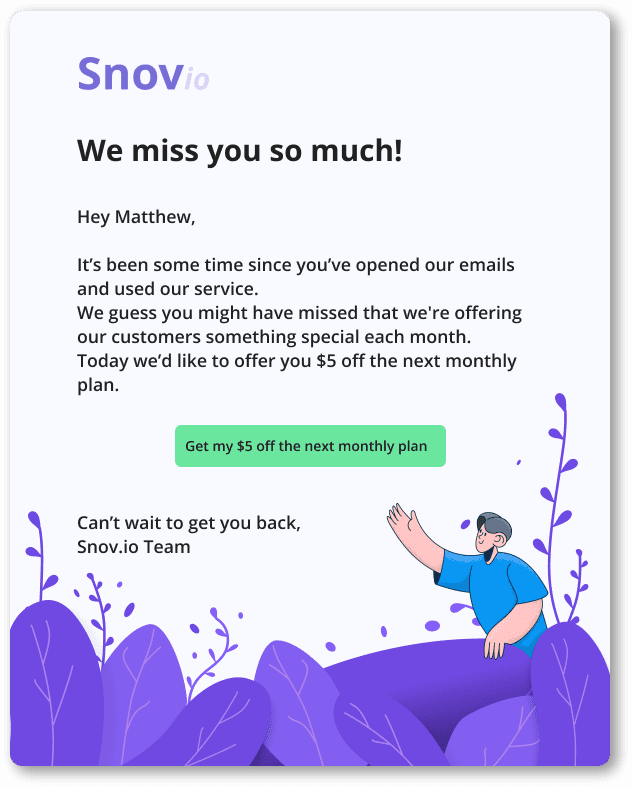
Feel free to grab the text version here:
Hey [Name],
It’s been some time since you’ve opened our emails and used our service.
We guess you might have missed that we’re offering our customers something special each month.
Today we’d like to offer you $5 off the next monthly plan.
[Call to action]
Can’t wait to get you back,
[Company name] Team
If you haven’t noticed any reaction from your user to the initial email, don’t give up. In the next one, state how you’ve improved your product, underlining that now they will get even more value from your solution.
Here’s how you can do it gracefully but transparently:
Hi [Name],
We’ve made some improvements since you’ve been away.
We’ve built new features and improved the old ones to help you maximize the value you get from using our service.
Now you can [Describe the benefits a customer will get from your new features].
Log in to your [Company name] account and feel the growth by yourself!
[Call to action]
If you have any questions, contact our support team at [Email address].
Love to see you back,
[Company name] Team
If it still doesn’t help, ask your users directly what can make them stay, but prepare these options to include them in your last-attempt survey. Consider this example:
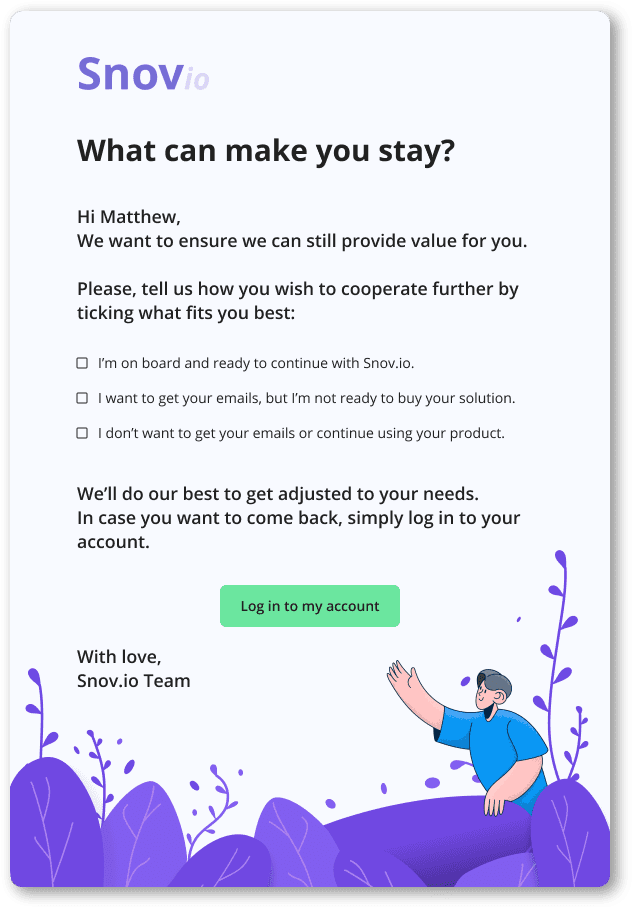
And here is the same re-engagement template in the text version:
Hi [Name],
We want to ensure we can still provide value for you.
Please, tell us how you wish to cooperate further by ticking what fits you best:
- I’m on board and ready to continue with [Your company name].
- I want to get your emails, but I’m not ready to buy your solution.
- I don’t want to get your emails or continue using your product.
We’ll do our best to get adjusted to your needs.
In case you want to come back, simply log in to your account.
[Call to action]
With love,
[Company name] Team
Build a re-engagement email drip campaign strategy to show your users how much they matter to you and remind them that there’s always great value in your product. And if they still don’t react to your sequence, let them go with an easy heart – you’ve done your best to win them back, after all.
Cold sales drip campaign examples
Cold outreach is what salespeople regularly use to build connections with prospects and make a sales pitch, mildly persuading them to buy a product or service. The most important thing about these email drip campaigns is following up. See the sales drip campaign example below to get an idea of how this may look in practice.
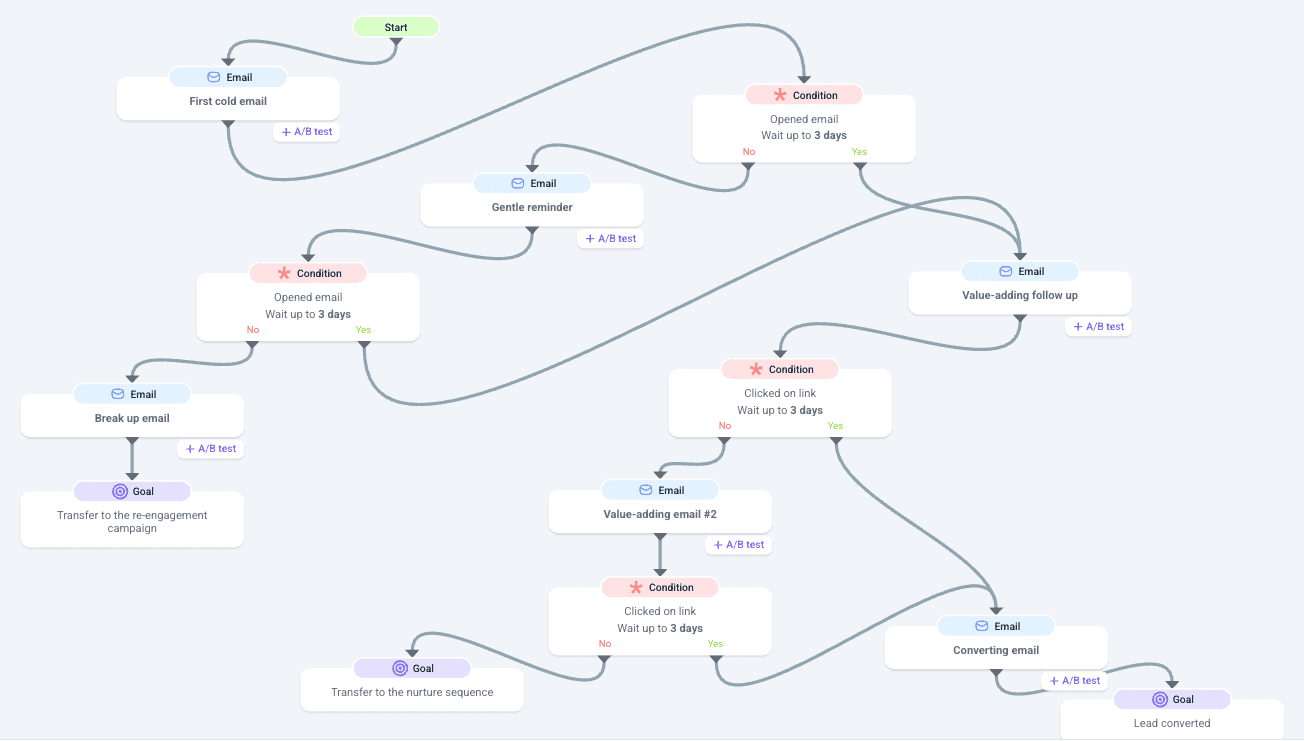
Usually, prospects get about five follow-ups after the initial message. They can be spaced out in a variety of ways. Most often, I schedule them like so:
- Follow-up 1 on day 3
- Follow-up 2 on day 7
- Follow-up 3 on day 14
- Follow-up 4 on day 30
- Follow-up 5 on day 60
However, simply sending out messages on a particular schedule wouldn’t be a drip campaign. Content should be personalized, and depend on the recipient’s behavior. Meaning, both the lead who opened your first cold email and the one who didn’t will receive a follow-up on day 3. Yet, the contents of those messages will be very different.
-
Opening cold email
The initial cold message should be short and attention-grabbing. Ensure you explain why you’re reaching out to prospects, state what’s in it for them, prove they can trust you, and crown it all with a single and straightforward call to action.
Subject line: A quick question
Hey [Name],
My name is [Your name].
I found your company on LinkedIn and cannot help but praise the ideas your company is promoting in the field.
Quick question: what are your plans for [The problem your company is solving]? I think I might have some ideas for you.
Let me know what you think.
Regards,
[Your name].
-
First follow-up
The first follow-up must be a gentle reminder, nothing more. Simply ask if prospects saw your previous email or got a chance to consider your offer.
Subject line: Just a quick reminder
Hi [Name],
I sent you an email 2 days ago considering [Your offer].
Have you managed to think about my offering?
Let me know what you think about it.
Regards,
[Your name].
11. Value-bringing follow-up
Your follow-up messages must bring extra value to your initial cold email. For instance, you can include sales case studies, testimonials, referrals, or just any relevant content that will help you persuade the prospect that your solution is worth it, handle any objections, and overcome skepticism.
Here’s an example of a follow-up within your cold email drip campaigns to get inspiration from:
Subject line: You are not alone
Hi [Name],
We’d love to tell you more about our product and what we can do for [Prospect’s company name]. [Customer’s company name] had the same problem trying to solve [Prospect’s pain point].
Since they chose [Your company name], they have seen incredible results:
- [Amazing stat 1]
- [Amazing stat 2]
- [Amazing stat 3]
You can check out their full story here [Link].
How can we help your [Bottom line, ROI, etc.]? Let’s talk about it. Could I have 10 minutes of your time to show you how? What day works for you?
Waiting for your response,
[Your name]
12. Break-up email
You tried to connect with the prospect but in vain. Well, this happens pretty often in sales. Use your break-up email as the final follow-up, but do it cleverly.
I recommend that you ask the prospect’s opinion about how you can be of value to them, and for better effect, do it right in your break-up email subject line. Consider an example:
Subject line: What could change your mind?
Hi [Name],
Hope you’re well. I’ve tried to connect several times to discuss [Your product/ service] as a solution for [Prospect’s pain point]. I haven’t heard back from you, so I wonder if there is anything that could turn your attention to my offering.
If you’re still interested, please, let me know.
Regards,
[Your name]
Post-purchase email drip campaign example
Numbers don’t lie: it costs up to 5x more to acquire a new customer than to retain an old one. So even after you’ve got a new closed won, you can’t stop nurturing the customer…till they repeat their purchase, again and again.
13. Thank-you message
Post-purchase lead nurturing email campaigns help you engage with your customers after retaining them. As soon as the sales deal is closed, send the customer your first message, thanking them for buying your product and underlining that you’re always there for them. Alternatively, you can provide them with a discount on the next purchase.
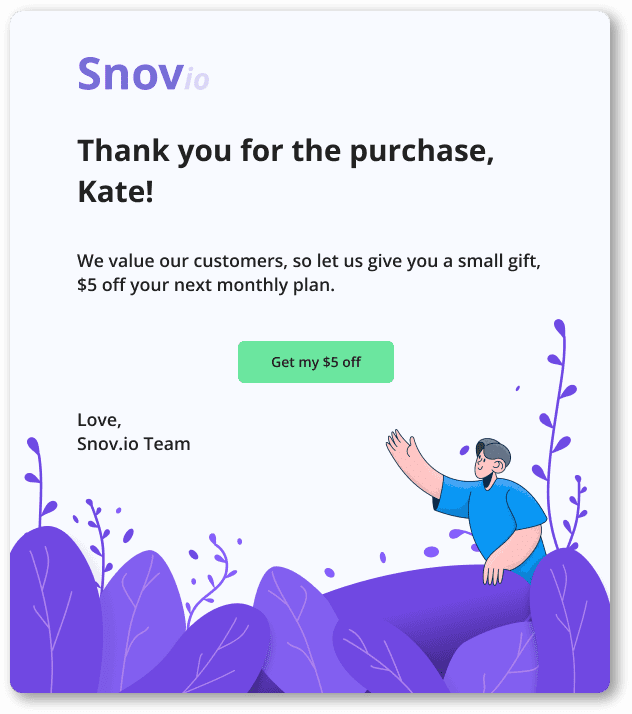
Here’s a version for you to copy:
Thank you for the purchase, [Name]!
We value our customers, so let us give you a small gift: $5 off your next purchase.
[Call to action]
Love,
[Company name] Team
14. Requesting feedback
Set your post-purchase sequence so that after 2 or 3 weeks, the customer receives another email from you asking them to share their impression of their purchase.
Save this text template for your post-purchase campaign:
Hi [Name],
It’s [How long?] since you purchased [What?] from [Your company name].
How’s your life changed? Did you like the purchase as much as we like you as our customer?
Please, tell us how much you’re happy with it.
And let us remind you that you get your $5 off the next purchase.
[Call to action]
Thanks for being with us,
[Company name] Team
Abandoned cart email drip campaign example
Abandoned cart campaigns are probably one of the most popular email drip campaign strategies for e-commerce businesses.
Such emails are triggered by a customer’s behavior when they add an item (or several items) to their cart but eventually don’t continue with the purchase.
15. A simple reminder
The first email in your abandoned cart series can simply remind the contact that there’s something in their cart waiting for them.
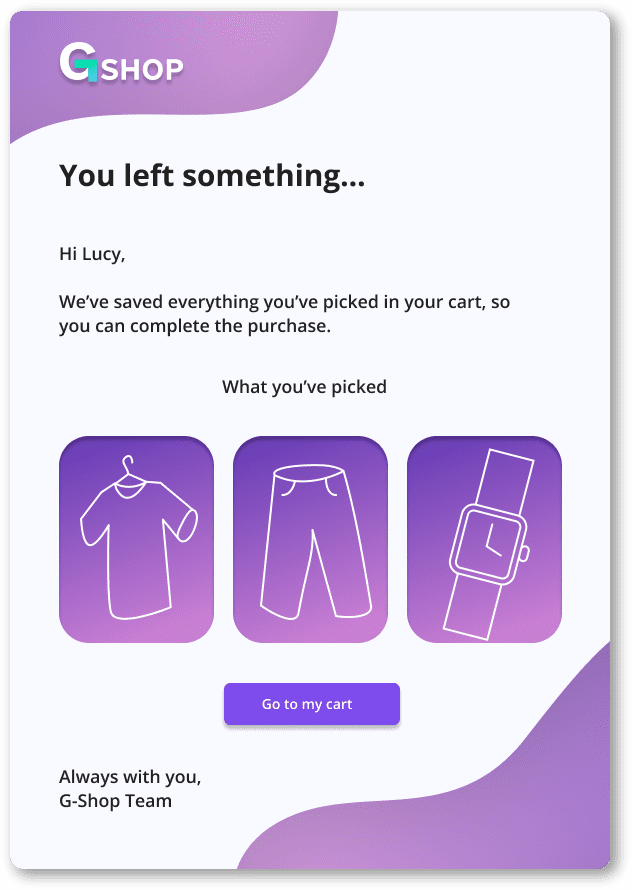
And here’s a text version to steal away:
Hi [Name],
We’ve saved everything you’ve picked in your cart, so you can complete the purchase.
[Call to action]
Always with you,
[Company name] Team
16. Second reminder with a special offer
For those who did not respond to your first email, set up an automated email drip campaign so they’ll receive another email in which you hurry them up by offering a small discount.
Feel free to grab the template here:
Hi [Name],
Take an extra 10% of your cart. The discount will be valid for the next 48 hours only.
[Call to action]
With love,
[Company name] Team
There are, of course, many more drip campaign types one can think of. Start with the basics, and then experiment to discover the sequence that works best for you for each recurrent scenario.
How to build an email drip campaign step by step
If you haven’t created automated email sequences before, having the message examples is not enough to get started. Here’s a simple, repeatable process you can use to launch your first email drip campaign in Snov.io.
Step 1: Define the goal and audience
Start with a single, clear goal. Examples include booking demos, re-engaging cold leads, onboarding new users, or following up after a download.
Next, define who this campaign is for. The tighter the audience, the better the results. A lead nurturing email campaign should look very different from one targeting cold prospects.
Step 2: Segment leads in Snov.io
Use filters to group leads based on criteria like job title, company size, industry, source, or previous interactions. Segmentation ensures each recipient receives messages relevant to their context, which directly impacts open and reply rates.
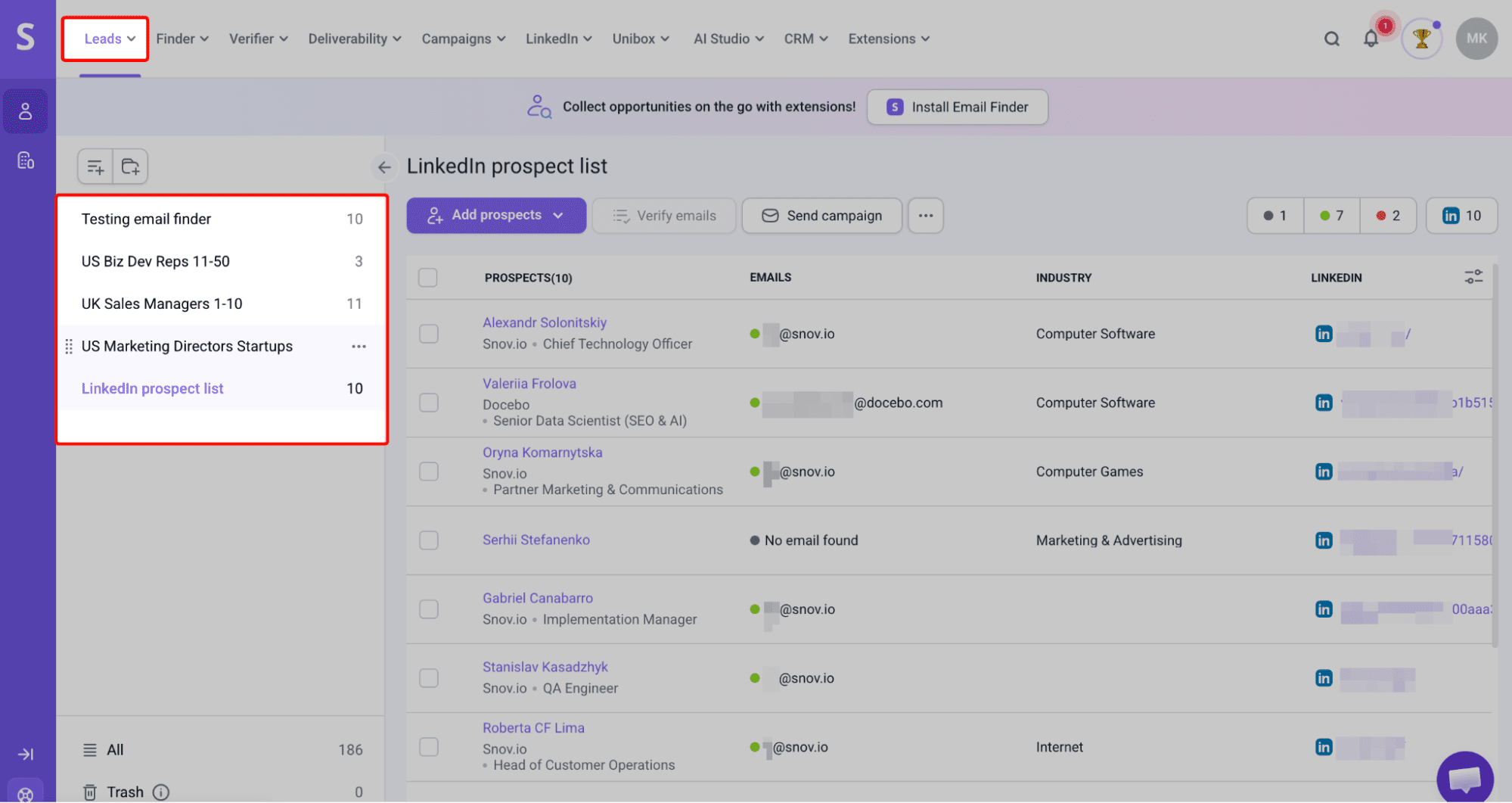
Create a separate prospect list for each segment in the Snov.io app. This way, you’ll be able to launch a campaign targeted towards a particular segment with just one click.
Step 3: Create the sequence and delays
Build a short sequence of emails, each with a specific purpose. The duration and the delays between messages are covered above, where I discuss different types of automated email sequences.
To speed up the process, create a basic sequence, using one of the email drip campaign templates I covered above, save it as a template inside the app, and then duplicate for each segment. Afterwards, tweak each sequence to fit the particular segment.
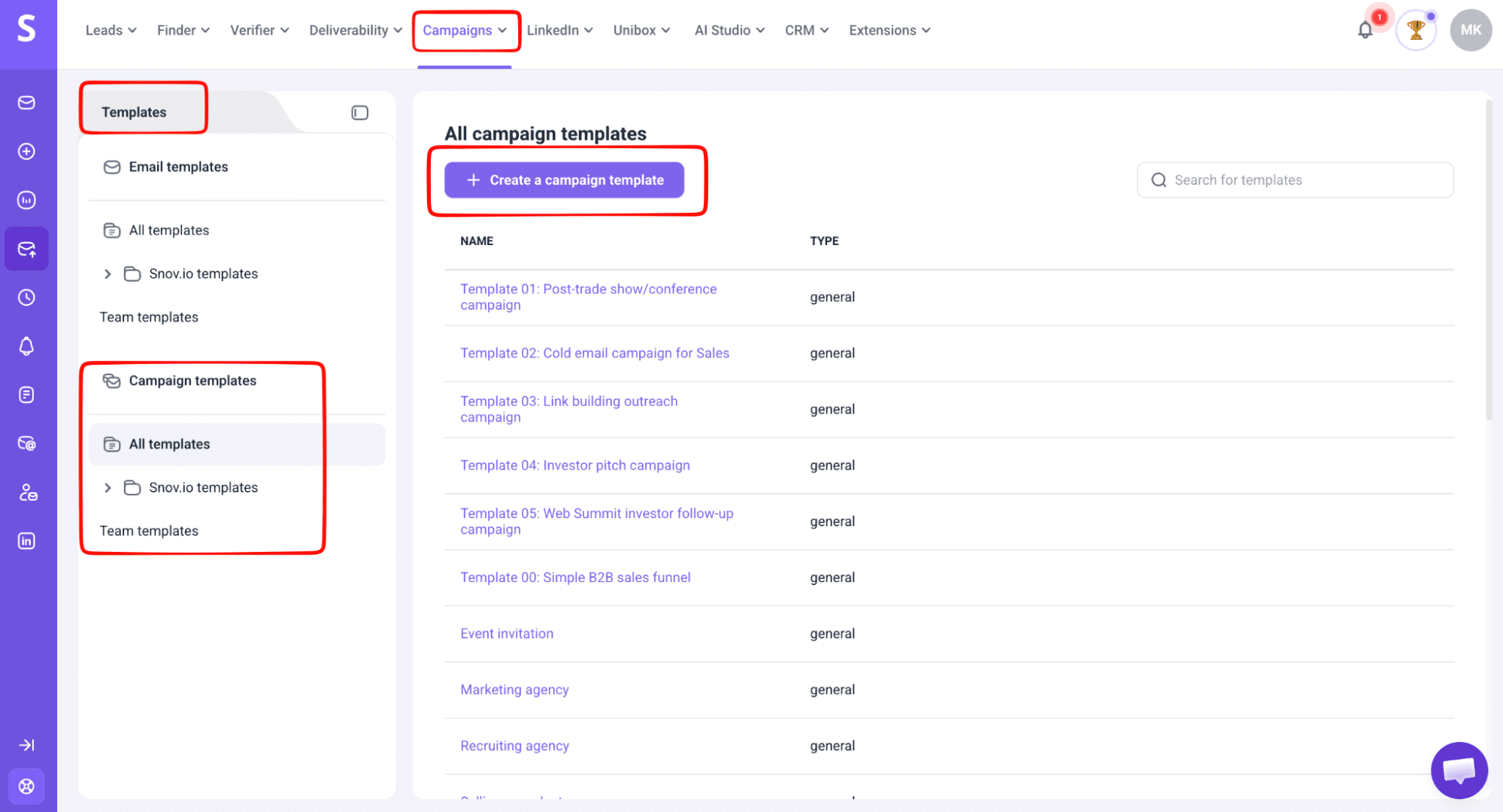
Alternatively, you can use one of the campaign templates created by our team of experts. Find them inside the template library in your Snov.io app.
Step 4: Launch and monitor performance
Once the campaign is live, track key metrics such as open rate, click rate, reply rate, and unsubscribes. You can find this information in your Snov.io account, under the Reports tab.
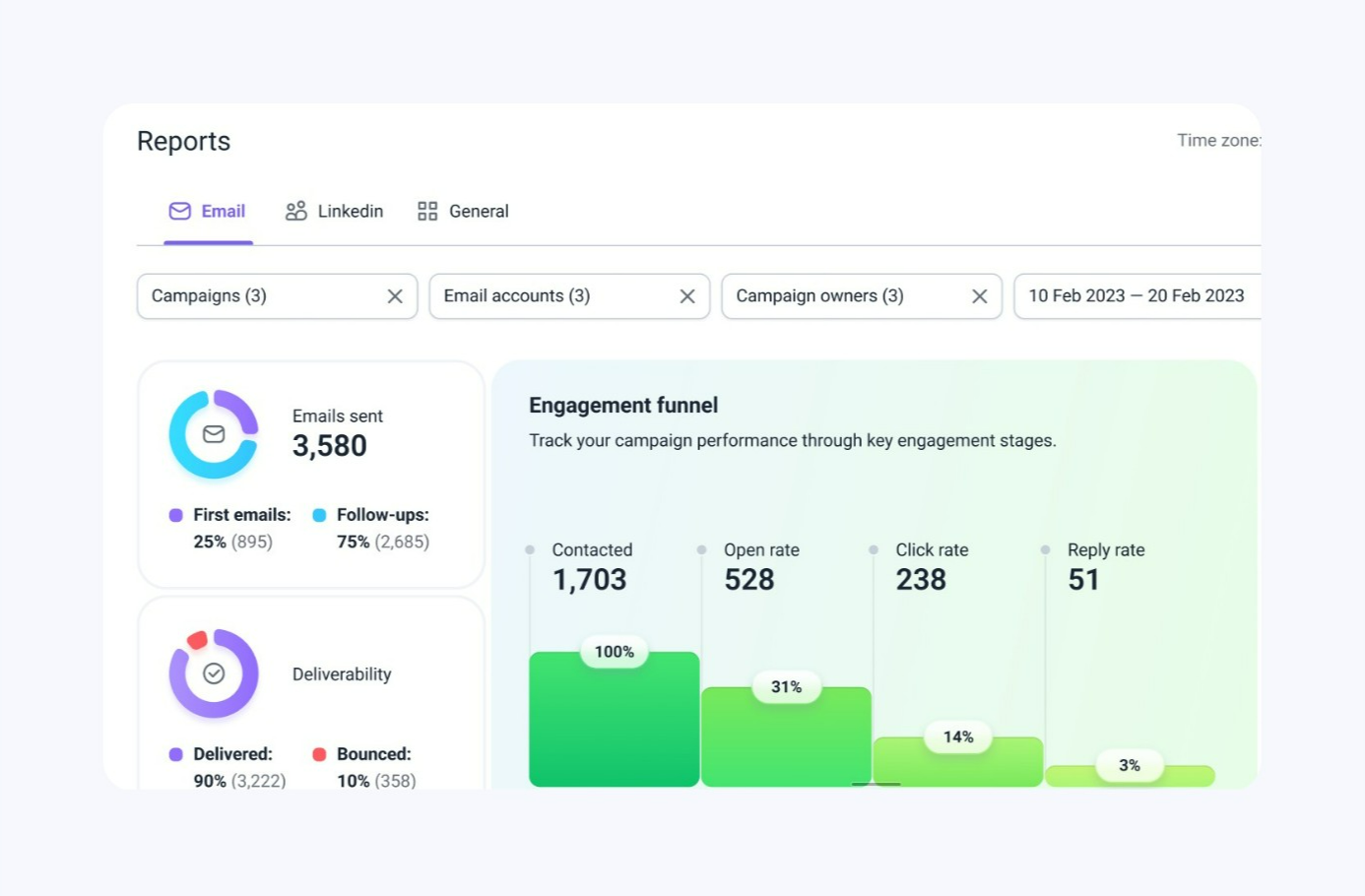
Use this data to refine subject lines, copy, timing, or segmentation before scaling the campaign further.

Common email drip campaign mistakes
Even well-designed drip campaigns can underperform if a few basics are overlooked. These are the most common issues I recommend watching out for.
- Over-emailing
Sending too many emails in a short period leads to fatigue, unsubscribes, and spam complaints. Fewer, well-timed emails usually outperform long sequences.
- No personalization
Generic messages reduce engagement. Even simple personalization, such as referencing a role, company type, or previous action, can significantly improve results.
- No exit conditions
Drip campaigns should stop when a lead replies, converts, or unsubscribes. Without exit conditions, users may continue receiving irrelevant messages, damaging trust.
- No performance tracking
Launching a campaign without reviewing results defeats the purpose of automation. Tracking performance is essential for understanding what works and optimizing future campaigns.
Benefits of email drip campaigns
I started the post by saying that your drip email marketing strategy can’t do without drip campaigns, not without reason. They ensure your communication with users runs smoothly and, most importantly, is highly personalized.
With well-crafted email drip campaigns, you can:
Increase engagement and customer loyalty
Email drip campaigns allow you to get in touch with your customers regularly and communicate the relevant message to them. This helps you build trust with your users and encourages them to respond to your emails.
Have a reliable lead nurturing mechanism
What if your potential customers are not ready to buy from you at the moment? Drip campaigns will help you move your leads through the sales pipeline to the purchase by communicating the benefits of your solution, answering questions, or addressing any objections.
Promote relevant content
Drip campaigns allow you to send the right content at the right time, depending on your customers’ sales funnel stage. For example, your prospects might receive content that will move them further toward buying your product, while your customers might receive valuable educational content based on their current needs.
Increase brand awareness
Owing to systematic emails subscribers get from you, they’ll always keep your company in mind. So even if your prospects are not going to buy a product like yours at the moment, when they are ready, your brand will be the first they’ll think of.
Re-engage inactive users
Some contacts will inevitably stop reacting to your emails. A good marketer knows how important it is to keep the contact list healthy, but before you clean it from unengaged users, you should try re-engaging them. Email drip campaigns will help you do this better than any other channel.
These are only some of the vivid benefits of using email drip campaigns. You’ll uncover many more of them as soon as you implement them for your business strategy.
Wrapping up
Email outreach is one of the best ways to be in constant contact with your potential and existing customers. But, it only works long term when it’s structured.
In this guide, I’ve covered the structure and message options specifically for email drip campaigns. They fit sales teams booking meetings, marketers nurturing leads, and founders building predictable pipelines.
If you want more templates and a way to automate these sequences end to end, you can build and manage them directly inside Snov.io’s Drip Email Campaigns tool. Plus, if you’re interested in other types of email outreach, stay tuned for other in-depth guides on email marketing.
See ya!