
TL;DR: Quick playbook for creating effective lead magnets in B2B
Here’s a 5-stage process of how to create a lead magnet that converts B2B leads:
Continue through this guide if you want to explore each stage in depth and see the best lead magnet examples that actually generated leads and revenues.
Did you know that an email address is the #1 type of contact information that 86% of people would willingly share with brands? Just give them a solid reason to do that — create a quality lead magnet.
I’ve prepared this complete guide to creating lead magnets that help you not only capture your target audiences but also convert them into paying customers. Follow expert recommendations, avoid common mistakes, and sip inspiration from Snov.io customers and other brands.
Key points of this guide:
- What is a lead magnet?
- How do lead magnets work?
- What makes a good lead magnet today for B2B vs B2C?
- How to create a high-quality lead magnet for B2B leads
- Top 5 B2B lead magnet examples: Snov.io customers’ choice
- Other B2B lead magnet ideas worth trying in 2026
- The best lead generation formula: Lead magnets + outbound strategies
- Key takeaways: How to create a lead magnet that converts
What is a lead magnet?
A lead magnet, or lead generator, is any free resource (tool, service, or any other freebie) offered in exchange for a potential customer’s contact information. Primarily, it’s a name and email address, but businesses also collect other contact details, such as a phone number, company name, or job title.
However, if we talk about B2B in particular, I prefer the following lead magnet definition by Alex Hormozi from his book, $100M Leads:
A lead magnet is a complete solution to a narrow problem.
American entrepreneur, investor, and philanthropist

A good lead magnet focuses not on capturing leads but on offering solutions to specific pain points — the value people actually look for.
|
💡Expert hack: Features of a perfect lead magnet can be grouped around the codeword PRAISE: P: Problem-solving R: Relevant A: Attractive I: Instant S: Specific E: Easy-to-use |
In this context, valuable lead magnet examples in B2B may be as follows:
- Quick-win guides or e-books
- Checklists
- Workbooks
- Cheat sheets
- Short courses (e.g., a mini-course or masterclass)
- Templates
- Research reports
- Webinars, etc.
Meanwhile, several email marketing guides I came across refer to lead magnets as “lead baits.” Frankly, for me, this phrasing sounds a bit aggressive and inappropriate because you don’t “hunt” for prospects with “bait.” You collect and nurture leads by sharing helpful information and solving their pain points.

How do lead magnets work?
When providing immediate value and addressing your target audience’s pain points, lead magnets work like accelerators for your entire lead generation strategy — from the first touchpoint to conversion:
- They attract leads: Whether on your website, in online communities, or across social media channels, lead magnets can serve as powerful attention-grabbers to attract potential customers and get them interested in your company and your offer.
- They turn website visitors into new leads: Anonymous web lurkers become your potential customers with exact names and addresses for your cold emails or email marketing campaigns.
- They grow contact lists: If you’re looking to expand your email list, an effective lead magnet can do the job automatically.
- They warm up cold prospects: Even a single delivery message with your lead magnet and a “thank-you” note can break the ice. And there you have a warmed-up prospect who is more likely to engage with you.
- They nurture leads by building trust: Good lead magnets help demonstrate expertise and position you as an authoritative, trustworthy voice in your specific field. Plus, the principle of reciprocity contributes to trust-building as people share their contact details, and you give them something valuable in return.
- They drive conversions and sales: More high-quality leads nurtured → more paying customers → more revenues.
Now, let’s talk numbers.
For example:
In the words of Alex Demeter, CEO and Founder of Hyper Helios, he already “generated over $20M from lead magnets alone.” Thanks to the framework below, the lead magnet’s landing page on his website converts at 30% or higher.
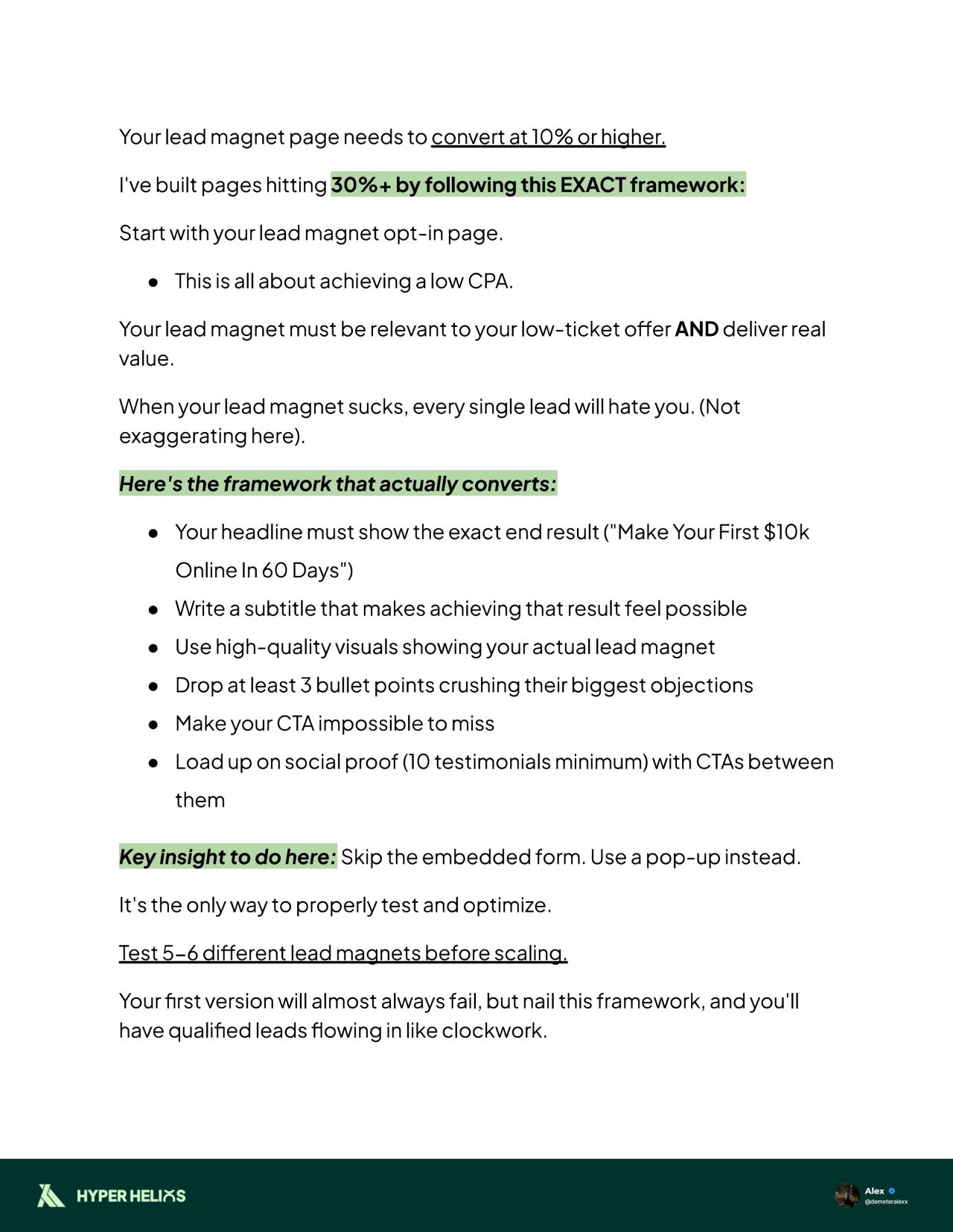
At the same time, some lead-generation experts, particularly on LinkedIn, do claim that most lead magnets are a “slow-lane” or “slow-burn” solution. So, even if lead magnets work, you shouldn’t expect super-fast results.
What makes a good lead magnet today for B2B vs B2C?
Both B2C and B2B lead generators are effective if they offer high perceived value and a quick win for potential customers, all while driving the connection toward a closed deal or purchase.
However, there are several critical differences to keep in mind when creating lead magnets for B2B vs B2C audiences. Examine them in the following table.
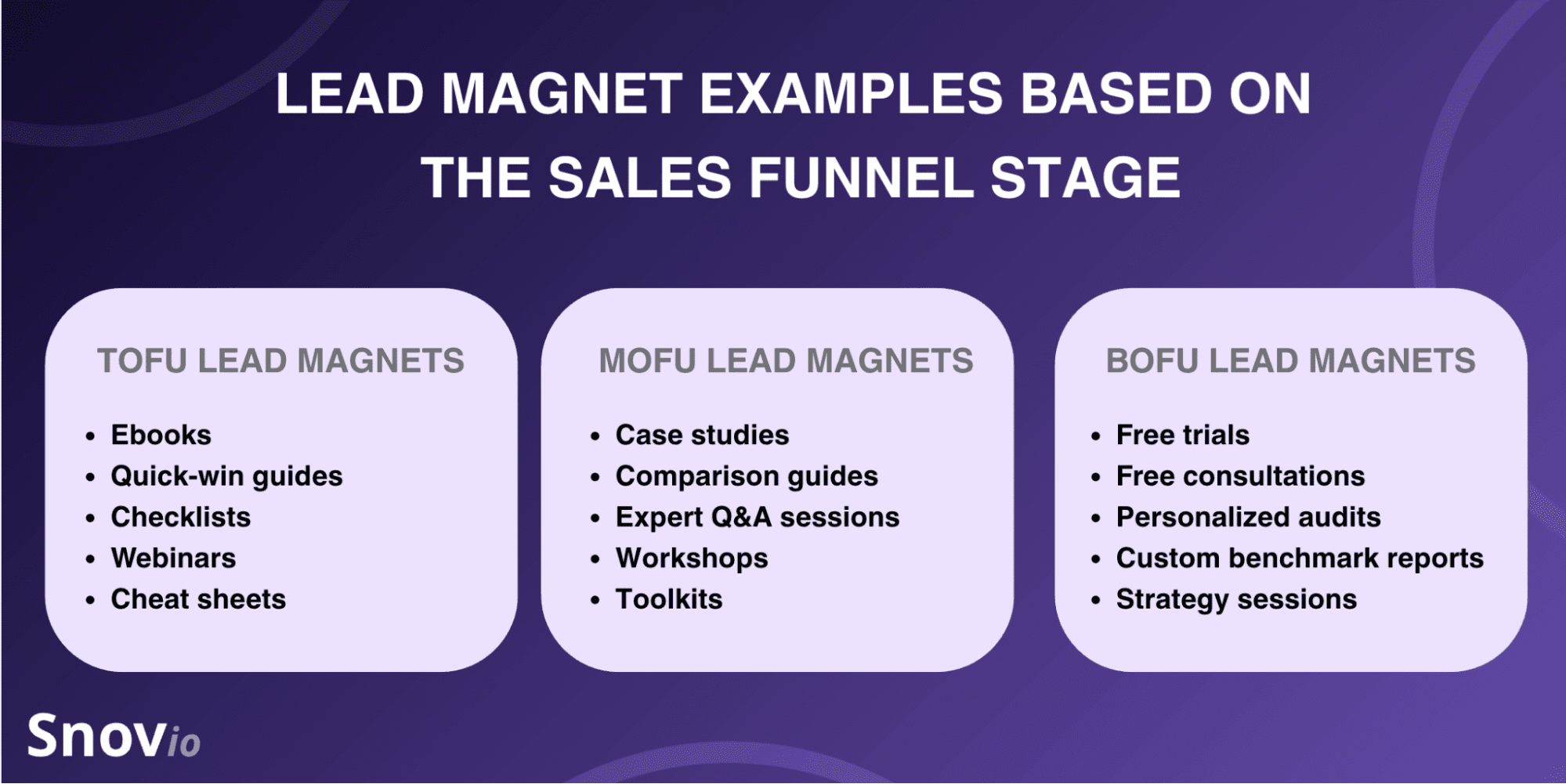
Note: In B2B, the sales funnel stage also matters when creating an effective lead magnet.
For example:
For the top of the funnel (TOFU), the best lead magnet ideas would be educational e-books, courses, or webinars.
At the middle of the funnel (MOFU), you need to help your potential customers evaluate options with comparison guides or calculators.
And to generate leads at the bottom of the funnel (BOFU), offer free trials, personalized audits, or strategy sessions to help them make a final decision.
How to create a high-quality lead magnet for B2B leads
In this section, I’ll walk you through a detailed step-by-step process: from the preparatory to the testing stage of creating effective lead magnets for B2B audiences.
Prioritize one specific pain point of your target audience
If you haven’t done it yet, identify your ideal customer persona (ICP) first to hyper-specify your target audience. Who exactly are you targeting with your lead generation strategy?
If you’re having trouble defining your ideal audience, you can use the AI ICP and Buyer Persona Builder from Snov.io, which will help you do it in minutes.
Once you’ve identified your ICP(s), narrow down on their pain points. The narrower your lead magnet’s focus, the better.
Your lead magnet shouldn’t just identify problems. It should provide an actual, implementable solution to ONE specific problem. […] The more specific you are, the more valuable it becomes to the right person. I’ve seen lead magnets with 10x higher conversion rates simply by narrowing their focus.
Growth Marketer

To discover one particular issue your prospects struggle with, you can:
- Conduct one-question polls (e.g., on LinkedIn) on “What challenge bothers you most these days?”
- Notice common objections they mention during sales calls
- Collaborate with your SEO and marketing teams to analyze people’s search intent, visitor behaviors on your website, and user interests across social media channels
For example:
Instead of a broad “LinkedIn outreach guide,” focus on one pain point in LinkedIn prospecting, say, getting people to respond to InMails, and provide valuable insights on what helped you get “X” responses or share a tried-and-tested template.
Choose a proper format for your lead magnet
Different formats may yield different conversion rates. Based on MailerLite’s analysis of 41,000 signup forms and pop-ups, the top five highly-converting lead magnets are as follows:
- Giveaways — 29.37%
- Learning resources (workshops, online courses, training sessions) — 27.4%
- Interactive tools (quizzes, calculators) — 26.44%
- Reports and e-books — 24.61%
- Consultations and services — 23.31%
Note: Discounts have the lowest conversion rate of all (16.2%).
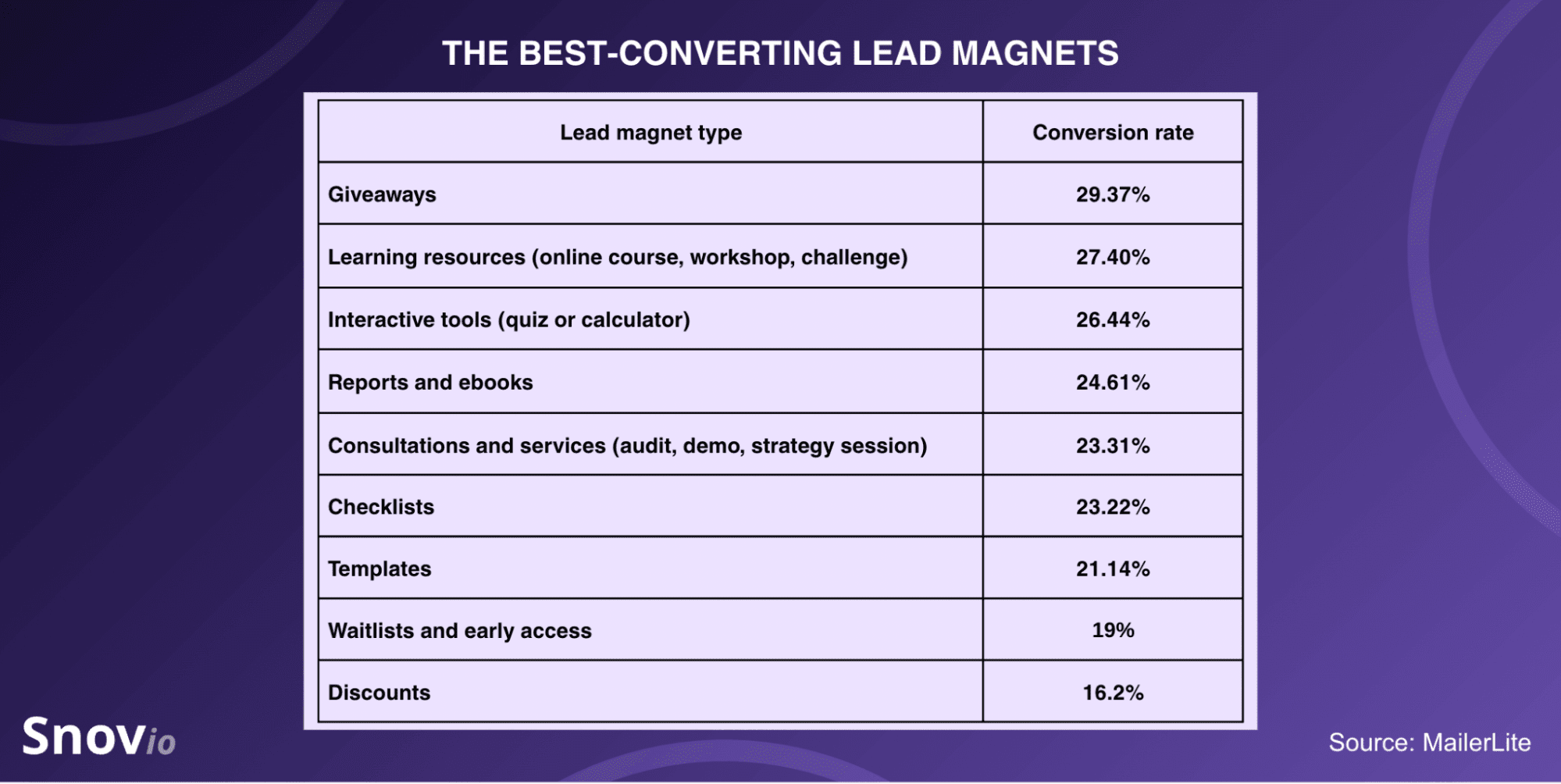
In addition to this data, I would recommend choosing a lead magnet format based on your target audience and their content consumption preferences.
For example:
Okisam, one of Snov.io’s customers, prepared a live session recording on how to get a brand recommended by AI.

It can work as an effective lead magnet for both listeners and visual learners.
Pick the right tool for creating lead magnets
To save time and make it easier to choose, I’ve done some research and gathered the following expert-recommended tools for different formats.
Select the one to design attractive lead generators based on your needs:
- For infographics or one-pagers → Canva or Visme
- For e-books, quick-win guides, or checklists → Inkfluence AI or Genspark.ai
- For cheat sheets → Clipsheet.app or Neatsheet.io
- For free course creation → MiniCourseGenerator or TailoredRead
- For repurposing blog posts into lead magnets → Beacon or Designrr.io
- For calculators → Involve.me, Calconic, or Outgrow
- For free consultation sessions → Calendly, Reservio, or Schedly
This list is by no means exhaustive. While crawling through the best recommendations from top entrepreneurs and marketers, you may find many more software tools worthy of consideration.
Use AI tools like Gamma and Miro to create lead magnets in minutes, not days. Bad: Spending 3 weeks designing a “perfect” lead magnet. Good: Gamma for instant PDF templates, Miro for instant flowcharts, Napkin for frameworks. You can create three lead magnets in 30 minutes.
Chief Operating Officer at Uppit AI

More so, you don’t always need a separate lead magnet maker. Say, if you’re planning to make a downloadable lead magnet PDF, you can easily do that without any extra tools. Just type your text in a Word Doc or Google Doc, add all the necessary formatting and visual elements, and save it as a PDF. That’s it.
Craft your lead magnet
At this stage, the most active debates among professionals are still about the question: How long should a lead magnet be?
Well, my answer is simple: as long as it needs to be to provide valuable insights and solve a specific problem for your potential customers.
Some lead magnets may be super-short: a 1-page checklist or a 10-minute video guide. Others can be much longer: a 50-page e-book or a 90-minute webinar.
|
💡Expert hack Prepare both a short-form and a long-form lead magnet and let your potential leads choose which one they prefer. |
That’s what Xero did by letting its SaaS prospects choose the formats:
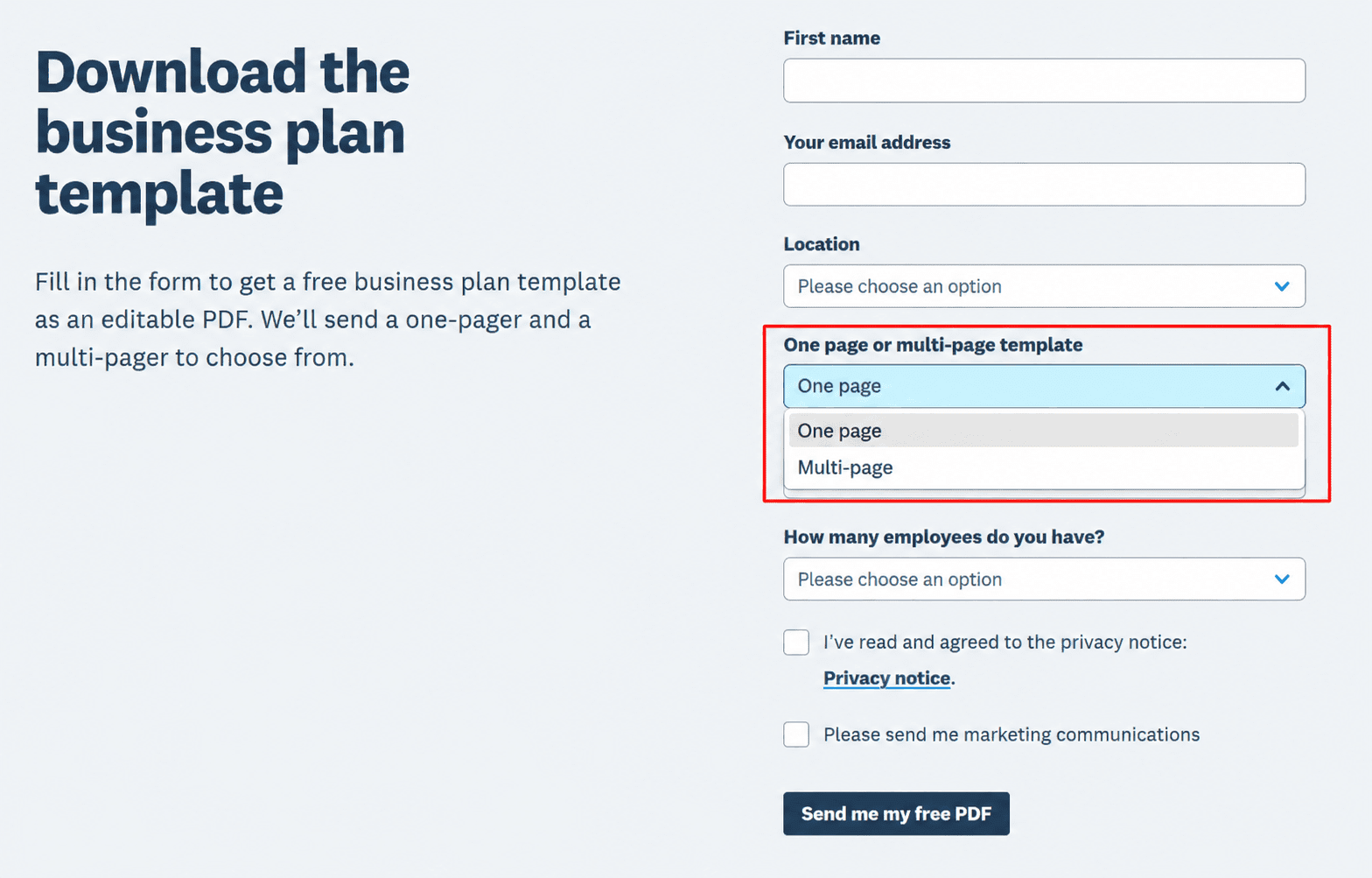
Users are free to select the length: a 1-page or multi-page business plan template.
Design a lead magnet’s landing page or an embedded form
Not every lead magnet requires a dedicated landing page (usually called a ‘squeeze page’). But if you aim to drive organic traffic and attract more leads, most lead magnets do. Plus, it will be easier to A/B test it and monitor engagement metrics on one web page.
Below are a few tips and caveats from experts on how to create an effective lead magnet’s landing page.
For example:
Here’s an illustrative model from the email marketing professional who built 100+ lead magnet landing pages that maximize conversions.
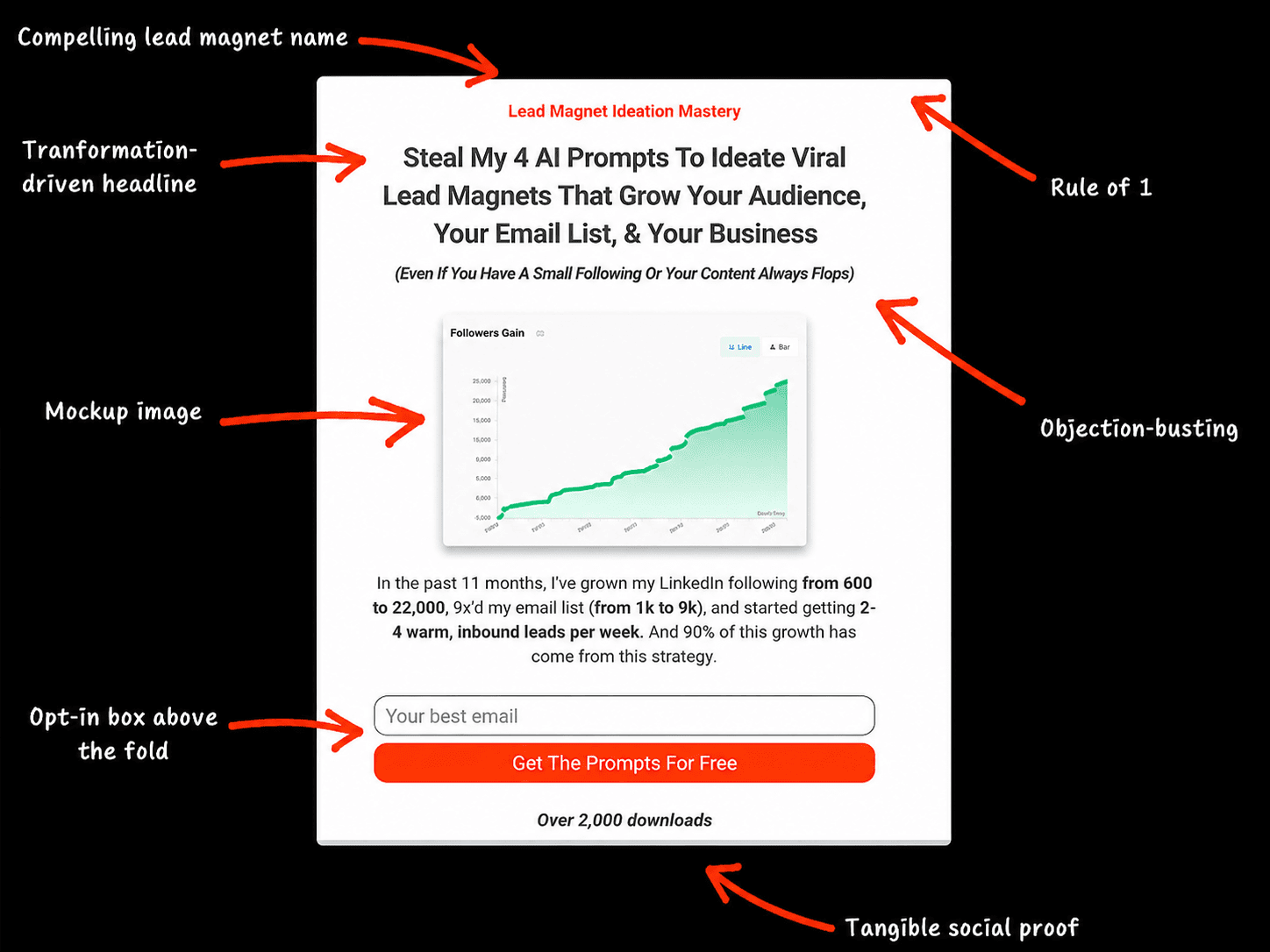
Alternatively, you can use an embedded lead-gen form or a pop-up without a separate squeeze page. But remember that pop-ups may generate fewer leads. If you’ve peeked into MailerLite’s research mentioned earlier, you already know that embedded forms have a considerably higher conversion rate of 24.44%, compared to 8.96% for pop-up forms.
Create a delivery email with a follow-up sequence
As soon as people click your CTA button, they expect immediate value — a promised lead magnet delivered to them instantly. No delays. Otherwise, this primary connection will be lost.
For example:
Take a glimpse at this delivery email I recently received, with a report download link and a thank-you note: “Thanks for downloading our 7th Annual State of Agile Marketing report!”
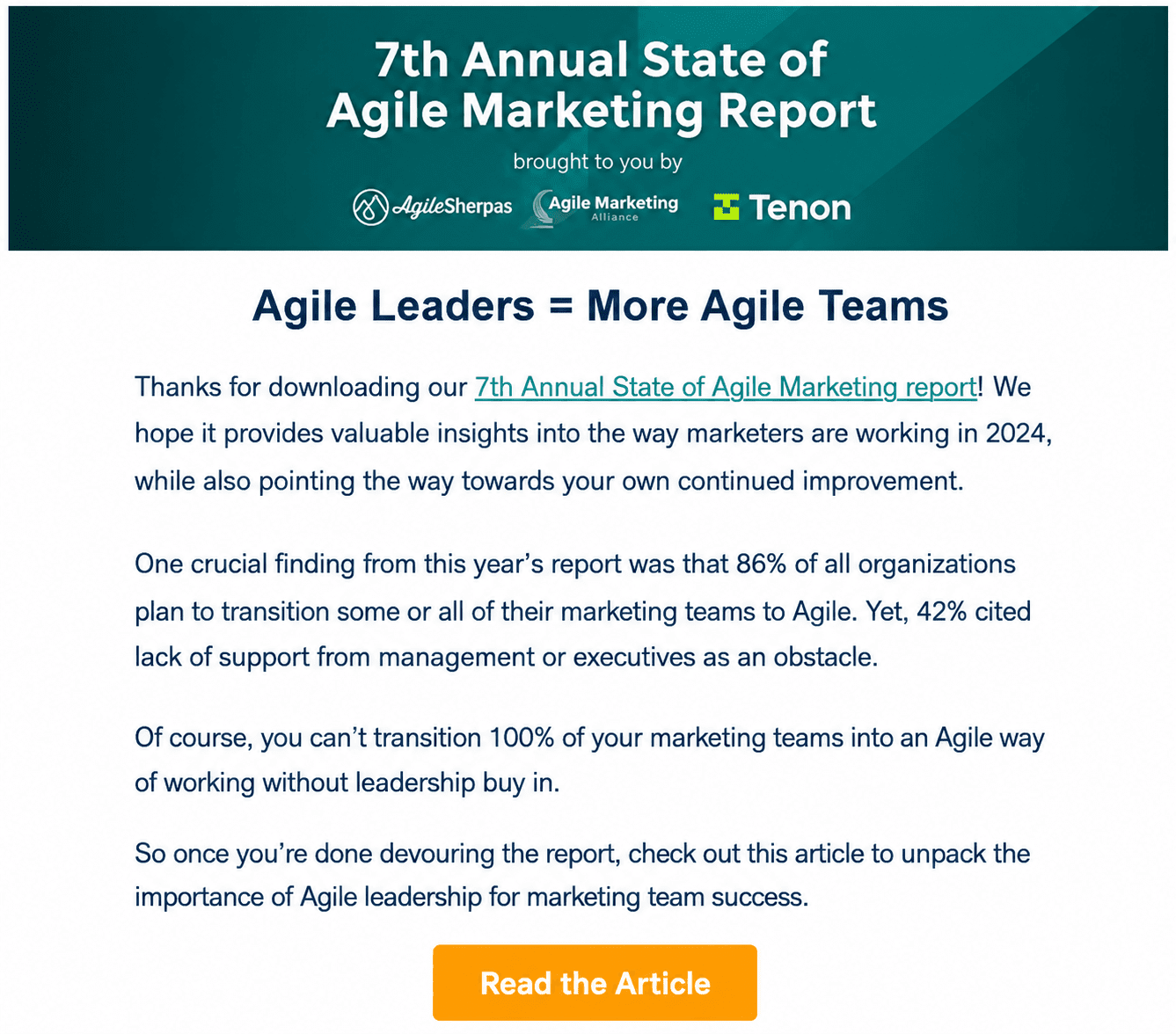
Yet, experts don’t recommend you stop here. Ideally, build an email sequence with a delivery message and a relevant follow-up to continue nurturing leads so they become paying customers soon.
Here’s a follow-up email template you can use to check whether your new leads found your piece of content useful and ask a low-friction question to start the conversation rolling:
Hi [First Name],
Just checking in — did you have a chance to look through the [Lead Magnet Name]?
I was curious: what are your thoughts on [Specific Topic/Problem/Number]?
Cheers,
[Your Name]
Spread the word about your lead magnet
Even the most valuable and effective lead magnets can be left unnoticed on your web page if nobody knows they exist. Creating a free resource is only half the job done. You should place it in front of the right people.
Pick a digital space where your target audience is actively spending time, while looking for solutions. Think of the best places where you can promote your lead magnet, such as:
- Partner newsletters
- Affiliate articles
- Forums or online communities
- Banners
- Blog posts
- Organic social media posts
- Sponsored marketing campaigns
For example:
Look at how UGEN, an employer branding agency, put its LinkedIn lead generation strategy to action with a template shared via a promoted post:

Its bright visual elements caught my eye instantly. The only problem with it, though, is mistargeting. It would have worked for me if I were an HR manager — their intended audience.
So, remember that in any case, whether across social media channels or blogs, your lead magnet sharing digital marketing campaign should aim to attract leads that actually need your free resource.
A/B test your lead magnet
Once you’ve finished all the preparation, creation, and promotion stages, you’re ready to move on to the final step — testing.
Here’s what experts advise that you A/B test specifically:
- Headline: e.g., “How to” vs “X tips” phrasing for a lead magnet PDF guide
- Signup form length: e.g., email only vs name and email address
- CTA text: e.g., first-person vs second-person pronouns (“Get my free copy” vs “Get your free copy”)
- CTA button color: e.g., red vs green button (Note: Numerous tests have actually proved that the red CTA button always outperforms the green one, but you can run your own experiment to see which color converts more leads on your landing page.)
- Social proof: e.g., client logos vs testimonials
You can actually experiment with different formats.
For example:
One B2B digital marketing agency tested 12 lead magnets during 3 months for their client. All of them attracted new leads, but only 1 actually converted them into paying customers.
The insight: Stop trying to educate everyone. Start qualifying buyers. Your lead magnet test: Ask yourself: “Would my ideal customer’s boss approve them downloading this?” If not, you’re attracting the wrong people.
CEO at Tej SolPro

Top 5 B2B lead magnet examples: Snov.io customers’ choice
I’ve reviewed dozens of lead magnets used by Snov.io customers for capturing leads at different stages of the sales funnel. Below, I’ll share 5 of the best ideas for B2B lead generation to inspire you right away.
Lead magnet example # 1: Survey from Belkins
Sales funnel: TOFU
Where it is placed: Pop-up, banner, dedicated landing page, LinkedIn post
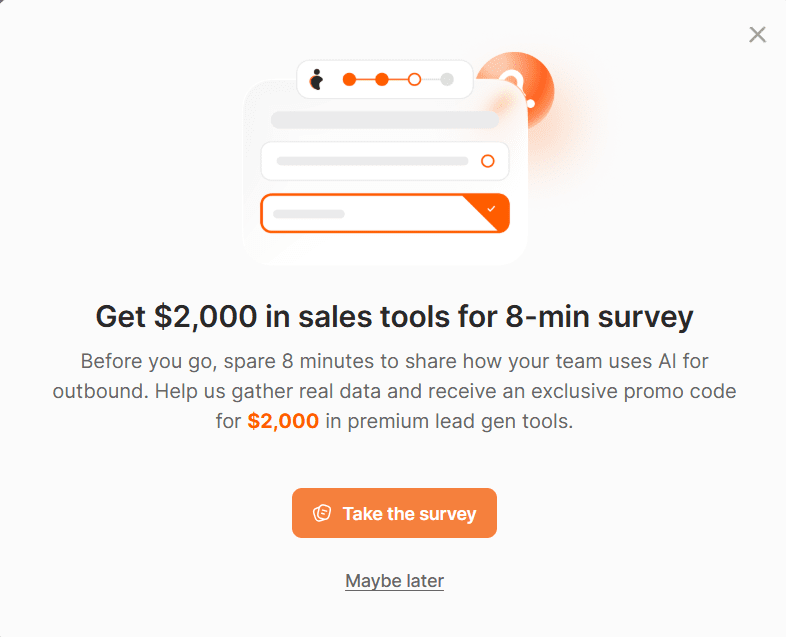
Running a B2B lead generation business, Belkins offers a “B2B sales and marketing library” with a whole bunch of free resources in exchange for contact information.
For this review, I’ve chosen their first lead magnet – a survey.
Why it works:
- It drives engagement and makes visitors feel heard, gathering their firsthand data for further analysis and reporting.
- Displayed as an exit-intent pop-up, it offers immediate value as an incentive: “exclusive promo code for $2,000 in premium lead-gen tools.”
- Only a business email address is required in the signup form.
- The “Before you go” exit-intent pop-up can encourage leads to stay on the website and take the requested action.
Now, compare it with the similar pop-up variant:
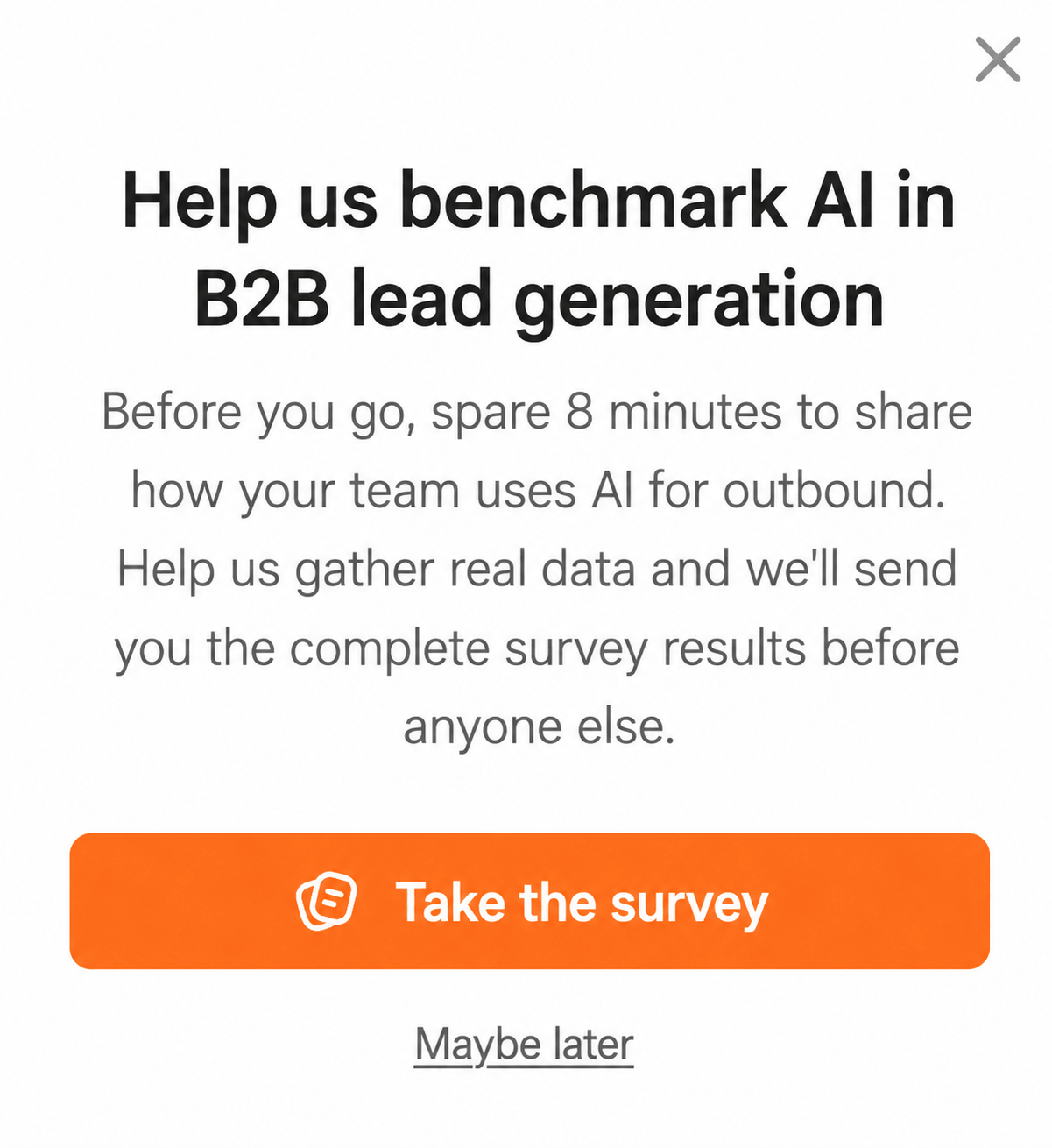
No incentive, just a psychological trigger of exclusivity: “We’ll send you the complete survey results before anyone else.”
📍Key insights from Belkins on how to create lead magnets:
Always test, re-adjust, and improve.
Belkins redesigned it (added a visual element) and changed the CTA from “Help us” to “Get $2,000 in sales tools” to shift the focus from “us” to “you” and generate leads more effectively.

Lead magnet example # 2: Free trial from Moosend
Sales funnel: Primarily BOFU, with some MOFU appeal
Where it is placed: Newsletter, homepage CTAs, product pages, banner, pop-up, chatbot, social media posts
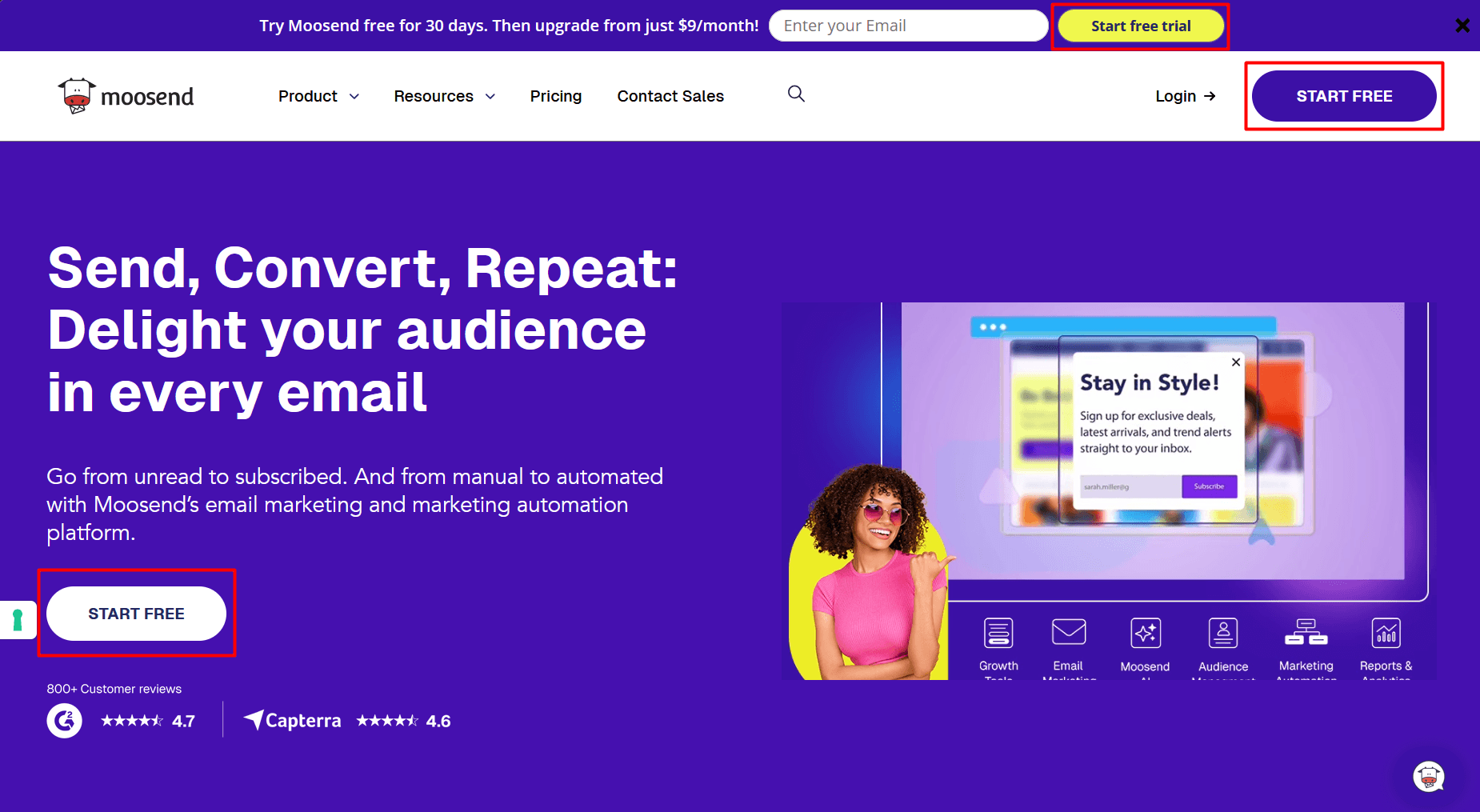
Looking for how to create a lead magnet for SaaS in particular?
Consider this idea from Moosend, an email marketing software provider. In addition to templates, webinars, infographics, and free tools (e.g., Subject Line Tester), the company offers a free trial as a SaaS-first lead magnet.
Why it works:
- It feels less like a lead magnet and more like a product-led, hands-on user experience.
- It lasts for 30 days, which looks more beneficial than typical 7- or 14-day free trials.
- It builds a natural path toward a paid subscription.
📍Key insights from Moosend on how to create lead magnets:
Promote your lead magnet as much as possible, but don’t overindulge.
Moosend placed the free-trial CTAs literally everywhere, but what I appreciated was that they didn’t overwhelm me all at once. The lead-gen form popped up after browsing the website for a while, and I had to click the chatbot icon to see the free-trial CTA button there.
Lead magnet example # 3: LinkedIn Live event from SurveySensum
Sales funnel: TOFU
Where it is placed: Social media posts

Similar to other Snov.io clients, SurveySensum offers a wide variety of lead magnets, including personalized demos, webinars, research reports, e-books, and events. This one is their latest LinkedIn Live event, which they share as an educational lead magnet on social media channels.
Why it works:
- It has a one-click registration with email only.
- It lets potential leads ask questions in real time.
- It helps establish thought leadership by sharing niche expertise on the platform.
📍Key insights from SurverSensum on how to create lead magnets:
Specify one pain point within the niche and provide valuable insights to address it.
SurveySensum used wordplay in the LinkedIn Live event title to attract potential customers struggling to find the right “medicine” for hospital growth in the healthcare industry.


Lead magnet example # 4: ROI Calculator from CoSupport AI
Sales funnel: MOFU
Where it is placed: Embedded form on the homepage, lead magnet’s landing page, blog posts
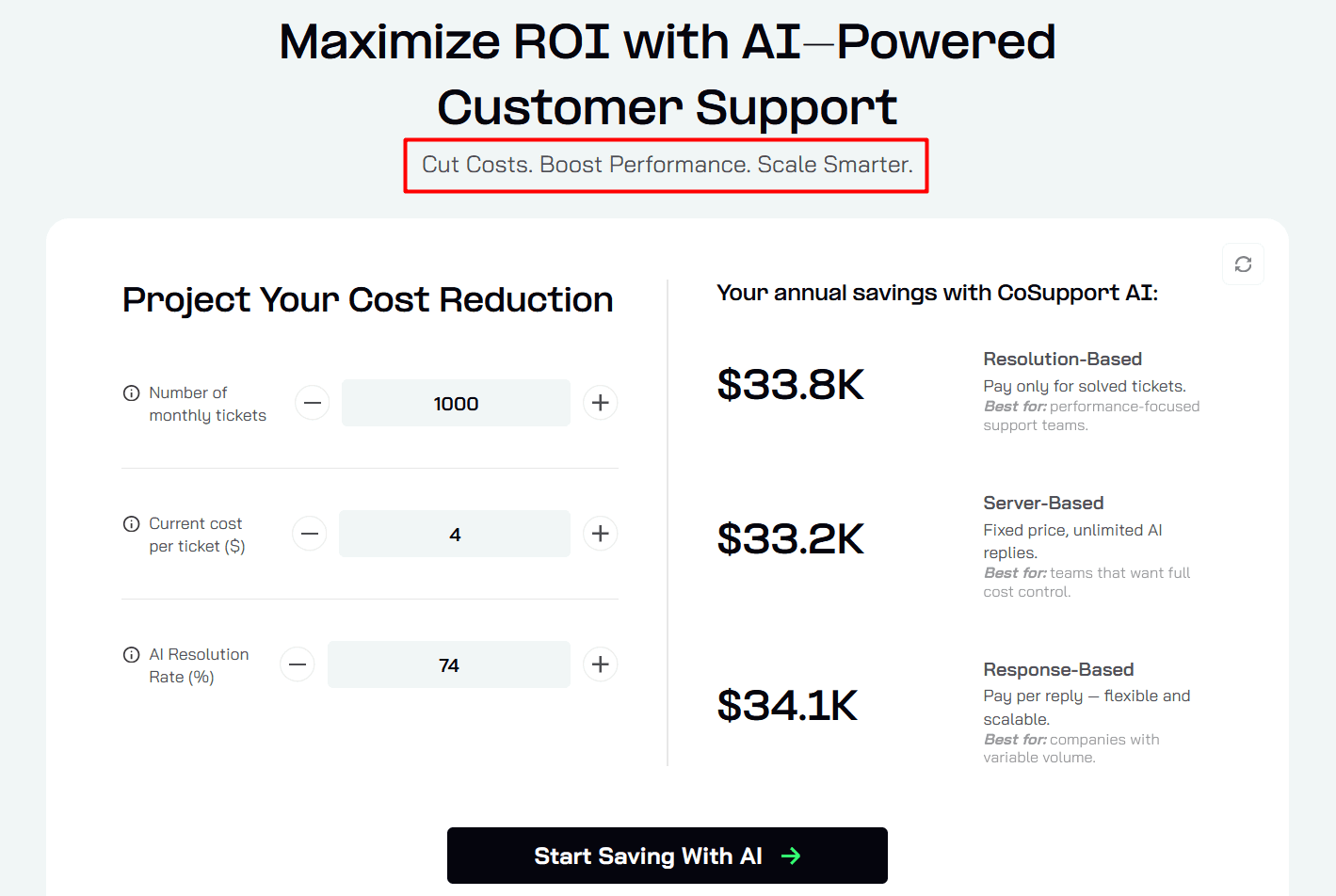
Another Snov.io customer, CoSupport AI, uses a 14-day free trial, a demo, and downloadable e-books as SaaS lead generators. But what truly kindled my interest was their ROI calculator. You’ll understand why in a second.
Why it works:
- It attracts high-intent leads by addressing their major pain points (limited budget, low performance, scaling challenges).
- It features the key benefits in the subtitle: “Cut Costs. Boost Performance. Scale Smarter.”
- It provides personalized annual savings results.
- Only two fields are mandatory in the lead-gen form: name and corporate email address.
Plus, according to a recent study of 200+ lead magnets across different niches, conversion rates for interactive tools, like calculators and quizzes, can significantly outperform those for static resources like PDFs — 25–40% versus 8–12%.
📍Key insights from CoSupportAI on how to create lead magnets:
Make it easy to use.
The calculator is intuitive and convenient owing to its simple “Plus” and “Minus” buttons. Thanks to the recalculate feature, potential customers can also clean the results and reuse the tool as many times as they wish.
Lead magnet example # 5: Free audit by Neadoo
Sales funnel: BOFU
Where it is placed: Homepage, service pages
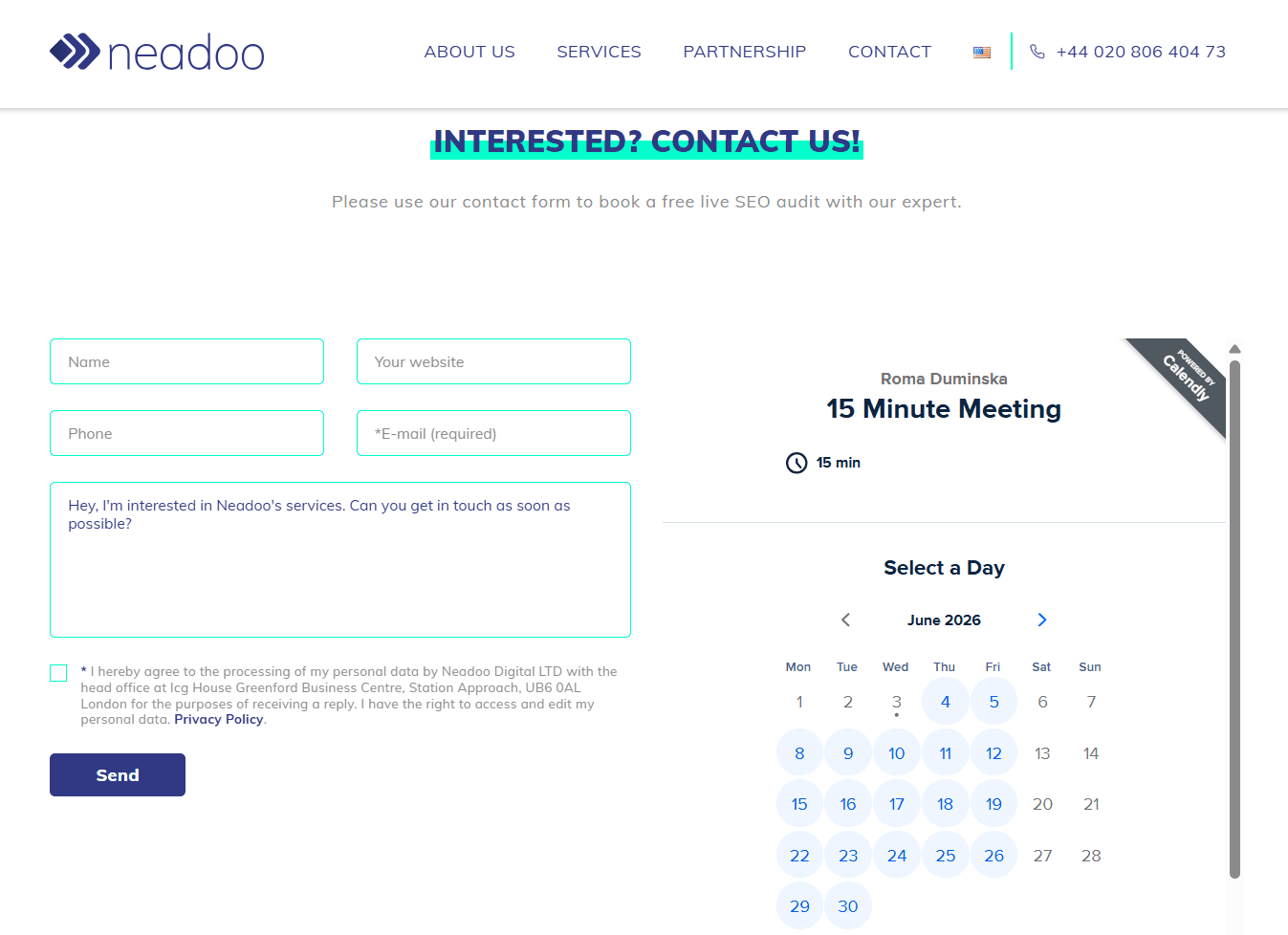
Why it works:
- It is a live audit where people can ask questions in real time and see the gaps or opportunities they didn’t even know existed.
- It provides personalized, immediate value rather than generic recommendations.
- Only the name and email address are obligatory to book a meeting via Calendly.
- The meeting doesn’t take much time — only 15 minutes.
📍Key insights from Neadoo on how to create lead magnets:
Speed up the form-filling process and personalize the content.
I was pleasantly surprised to see the pre-filled form with a ready-made message that saves time. Plus, the calendar next to the signup form is also very convenient. A live service like this also taps into personalization, which is essential when creating lead magnets for a B2B audience.
Other B2B lead magnet ideas worth trying in 2026
Now, let’s review several other B2B lead magnet examples that attracted potential leads and eventually converted them into buyers.
Educational lead magnet idea: Webinar from HubSpot
Sales funnel: TOFU
Where it is placed: Squeeze page, social media posts (primarily LinkedIn)

Webinars are named the most effective channel for lead generation by 51% of B2B marketers. Not a surprise, HubSpot leans heavily on regular webinars to educate the target audience and generate more leads. They use them mainly for capturing leads from the website and LinkedIn.
Why it works:
- It attracts new leads who are more engaged and more likely to convert (because, let’s agree, registering for a webinar and attending it requires more time and commitment than just downloading and reading a one-page PDF).
- It helps speakers demonstrate expertise and nurture leads, building trust via a stronger real-time connection.
- It targets a specific geographic segment (German-speaking), making the content more accessible and relevant for this target audience.
📍Key insights from HubSpot on how to create a great lead magnet:
Educate your potential customers continuously and speak their language. Literally. In this case, it’s German, but HubSpot also releases webinars in Spanish and other languages from time to time.
In my experience, most B2B companies don’t need more than 1–2 webinars per month. The limiting factor is rarely execution — it’s having enough distinct audience segments to sustain that frequency.
PR and Communications Manager at Snov.io

Interest-triggered lead magnet idea: Guide from Hubstaff
Sales funnel: TOFU
Where it is placed: Pop-up on the relevant blog post

This lead magnet from Hubstaff popped up when I was scrolling through the blog post on remote team management.
And here’s the downloadable PDF guide that appeared on the blog article about time-tracking in the construction industry.

Why it works:
- It captures leads at the right moment of engagement.
- It relies on interest-driven segmentation and contextual targeting.
- It is highly relevant to the particular topic, which increases its perceived value.
📍Key insights from Hubstaff on how to create a great lead magnet:
To craft a perfect lead magnet for every need, segment your target audience by interest or other factors (technographics, firmographics, behaviors, etc.), and make it relevant. The higher the relevance, the higher the likelihood of conversion.


Embedded lead magnet idea: Template from SocialBee
Sales funnel: TOFU, MOFU
Where it is placed: Embedded form in the blog article
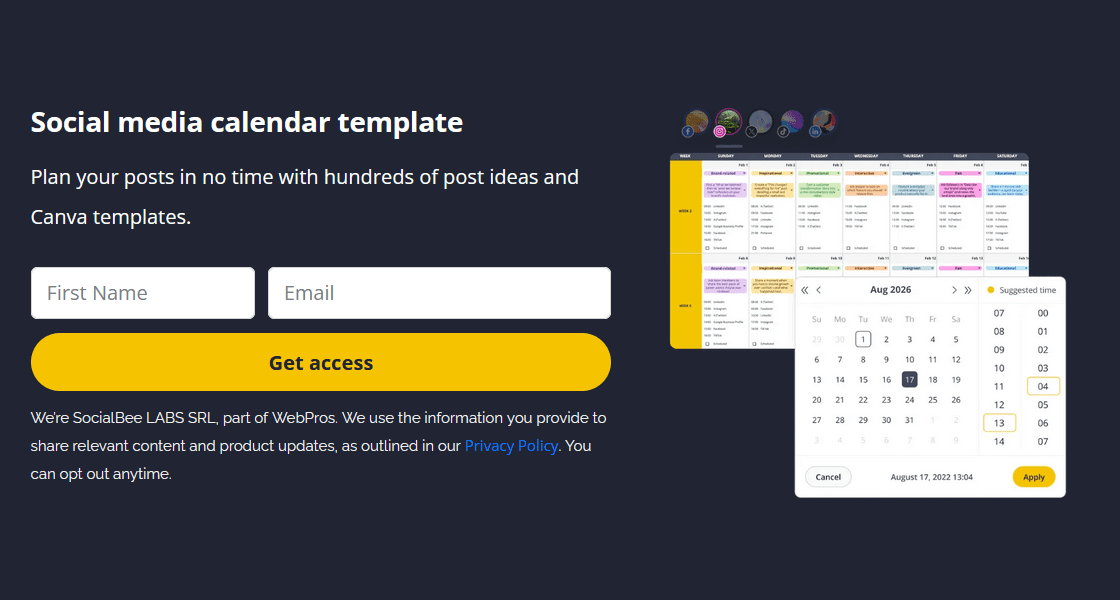
This lead-gen form from SocialBee promises a social media calendar template in exchange for a prospective customer’s contact information. It is inserted in the relevant blog article on how to create a content calendar for social media channels.
Why it works:
- The lead magnet integrates naturally into the blog post and extends the content experience.
- It attracts high-quality leads interested in the topic.
- Only two fields to fill out: first name and email address.
- It shows a clear, illustrative mockup image of what’s inside.
📍Key insights from SocialBee on how to create a great lead magnet:
Provide a free resource that helps people apply the specific piece of advice they’re consuming and receive immediate value.
Similar to Hubstaff, SocialBee has developed a lead-generation strategy that uses various free topic-related templates ingrained in blog posts.
The best lead generation formula: Lead magnets + outbound strategies
Though being a proven tactic for generating leads in inbound sales, even a perfect lead magnet may be insufficient. To succeed in digital marketing, you should implement an “allbound” approach, that is, synchronize inbound + outbound strategies.
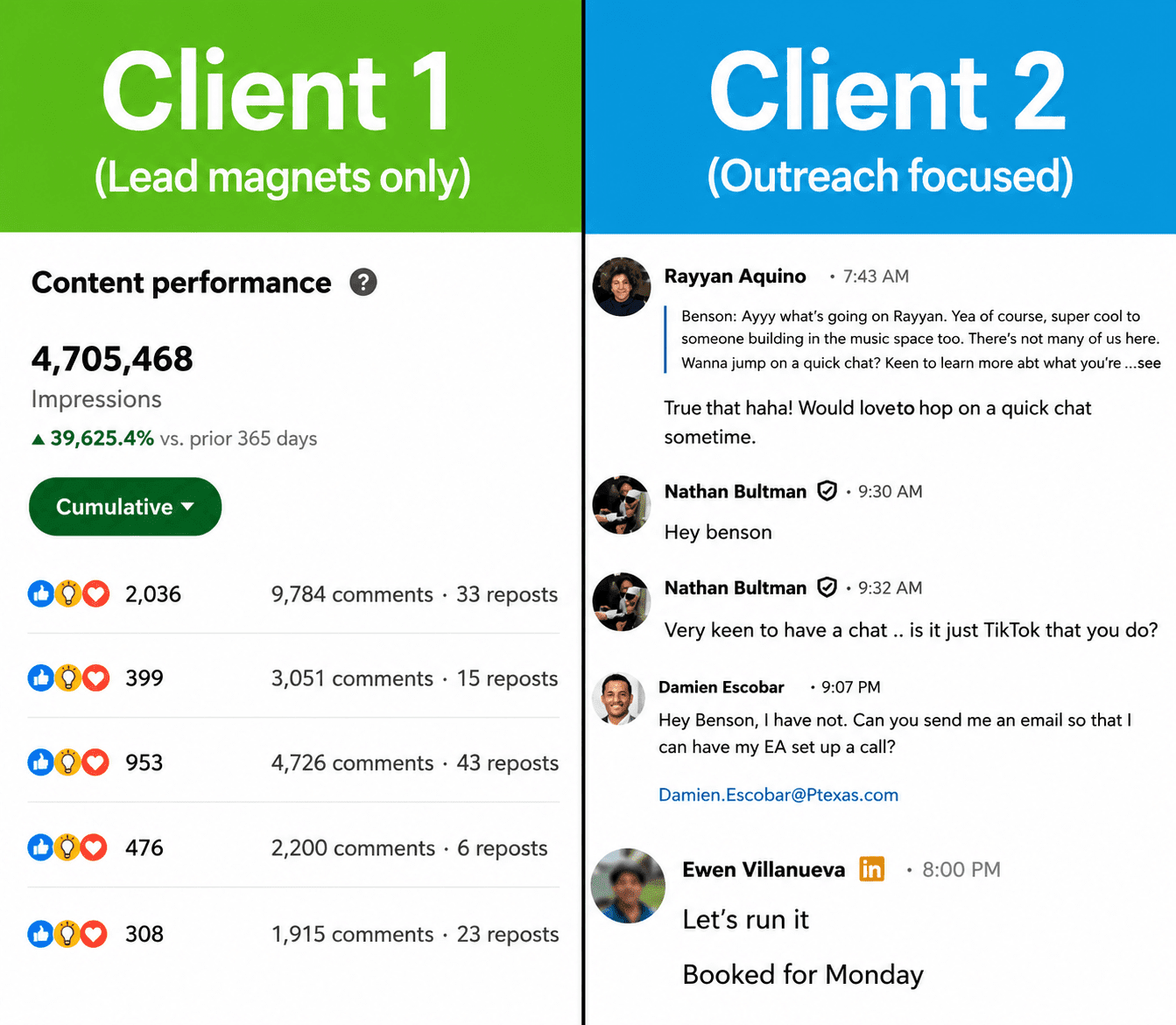
Content alone? You get impressions and nothing else. Outreach alone? You get ignored because nobody knows who you are. Lead magnets alone? You get comments but no pipeline. All three together? The sweet spot.
Founder of Acquired Digital

Timi Merivirta, CEO of InLead, supports this approach, saying, “Different strategies work for different buyers.” And here’s the evidence that backs it up. For one client, his agency generated “~$700,000 through lead magnets alone.” For another, they focused solely on LinkedIn outreach and didn’t post any lead magnet at all.
Another company, Okisam, combined lead magnets with the outbound automated prospecting using Snov.io’s Email Finder to quickly find verified leads and reach out to them from a single platform. On the outcome, they saw a 292% rise in the email open rate and a 35% increase in the lead conversion rate.

Key takeaways: How to create a lead magnet that converts
Creating an effective lead magnet comes down to 5 stages as follows.
- Preparation stage: Specify the exact pain points your ICPs struggle with. Then pick the right format based on how your ICPs consume content. Find the proper formatting tool for your lead generator.
- Creation stage: Make your lead magnet as long as it needs to deliver enough value. Consider a dedicated landing page to generate organic traffic and simplify A/B testing.
- Post-creation stage: Set up an automated delivery email + a short follow-up to warm up your leads.
- Promotion stage: Place it in front of your target audience across various digital places (blogs, social platforms, etc.)
- Testing stage: Run A/B tests to improve conversion rates.
Yet, remember that lead magnets may not be enough to build your pipeline. A winning approach would be “allbound,” combining and seamlessly orchestrating inbound with outbound lead generation.
Craft an attractive lead magnet and use lead-gen and multichannel outreach automation software like Snov.io to save time and maximize your efforts.